20. Contributing to NNx¶
Thanks for being interested in contributing. NNx is a small library; the goal is to keep it small, tested, and useful for the existing notebook consumers while inviting new ones.
1. Getting set up¶
git clone https://github.com/thekaveh/NNx.git
cd NNx
python -m pip install -r requirements-tools.txt
uv sync --all-extras --frozen
uv run pre-commit install       # optional but recommended
Diagram fallback generation also needs the native Cairo library: install it
with brew install cairo on macOS or sudo apt-get install libcairo2 on
Debian/Ubuntu. CairoSVG itself is pinned in the docs-publish dependency group.
--all-extras installs every optional stack, including the vision,
graph and plots domains that import nnx never loads. A change to the
core / extra split is checked against an installed wheel per profile with
scripts/smoke_core_install.py (CI's installed-profiles job). Run it from a
clean environment outside the checkout with PYTHONPATH unset.
Verify a clean baseline:
uv run pytest -n logical --dist loadgroup  # full suite, on every CPU (pytest-xdist)
uv run ruff check src/ tests/ examples/ scripts/  # lint
uv run ruff format --check src/ tests/ examples/ scripts/  # format check
uv run pyright --warnings              # type check
uv run python -m scripts.docs.extract_architecture_svg --check
uv run python -m scripts.docs.build_docs --check
uv run python -m scripts.docs.build_docs
uv run mkdocs build --strict           # generated docs (gates CI)
Repository Markdown is canonical. docs/manifest.yaml is the single page
inventory and each source H1 begins with its manifest number;
scripts.docs.build_docs generates ignored mkdocs.yml,
generated/site, and generated/wiki projections. Do not edit generated
outputs. A successful push to main publishes the same canonical content to
GitHub Pages and the repository wiki.
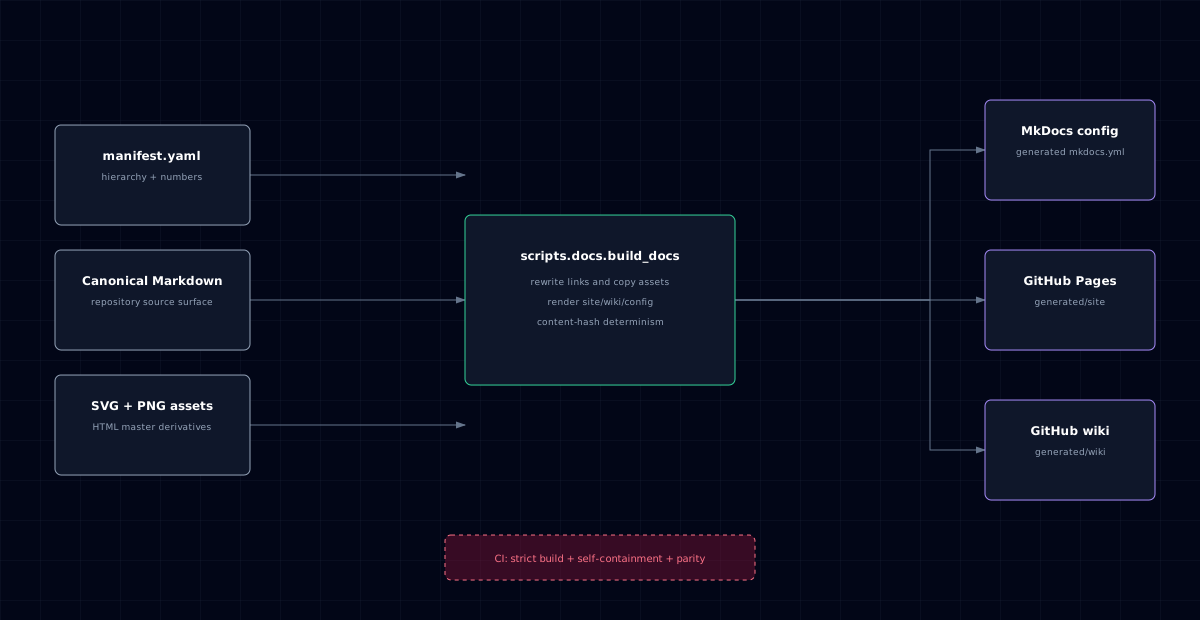
Diagram HTML masters first flow through
scripts.docs.extract_architecture_svg. The site selects SVG assets while the
repository and wiki select PNG fallbacks. CI checks canonical GitHub links,
tracked-file ownership, placeholder markers, stale API signatures and diagrams,
projection determinism, generated links, and a strict MkDocs build before
publication.
Useful env vars:
NNX_TQDM_DISABLE=1silences the training progress bar. Set this in CI / non-TTY contexts, and in any test that drivesNNModel.train()orTrainer.train()(the test suite'sconftest.pyalready does this session-wide). Accepts1/true/yes, case-insensitive.
2. Workflow¶
- Open an issue first for non-trivial changes — saves churn if the design is off. Tiny fixes can go straight to PR.
- Branch from
develop. Name branches descriptively (fix/...,feat/...,docs/...,refactor/...). - Write tests. Every PR that changes behavior should land with a focused test that fails before the change and passes after it. The existing
tests/test_*_series.pyfiles (organized by audit pass) are good models. - Keep PRs small. One coherent change per PR is much easier to review than a sweeping mix.
3. What we care about¶
- Strict back-compat for the existing notebook consumer. Don't rename, remove, or restructure public APIs without a migration path. Preserve existing
runs/<id>/artifacts; on-disk evolution requires a versioned, backward-compatible reader. New fields on params dataclasses must omit themselves from.state()when set to their defaults (preservesrun.idhashes). See the omit-when-default regression tests intests/test_params_round_trip.py(search fortest_nn_*_state_omits_*_when_*) for the canonical pattern. - State / from_state round-trip. Every params dataclass with a
state()method must round-trip cleanly throughfrom_state(state()). The contract is enforced bytests/test_params_round_trip.py. - Tests run on CPU and finish fast. Keep new tests under a few seconds; build small
TensorDatasets inline in the test. - One-line update to
CHANGELOG.mdunder[Unreleased]for any user-visible change.
4. Style¶
- Ruff enforces formatting and a curated lint rule set (
E F W B I UP). Runruff check --fix src/ tests/ examples/ scripts/andruff format src/ tests/ examples/ scripts/before pushing. Pre-commit handles both automatically when installed. - Type annotations are encouraged on new code. We type-check with pyright (basic mode) in CI, with
--strictplanned over time. - Docstrings on public functions / classes explain the why (constraints, edge cases) — not just the what. Multi-paragraph is fine when warranted.
- Comments explain non-obvious decisions, hidden constraints, or surprising behavior. Don't narrate code that's already self-documenting.
5. Testing¶
uv run pytest -n logical --dist loadgroup  # full suite, on every CPU (pytest-xdist)
uv run pytest tests/test_pass2_n_series.py::test_n7_evaluate_aggregates_across_batches
uv run pytest -k "graph"               # name filter
uv run pytest -n logical --dist loadgroup --cov=nnx --cov-report=term-missing  # with coverage
Tests live under tests/. The conftest.py holds a few shared fixtures and hygiene guards. They include a session-wide NNX_TQDM_DISABLE, a per-test env_snapshot cache reset and a dynamo-dispatch skip guard. Otherwise it is intentionally minimal. Add a shared fixture there when boilerplate repeats across several tests, not preemptively.
5.1. Feature combinations¶
docs/feature-composition.yaml records which feature combinations are
verified, unsupported or unverified. Each has a stable scenario ID (TC-01,
CR-03, MT-01, ...), its profile and the pytest node ids that prove it.
Feature composition renders it.
A change can move a boundary: what two features do together, what is
refused, or a test being renamed. Review the scenario IDs such a change
touches; grep the registry for the feature or the test file. Update their
status, expected and tests:
uv run python scripts/check_feature_composition.py --check                 # schema, unique IDs, every node id collected
uv run python scripts/check_feature_composition.py --check --run --report composition.json  # run and gate them
uv run python scripts/check_feature_composition.py --render                # refresh the committed page (no evidence)
An import, a skip, an xfail or a setup / teardown failure is never proof of a
combination. A verified scenario lists tests that assert its behaviour and pass
in every phase. An unsupported one links an executed negative test (or the
exact documented limitation). The CI feature-composition job fails when a
verified row fails or loses coverage.
The gate is strict only on a published evidence profile: the same OS,
Python version and device (cpu is Linux, Python 3.12). There, --run also
fails when an extra in the profile's dependencies (under
evidence_profiles) is not installed. Run it after uv sync --all-extras.
Elsewhere, rows needing a missing extra are simply not judged.
GPU evidence¶
The registry publishes two evidence profiles: cpu (the CI docs job) and
cuda. The CUDA rows are TC-06 FP16 AMP, TC-10 BF16 AMP and TC-11 two-GPU
NCCL DDP. They are verified only by a report from the cuda profile. On CPU
their tests skip and the page shows them unverified. To produce that report:
- GPU runner: register a self-hosted runner labelled
self-hosted, linux,
  x64, gpu
. TC-11 needs two CUDA devices. Then set the repository variableNNX_GPU_RUNNERtotrue. The docs workflow'sGPU composition evidencejob then runs the scenarios on it, and the docs build renders the page from both reports. -
Manual run on a Linux machine with Python 3.12 and CUDA:
uv sync --frozen --all-extras --python 3.12
uv run python scripts/check_feature_composition.py --run --report composition-cuda.json
uv run python scripts/check_feature_composition.py --render --report composition.json --report composition-cuda.json
Each
--reportcounts for the profile it ran on; a report from a profile the registry does not list, or from other sources, renders unverified.The render with reports rewrites
docs/feature-composition.mdwith their evidence. Do not commit that page: the committed one is rendered without evidence, which--checkenforces. Restore it with--renderalone.
Change docs/external-contracts.md and the matrix rows only from executed
evidence: a CUDA report whose listed tests passed in every phase.
6. Submitting a PR¶
- Push to your fork and open a PR against
develop. - Fill in the PR template (Summary / Test plan).
- Wait for every CI job to go green. The jobs are lint, format, tests and
mkdocs on Python 3.10–3.14. They also include the feature-composition,
export-conformance, installed-profile and
floor-depslanes. - The branch ruleset requires only
lint-and-testandpip-auditon 3.10–3.12. Check the other lanes before you arm auto-merge. - Address review comments by pushing new commits; pull requests merge with a merge commit.
7. Releases¶
NNx uses release-please for automated version bumps, changelog updates, and tagging. Contributors don't touch versions or tags. Write a Conventional Commit-style PR title (feat:, fix:, chore:, docs:, etc.). For any user-visible change, add a one-line entry under [Unreleased] in CHANGELOG.md.
The end-to-end flow:
-
Every merge to
mainupdates a long-lived "Release" PR maintained byrelease-please.yml. The PR accumulates the next version +CHANGELOG.mddiff based on the conventional-commit types since the last tag. Before 1.0,feat:andfix:both trigger a patch bump (0.X.Y;bump-patch-for-minor-pre-majorinrelease-please-config.json). A breaking change (!or aBREAKING CHANGE:footer) bumps the minor version (0.X.0;bump-minor-pre-major). To force a minor bump otherwise, add aRelease-As: 0.X.0footer to a commit.The Release PR carries only release-please's own commit. Nothing else pushes to it, because the
mainruleset holds a PR for review when a bot made its latest push. That holds even for a verified commit, so each release PR needs one approval.release-please bumps the version in three places, so the lock and the API-reference check stay consistent:
pyproject.toml, through its Python updater.- The lines marked
x-release-please-version: the__version__fallback insrc/nnx/__init__.py, thennx.__version__line ofdocs/api.mdand the version line ofREADME.md/PYPI_README.md. - The package's version in
uv.lock, through a toml updater.
Each time the workflow creates or updates the Release PR, it dispatches the required CI and security checks on the release branch. The CHANGELOG on the release commit is not finalized: release-please's generated list sits above the curated
[Unreleased]notes. When the release is created, the workflow publishes the curated notes as the release body (scripts/release/finalize_changelog.py --release-notes).The post-release sync of
mainintodevelopfinalizes the CHANGELOG against the one the release shipped:git show vX.Y.Z:CHANGELOG.md > /tmp/released-changelog.md python3 scripts/release/finalize_changelog.py CHANGELOG.md --released /tmp/released-changelog.mdIt moves the shipped curated notes under the new version heading in place of the generated list. Entries added on
developafter the release stay in[Unreleased]. A shipped entry edited ondevelopafter the release is refused, to be fixed by hand. That includes an item appended to a grouped entry such as "Smaller fixes", so start a new entry for a later change. Keep[Unreleased]curated: it becomes the release notes.Some changes to
[Unreleased]reachmainonly through hidden commit types (docs:,chore:,test:). Such a change does not refresh the Release PR until the next visible one. -
A maintainer reviews and merges the Release PR when ready to ship. Release Please then creates the tag and draft release. It publishes the curated notes as the release body. It then dispatches the top-level
release.ymlworkflow with the immutable release commit and tag. -
release.ymlruns these steps:- It verifies the Release Please commit belongs to
main. - It runs the full test matrix and builds the package.
- It smoke-tests the built artifacts per dependency profile, on the floor and current torch, before anything is published.
- It publishes through PyPI trusted publishing, gated by the
pypiGitHub Environment's approval rule. - It verifies
pip install thekaveh-nnx==X.Y.Zfrom a clean environment. - It uploads the verified distributions to the draft release, publishes it and verifies its attestation.
Keeping trusted publishing in this top-level workflow ensures its OIDC token and package attestations carry the same PyPI-authorized workflow identity.
- It verifies the Release Please commit belongs to
The [project] version is intentionally static and managed by release-please. Do not distribute wheels or sdists built from an untagged commit. After development resumes, such an artifact can contain code newer than the release. It still carries the last release number. Use editable installs for local source work. Distributable artifacts must come from Release Please's dispatched release workflow, which verifies tag/version and tag/commit agreement before publishing. Direct tag pushes do not publish packages.
7.1. CI runner image¶
Every workflow job runs on one pinned GitHub-hosted image, ubuntu-26.04 (tests/test_ci_runner_image.py checks it). The exception is the opt-in self-hosted GPU evidence job (§5.1). Jobs never run on a moving label such as ubuntu-latest. GitHub re-points such a label to new Ubuntu releases without a change in this repository.
Moving to a new image is a deliberate pull request:
- Change every
runs-onand the test'sRUNNERtogether. - Let that pull request's CI run on the new image. Also run the release scripts there;
scripts/release/finalize_changelog.pyruns on the image's systempython3. - Note the result.
apt steps carry their own short timeout-minutes, so a package-mirror stall fails fast instead of consuming the job's budget.
8. Things we won't merge¶
- Changes that break on-disk format compatibility without a versioned reader.
- Public API renames without a deprecation shim and a
__getattr__alias for at least one minor version. - Code without tests.
- Dependencies added to
[project.dependencies](the core deps list) when they could go under[project.optional-dependencies]instead.
9. License¶
By contributing you agree that your contribution will be licensed under the Apache License 2.0.