
NNx
Lightweight PyTorch training, evaluation, and visualization with first-class graph neural network support.
Transparent orchestration for durable experiments, with your models and step logic left in your hands.


















NNx is a lightweight PyTorch toolkit for repeatable training, evaluation and visualization. It provides frozen configuration objects, a supervised train, evaluate and predict loop, callbacks, metrics, and content-addressed checkpoints that support resume. Your models and per-step logic stay replaceable, so one loop serves standard, graph and transformer networks and other training methods. NNx is for researchers and engineers who want transparent PyTorch code without a larger training platform.
1. Overview¶
1.1. Capabilities¶
- Training loop —
NNModeltrain, evaluate and predict, with callbacks, schedulers, FP32/FP16/BF16 precision, gradient accumulation and clipping, declared metrics, and a multi-optimizerTrainer. - Runs and resume — content-addressed run directories, checkpoint tags, verified warm resume, experiment plans and provenance records.
- Tasks — classification, regression, multilabel, ranking, graph classification and link prediction.
- Training methods — custom step functions and objectives, distillation, contrastive learning, Mixup and CutMix, Mixture of Experts, diffusion, I-JEPA and DPO.
- Fine-tuning and transforms — layer freezing, LoRA, DoRA, IA3, prefix and prompt tuning, quantization, pruning and model surgery.
- Networks and export — feed-forward, convolutional, graph, transformer and ViT networks; a small language-model path; ONNX, Hub, safetensors and experimental GGUF export.
- Evaluation and decisions — reproducible splits, calibration, abstention, multi-seed comparison and typed decisions.
The Capability reference describes each item with its entry points. Concepts explains how the parts fit together.
2. Install¶
2.1. Release or source¶
This documentation describes the source on main: NNx 0.4.1 and its unreleased changes.
Install the newest release from PyPI, then check its version:
pip install thekaveh-nnx
python -c "import nnx; print(nnx.__version__)"
The newest PyPI release can be older than this documentation. An older release lacks the features and extras added after it, as listed in the Changelog. In that case, install the current source instead:
pip install "thekaveh-nnx @ git+https://github.com/thekaveh/NNx.git@main"
pip install "thekaveh-nnx[domains] @ git+https://github.com/thekaveh/NNx.git@main"   # with an extra
The requirements and extras below describe this version. pip warns when a requested extra does not exist in the version it installs.
2.2. Requirements¶
The core install is torch, NumPy, pandas, scikit-learn and a few small utilities. import nnx loads no vision, graph or plotting stack. Those stacks are the vision, graph and plots extras, and domains installs all three. Using one without its extra raises an ImportError that names the extra.
NNx needs Python 3.10 or later and PyTorch 2.4 or later; the vision extra needs torchvision 0.19 or later. It is tested on Python 3.10 through 3.14. The PyTorch support matrix lists every tested combination and which have real CUDA evidence. Optional extras keep their own version constraints. The examples in examples/ run on CPU.
2.3. Optional extras¶
Add an extra to either install command, for example "thekaveh-nnx[graph,plots]".
pip install "thekaveh-nnx[vision]"              # NNDataset (torchvision datasets)
pip install "thekaveh-nnx[graph]"               # graph nets, NNGraphDataset, nnx.graph_tasks, nnx.link_tasks
pip install "thekaveh-nnx[plots]"               # VisUtils, nnx.lr_finder, the NNRun chart (Plotly)
pip install "thekaveh-nnx[domains]"             # vision + graph + plots
pip install "thekaveh-nnx[tensorboard]"         # TensorBoardCallback
pip install "thekaveh-nnx[wandb]"               # WandbCallback
pip install "thekaveh-nnx[onnx]"                # NNModel.to_onnx (legacy exporter)
pip install "thekaveh-nnx[onnx-dynamo]"         # NNModel.to_onnx(dynamo=True): adds onnxscript
pip install "thekaveh-nnx[onnx-runtime]"        # ONNX Runtime CPU execution: nnx.export_conformance parity profiles
pip install "thekaveh-nnx[quantize]"            # nnx.quantize_int8 (torchao PTQ INT8)
pip install "thekaveh-nnx[hub]"                 # safetensors checkpoints + HuggingFace Hub publish/load
pip install "thekaveh-nnx[embeddings]"          # nnx.embeddings: FAISS export + sentence-transformers
pip install "thekaveh-nnx[lm]"                  # HF BPE tokenizer (train_bpe, NNTokenizerParams) + datasets
pip install "thekaveh-nnx[gguf-write]"          # experimental NNx GGUF writer
pip install "thekaveh-nnx[viz]"                 # nnx.viz: summary + weight_histogram + activation_map + attribute + gradient_flow + netron_export (netron_export also needs [onnx])
pip install "thekaveh-nnx[viz-interactive]"     # adds Netron browser viewer for nnx.viz.netron_export(launch=True)
pip install "thekaveh-nnx[jev]"                 # nnx.decisions.JevProvider (hosted Jev models)
pip install "thekaveh-nnx[optuna]"              # nnx.search: budgeted experiment search
pip install "thekaveh-nnx[notebook]"            # IPython clear_output for legacy function callbacks in notebooks
pip install "thekaveh-nnx[docs]"                # local documentation build toolchain
For a reproducible contributor environment, install with the committed resolver state:
python -m pip install -r requirements-tools.txt
uv sync --all-extras --frozen
For an editable install with the test and lint toolchain, see CONTRIBUTING.md §1.
3. Quickstart¶
End-to-end CPU example — a tiny random-tensor classification run:
import torch
from torch.utils.data import DataLoader, TensorDataset

from nnx import (
    NNModel, NNParams, NNModelParams, NNTrainParams,
    NNOptimParams, NNSchedulerParams,
    Activations, Devices, Losses, Nets, Optims,
    EarlyStopping,
)

# 1. Data
X_train, y_train = torch.randn(256, 8), torch.randint(0, 3, (256,))
X_val,   y_val   = torch.randn(64, 8),  torch.randint(0, 3, (64,))
train_loader = DataLoader(TensorDataset(X_train, y_train), batch_size=32, shuffle=True)
val_loader   = DataLoader(TensorDataset(X_val,   y_val),   batch_size=32)

# 2. Model
net_params   = NNParams(input_dim=8, output_dim=3, hidden_dims=[32, 16],
                        dropout_prob=0.1, activation=Activations.RELU)
model_params = NNModelParams(net=Nets.FEED_FWD, device=Devices.CPU,
                             loss=Losses.CROSS_ENTROPY)
model = NNModel(net_params=net_params, params=model_params)

# 3. Train
train_params = NNTrainParams(
    n_epochs=10,
    train_loader=train_loader,
    val_loader=val_loader,
    optim=NNOptimParams(name=Optims.ADAM, max_lr=1e-2,
                        momentum=(0.9, 0.999), weight_decay=5e-5),
    scheduler=NNSchedulerParams(min_lr=1e-7, factor=0.5,
                                patience=3, cooldown=1, threshold=1e-3),
)
run = model.train(params=train_params, callbacks=[EarlyStopping(patience=5)])

# 4. Use it
print(f"trained {len(run.idps)} iterations; saved under runs/{run.id}/")
logits, classes = model.predict(X=X_val.numpy())  # returns PredictResult(logits=..., classes=...)
Run ids are content-addressed, so running the same script again in the same directory raises FileExistsError. Delete runs/ first, or pass overwrite_existing=True to NNTrainParams.
4. Advanced patterns¶
These patterns use the current source; an older PyPI release can lack some of them (see Release or source).
4.1. Switching networks¶
Change the Nets enum value passed to NNModelParams; NNModel constructs the underlying network for you:
NNModelParams(net=Nets.GRAPH_CONV,  device=Devices.CPU, loss=Losses.CROSS_ENTROPY)
NNModelParams(net=Nets.GRAPH_SAGE,  device=Devices.CPU, loss=Losses.CROSS_ENTROPY)
NNModelParams(net=Nets.GRAPH_ATT,   device=Devices.CPU, loss=Losses.CROSS_ENTROPY)
# Then pass NNParams(..., n_heads=4) for GRAPH_ATT.
# Use NNGraphDataset (PyG NeighborLoader-backed) to feed batches.
See examples/ for runnable end-to-end scripts.
4.2. Probabilities¶
predict() returns logits and classes. For probabilities, declare the task explicitly:
from nnx import ProbabilitySpec
proba = model.predict_proba(X_val.numpy(), ProbabilitySpec(kind="categorical", class_axis=1))
proba.probabilities, proba.decoded, proba.sample_ids  # softmax rows sum to 1; ids align with X_val
4.3. Reproducibility¶
from nnx import set_seed, dataloader_worker_init_fn
set_seed(42)                                        # pins torch / numpy / python / cudnn
DataLoader(..., worker_init_fn=dataloader_worker_init_fn)
NNTrainParams(seed=42, ...)                         # pins again at train() entry
4.4. Warm-resume training¶
run = model.train(params=NNTrainParams(n_epochs=10, ...))

# Build a fresh NNModel and continue from run's LAST checkpoint
# (optimizer topology/state, scheduler, scaler, epoch, loader generators,
# and Python/NumPy/PyTorch CPU/CUDA/MPS RNG state preserved):
NNModel(net_params=..., params=...).train(params=NNTrainParams(
    n_epochs=10,
    resume_from_run_id=run.id,
    resume_from_checkpoint="last",   # or "best" / "first" / "q1" / "q2" / "q3"
    ...
))
Callback and step state continues too. EarlyStopping's patience, the I-JEPA EMA target encoder, objective state and any object passed through train(..., components=[...]) are versioned components (nnx.components), validated before anything changes. resume_mode ("auto", "stateful" or "weights_only") chooses what is restored, and run.resume_status reports it.
resume_epochs="planned" continues a run's own plan up to its n_epochs; on an experiment plan, use resuming(..., epochs="planned"). With deterministic single-process training and in-process loaders, a run split at epoch boundaries equals the uninterrupted run bit for bit. Every checkpoint is a SHA-256-digested resume point, so a torn, mixed or corrupted one is refused with its reason (ResumePointError). The multi-optimizer Trainer resumes through NNTrainerParams.builder().resume_from(run_id). See Concepts §14.
Scope: Loader and sampler generators are restored by stable seed identity. Exact continuation still requires
train_loader.num_workers=0, because worker-local RNG state cannot be reconstructed. Resume happens at completed-epoch boundaries.
4.5. Custom metrics¶
NNTrainParams(
    ...,
    extra_metrics={
        # Called as fn(y_true, y_pred): truth first, decoded predictions second.
        "my_metric": lambda y_true, y_pred: float((y_true == y_pred).mean()),
    },
)
# Available on idp.train_edp.extra / idp.val_edp.extra and survives NNRun.load.

# Declared metrics (labels / probabilities / continuous inputs, full-sample values)
# and one monitor for BEST, ReduceLROnPlateau and an EarlyStopping given it:
monitor = MonitorSpec(metric="nll", min_delta=0.01)
NNTrainParams(..., metrics=[MetricSpec("nll"), MetricSpec("brier")], monitor=monitor)
# ... model.train(params, callbacks=[EarlyStopping(monitor=monitor, patience=5)])
See Concepts §6.4: custom metrics register with nnx.register_metric, training records carry a whole-epoch train_summary and the epoch's monitor selection, and named-monitor runs never claim runs/best.
4.6. Visualization¶
from nnx import VisUtils
fig = VisUtils.confusion_matrix(y_true, y_pred, class_names=["a","b","c"])
fig.show()
df = VisUtils.classification_report(y_true, y_pred)  # DataFrame
4.7. Auto device detection¶
from nnx import Devices
NNModelParams(net=Nets.FEED_FWD, device=Devices.get(), loss=Losses.CROSS_ENTROPY)
# Devices.get() picks MPS (Apple) > CUDA > CPU.
4.8. Precision (FP32 / FP16 / BF16)¶
from nnx import PrecisionPolicy
NNModelParams(..., precision=PrecisionPolicy("bf16"))                   # CPU, or CUDA with bf16 support
NNModelParams(..., precision=PrecisionPolicy("fp16", fallback="fp32"))  # CUDA fp16, else recorded fp32
An unsupported request fails before any run is reserved, unless it names a
fallback. run.precision records the requested and effective precision, the
fallback reason and TF32. The legacy mixed_precision=True (CUDA FP16,
silently FP32 elsewhere) keeps its meaning and run id. See
Quickstart §2.2.
4.9. Scheduler choices¶
By default the scheduler is ReduceLROnPlateau driven by the params dataclass. Pass kind= to switch:
from nnx import Schedulers
NNSchedulerParams(..., kind=Schedulers.COSINE_ANNEALING, T_max=100)
# Or: STEP, ONE_CYCLE, LINEAR_WARMUP_DECAY
4.10. Loading a run¶
from nnx import NNRun, NNCheckpoint, Checkpoints
run  = NNRun.load(id="<md5>")                              # rehydrate idps + params
ckpt = NNCheckpoint.load(run=run.id, type=Checkpoints.BEST)
model = NNModel.from_checkpoint(checkpoint=ckpt)
from_checkpoint also replays persisted topology transforms before loading weights. In particular, QAT-produced LAST checkpoints record their torchao recipe and reload as converted quantized models without downstream prepare/convert code.
5. Architecture¶
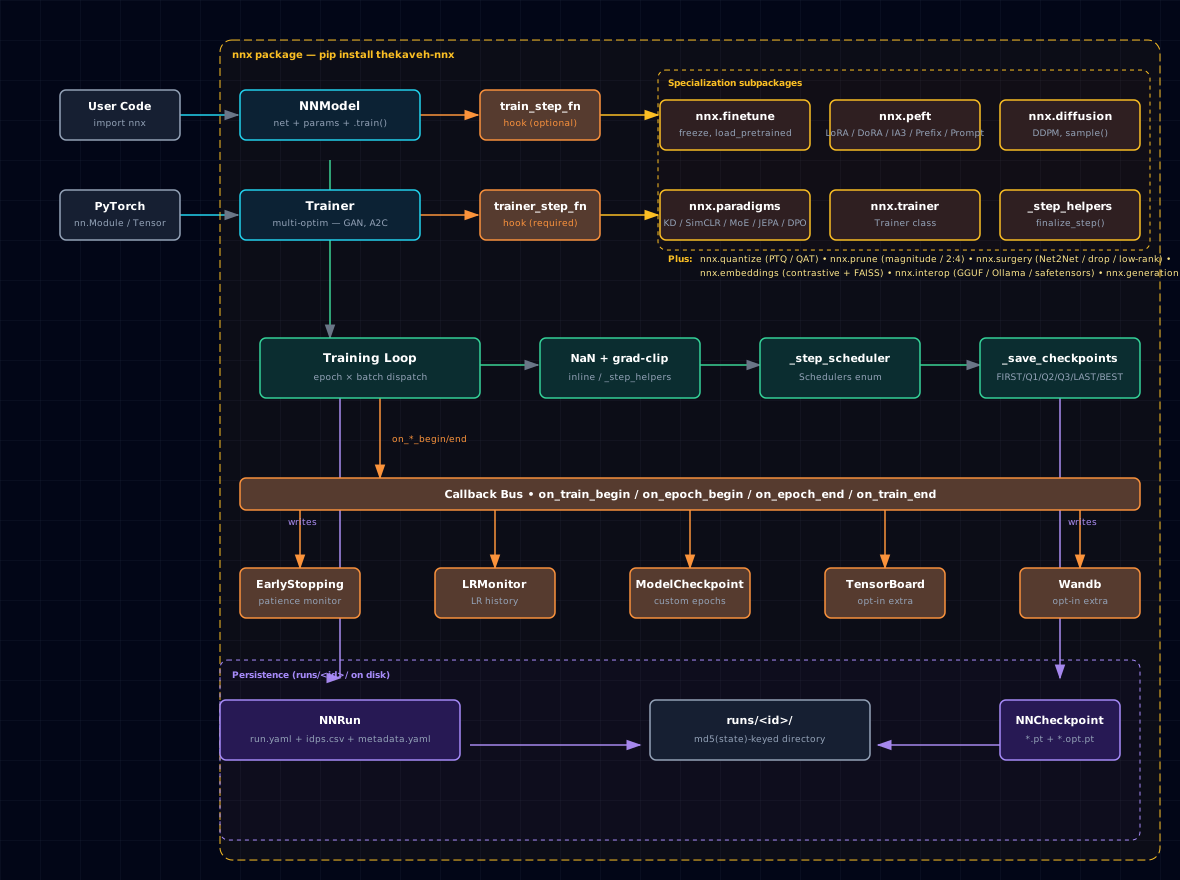
The architecture separates user-facing orchestration, per-batch extension hooks, callback lifecycle, and persisted run artifacts.
Reading the diagram top-to-bottom (summary):
- User code instantiates
NNModel(supervised) orTrainer(multi-optimizer for GAN / actor-critic). - The
train_step_fn/eval_step_fn/trainer_step_fnhooks are the training extension bus.diffusion,paradigms,quantize, andembeddingsprovide hook-compatible factories; the diffusion, paradigm and embeddings steps share one step-finalization helper. The other specialization packages compose around the loop without hooks: model transforms (finetune,peft,prune,surgery), exchange formats (interop), inference utilities (generation) and diagnostics (viz). - The training-loop internals run the per-batch step hook inside the data loop and save checkpoints once per completed epoch. Each scheduler steps once per completed epoch by default (
clock="epoch"), or once per committed optimizer update withNNSchedulerParams(clock="optimizer_update"). Paradigm and diffusion step factories also apply a NaN guard and gradient clipping. - The Callback bus fires
on_train_begin / on_epoch_begin / on_epoch_end / on_train_endto every registered listener (EarlyStopping,LRMonitor,ModelCheckpoint,TensorBoardCallback,WandbCallback). - After
on_epoch_end,NNRunandNNCheckpointcommit durable state in order: history → LAST → phase/BEST → deferred callback checkpoints.
Concepts §1 gives the full 8-layer breakdown, and Architecture gives the exact callback and commit ordering.
6. Documentation¶
The documentation below covers the public API, architecture, extension contracts, and runnable examples.
6.1. Conceptual + reference¶
- Concepts — architecture, persistence layout, the callback protocol and every specialization in detail.
- Capability reference — the main capabilities with their entry points, grouped by task.
- Quickstart — a runnable example with variations to copy and adapt.
- Language modeling — train a small decoder-only
TransformerNNend to end on CPU and generate text. - Direct Preference Optimization — fine-tune a language model on
(prompt, chosen, rejected)preference pairs against a frozen reference policy, without reward modeling or RL. - Typed decisions — ask
Choice,BooleanorScorequestions and get validated, labelled probabilities. Covers the providers, decision jobs and the provider benchmark. - I-JEPA — self-supervised pretraining of a vision encoder by predicting masked patches in latent space.
- Experimental GGUF export — write and inspect an NNx-tagged GGUF file, and the current stock-runtime limits.
- HuggingFace Hub — safetensors checkpoints and
save_pretrained/push_to_hub/from_pretrainedonNNModel. - Embeddings + FAISS export — train a text embedder with contrastive learning and export a FAISS index.
- Model surgery — the
nnx.surgeryprimitives, their function-preservation contract, and the load, edit, refine and save workflow. - API reference — signatures and docstrings for public symbols.
- Comparison vs Lightning / HF / fastai / Composer — when to use NNx or another PyTorch training toolkit, compared axis by axis.
- Architecture — the system overview and exact training lifecycle, including callback, scheduler, history, and checkpoint ordering.
- External dependency contracts — optional integrations, version sources and verification coverage; read it before changing dependency ranges or publish workflows.
6.2. Workflow + history¶
- Examples catalog — an ordered tour of the runnable scripts under
examples/, from the core loop to specialized methods. - Test import boundaries — when tests should use the public facade and when a deep implementation import is intentional.
- Contributing — setup, back-compat invariants, test policy, the omit-when-default rule for params, what we will and won't merge.
- Security policy — supported versions, private vulnerability reporting, and the checkpoint trust boundary.
- Changelog — release history (Keep-a-Changelog format), back-compat migration notes, and on-disk run.id hash shifts when they occur.
7. Project¶
7.1. Status¶
Alpha. Before 1.0, bug fixes can change behavior (see the Changelog), but public APIs are renamed only when they cannot work as designed.
7.2. Contributing¶
Bug reports and PRs are welcome via GitHub issues. See CONTRIBUTING.md for setup, verification, and the complete style guide.
7.3. License¶
Apache License 2.0. Copyright 2026 Kaveh Razavi. See LICENSE.