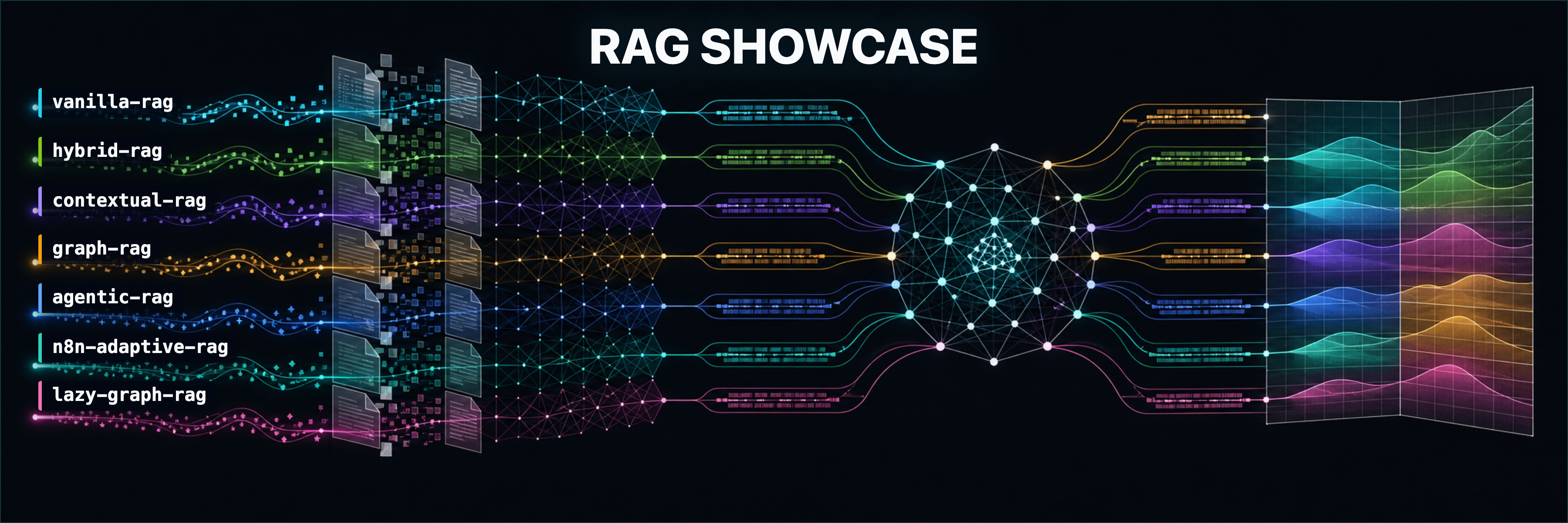
RAG Showcase
Seven RAG approaches. One shared stack. Measured side by side.
Compare vector, hybrid, contextual, graph, agentic, adaptive, and lazy-graph retrieval through one reproducible Atlas evaluation harness.
















RAG Showcase serves seven retrieval strategies as OpenAI-compatible model aliases in Open WebUI, so one prompt can fan out across vanilla, hybrid, contextual, LightRAG graph, agentic, n8n-adaptive, and experimental lazy-graph retrieval. Atlas supplies the shared gateway, model routing, ingestion, stores, workflow services, and health lifecycle; this repository contributes the approach plugin, corpus ladder, tuning flavors, and evaluation harness. The differentiator is controlled comparison rather than a collection of disconnected demos: approaches consume the same dataset profile and embedding model, return one response envelope with available evidence and metrics, and are scored from persisted artifacts by Ragas and a blinded judge panel. The default stack can run locally, while provider and model choices remain configurable through Atlas.
Quick Start · Measured Results · Architecture
Latest benchmark (2026-07-17): all 380/380 answer cells completed across seven base approaches, twelve query-time flavors, and three datasets. Winners changed with dataset complexity. See the full sortable results, methodology, and artifact ledger.
1. The Seven Approaches
| Endpoint | Approach | Designed to shine on |
|---|---|---|
vanilla-rag |
Dense top-k retrieval, then a single generation call (the control) | Simple factoids; the baseline |
hybrid-rag |
Weaviate hybrid retrieval (BM25 + dense), then TEI reranking | Exact keyword and identifier queries |
contextual-rag |
Anthropic Contextual Retrieval over context-prefixed chunks | Context-starved chunks |
graph-rag |
LightRAG over extracted entities, relationships, and vector context | Graph-shaped relationship questions |
agentic-rag |
ReAct loop over vector and graph retrieval tools | Multi-hop and comparative questions |
n8n-adaptive-rag |
Low-code workflow that routes by query complexity | Mixed simple-and-complex batches |
lazy-graph-rag |
Deterministic concept graph with budgeted query-time expansion | Graph-shaped corpora under a lower indexing budget |
The last column is the design intent behind each demo query family, not a measured result — the committed runs contradict some intended contrasts (see the per-query winners).
Any approach can also expose tuned flavors — for example hybrid-rag-high-recall
or graph-rag-fast — that route to the same base approach with reproducible parameter
overrides and their own selectable model alias. See Flavor Tuning.
The experimental lazy-graph-rag endpoint is the seventh
supported base approach. It remains outside the backward-compatible ad hoc
default matrix expansion, but joins the measured dataset ladder when
--include-flavor-tier is selected.
2. Headline Result
The 2026-07-17 ladder ran all seven base approaches and all twelve named flavors across three datasets of increasing structure. All 380 answer cells succeeded: 140 base-family cells and 240 flavor cells. Base-family winners shifted with the input:
| Dataset | Winning configuration | Judge score |
|---|---|---|
| Baseline curated | vanilla-rag |
4.17 |
| Graph-native dossiers | lazy-graph-rag |
4.31 |
| Cyber-threat graph (MITRE ATT&CK) | contextual-rag |
3.17 |
The flavor-tier winners were lazy-graph-rag-wide,
hybrid-rag-high-recall, and hybrid-rag-fast. These are concise headlines.
The Full sortable leaderboards contain every approach
and metric; the methodology,
dataset complexity report, and
live-run artifact ledger provide the protocol, ladder, and
source artifacts.
3. Documentation
-
Get Started
Prerequisites, one-command bring-up, and driving the comparison in Open WebUI.
-
The Approaches
Step-by-step internals, dependencies, and tuning knobs for all seven.
-
Evaluation and Results
Complete sortable rankings, methodology, the dataset complexity ladder, and committed live-run artifacts.
-
Architecture
The plugin seam, LiteLLM, retrieval stores, and workflow services.
4. Fully Local by Default
Everything runs on your own machine: local models through Atlas's Ollama provider
(qwen3.8:latest for chat, LightRAG extraction/keyword/query roles, and local Ragas
evaluation, plus nomic-embed-text for embeddings), Weaviate and LightRAG
for retrieval, a TEI reranker, and a local judge panel. No cloud calls are required to
run the showcase or reproduce its results. See the Hardware Sizing guide
for minimum and recommended profiles.
The project is also a deliberate test-drive of Atlas as reusable infrastructure. The Atlas Reuse Assessment records what reused cleanly, the seams that were added, and the pinned dependency contracts each integration was verified against.