3.1 RAG Approach Internals
This document is the canonical guide to how each approach in rag-showcase works, what it depends on, what can be tuned, and how it performed in the committed 2026-07-17 live dataset-ladder run.
The important terminology distinction:
- Hybrid retrieval means combining keyword search and dense vector search over chunks, then optionally reranking the chunk candidates.
- Graph RAG means querying an extracted knowledge graph of entities and relationships, here through Atlas's LightRAG service.
Therefore, hybrid-rag is not a graph-RAG approach. It is a text/chunk retrieval
approach with BM25 + dense retrieval and TEI reranking.
1. Shared Invocation Model
All seven approach routes are mounted under the RAG plugin's shared
/rag/<approach>/v1/chat/completions root inside the Atlas backend container.
../backend_plugins/rag/plugin.yml declares
that /rag root, /rag/health, inherited Kong auth, typed configuration, and
the plugin's service dependencies. Atlas validates the manifest in consumer
doctor and again before loading the plugin.
The backend routes are declared as Atlas-managed LiteLLM model aliases, so Open
WebUI and the comparison harness invoke every approach through LiteLLM's common
/v1/chat/completions surface rather than calling the backend directly. Named
flavors such as graph-rag-wide point at the same base route and are resolved
from the incoming request model. See
approach-flavor-tuning.md for the current flavor
manifest and benchmark invocation rules.
All approaches use the same selected Atlas ingestion profile and response wrapper:
atlas.consumer.ymlmaps each dataset to a versioned profile.- Atlas owns discover, parser fallback, Chonkie recursive chunking (800 / 100), embedding, and the base Weaviate write.
- Atlas stores plain chunks in
RagBase_<profile>and uploads parsed documents to LightRAG, recording every phase through drain/finalize. - The showcase contextual post-step reads those exact Atlas chunks, generates the
approach-specific blurbs, and writes
RagContextual_<profile>. - Matrix and judgment snapshots record the Atlas ingestion id, profile revision, and corpus digest that produced their retrieval state.
- Each approach returns a normalized answer, source block, metrics footer, and
additive structured
rag_showcaseevidence extension when contexts exist.
1.1 Shared Model Roles
The selectable Open WebUI model name is the approach alias, not necessarily the underlying LLM. The approach then calls one or more configured roles.
| Role | Default model | Used by | Notes |
|---|---|---|---|
embed |
nomic-embed-text |
Weaviate-backed retrieval and the agent vector tool | Same embedding role across chunk-based approaches for fair vector comparison. |
light_gen |
qwen3.8:latest |
vanilla-rag, hybrid-rag, contextual-rag |
Shared final answer model for chunk-based approaches. |
contextual_blurb |
qwen3.8:latest |
contextual-rag ingest |
Generates short context blurbs before embedding contextual chunks. |
agentic |
qwen3.8:latest |
agentic-rag |
Controls the ReAct loop and tool selection. |
| LightRAG EXTRACT | qwen3.8:latest setup default |
graph-rag; graph tool inside agentic-rag |
Atlas-owned role for entity and relationship extraction, with thinking disabled by Atlas model metadata. |
| LightRAG KEYWORD | qwen3.8:latest setup default |
graph-rag; graph tool inside agentic-rag |
Atlas-owned role for strict LightRAG keyword/query decomposition, with thinking disabled by Atlas model metadata. |
| LightRAG QUERY | qwen3.8:latest setup default |
graph-rag; graph tool inside agentic-rag |
Atlas-owned role for final LightRAG graph answers, with thinking disabled by Atlas model metadata. |
| n8n classifier | qwen3.8:latest |
n8n-adaptive-rag |
Workflow-level simple/complex classifier. |
| Lazy graph query | nomic-embed-text + qwen3.8:latest |
experimental lazy-graph-rag |
Shared embedding and final generation; concept indexing/traversal is LLM-free. |
Atlas's model catalog applies request_defaults: {think: false} to
qwen3.8:latest. The setting is scoped to that catalog entry, not injected by
the approach plugin or applied globally. If a role is changed to a different
local or cloud model, Atlas resolves that model's own adapter, capabilities, and
request defaults.
The full evaluation protocol, including judge models and result aggregation, is
documented in evaluation-methodology.md.
1.2 Shared Evaluation Contract
The evaluation manifest declares answer_with_contexts for vanilla, hybrid,
contextual, agentic, adaptive, and lazy graph RAG. Their retrieved snippets can
be sent to Atlas for context-grounding metrics. It declares answer_only for graph-rag
because the current LightRAG response exposes an answer and graph marker, but not
the exact text contexts selected internally.
All seven selected approaches can still be compared on successful-answer rate,
latency, and the optional blinded judge panel. Graph-rag's missing context is recorded as
not_evaluable for context-dependent Ragas metrics, never as a zero and never as
invented evidence. See
evaluation-methodology.md.
1.3 Approach Lifecycle and Persistence
The following comparison separates how knowledge is prepared from how a question is answered. A flavor changes parameters inside one family; it does not become a new architecture. The two candidate rows are included to make the design space explicit, but they are neither deployed nor included in any score, rank, success-rate denominator, or progression chart.
1.3.1 Knowledge Lifecycle
| Approach family | Maturity | Employed in showcase? | Knowledge preparation | Chunk enrichment | Graph creation | Durable state and scope | Human- or machine-oriented? | Query-derived learning persists? |
|---|---|---|---|---|---|---|---|---|
vanilla-rag |
Canonical control | Yes | Atlas parses, chunks, and embeds during ingestion. | None beyond parser output and metadata. | None. | Plain chunks and vectors in profile-scoped RagBase_<profile> Weaviate collections. |
Machine retrieval index; source text remains human-readable. | No. Each query is independent. |
hybrid-rag |
Canonical | Yes | Same Atlas ingestion as vanilla; Weaviate maintains vector and BM25 indexes. | None. | None. | Shares profile-scoped RagBase_<profile> collections. |
Machine retrieval indexes over human-authored chunks. | No. Rerank results are request-local. |
contextual-rag |
Canonical | Yes | After Atlas ingestion, the showcase generates a situating blurb for every chunk and embeds the enriched text. | Ahead of query, using an LLM-generated document-context blurb. | None. | Derived RagContextual_<profile> Weaviate collection tied to the ingestion profile. |
Machine retrieval index containing human-readable enriched chunks. | No. Query results do not rewrite blurbs or indexes. |
graph-rag (LightRAG) |
Canonical | Yes | Atlas submits full documents to LightRAG; LightRAG extracts entities, relations, summaries, chunks, and embeddings. | Entity/relation extraction and graph summaries happen during ingestion. | Ahead of query, once per ingested corpus state, then reused by every graph query profile. | LightRAG storage plus Neo4j for the shared ingested corpus; query profiles do not create separate graphs. | Primarily machine-oriented entity/relation graph, with descriptive labels and summaries. | No. A query reads the graph; it does not learn from or write back the answer. |
agentic-rag |
Canonical | Yes | Creates no independent index; reuses Atlas's plain chunks and the already-ingested LightRAG graph. | None of its own. | None of its own; graph availability is inherited from LightRAG ingestion. | Shared Weaviate and LightRAG state; ReAct messages and tool traces are request-local. | Mixed: machine indexes plus an LLM-readable tool trace. | No. Tool choices and observations are not persisted between queries. |
n8n-adaptive-rag |
Canonical orchestrator | Yes | Creates no retrieval state; delegates to another deployed approach. | None of its own. | None of its own. | Only n8n workflow configuration/execution history; retrieval state belongs to the selected route. | Human-editable workflow over machine retrieval services. | No. Classification and route choice are per request. |
lazy-graph-rag |
Experimental, opt-in | Yes - experimental | Reuses Atlas chunks; on the first query after a cache miss, deterministically indexes concepts and co-occurrences without an LLM. | None; it derives concept postings and edges from existing chunks. | First query per corpus fingerprint, then reused until the corpus changes or cache is cleared. | Named-volume cache keyed by collection and corpus fingerprint; no Neo4j. | Machine-oriented lexical concept/co-occurrence graph with inspectable counters. | No. Queries reuse but do not mutate the cached graph. |
proposed graphify-rag |
Researched candidate; unimplemented and unmeasured | No - candidate | Graphify prebuilds an explainable graph from code, documents, media, and other inputs; semantic extraction may use a configured model. | Inputs become typed concepts and EXTRACTED/INFERRED edges rather than enriched retrieval chunks. |
Ahead of query via Graphify build/update operations. | graphify-out/graph.json by default; optional Neo4j/FalkorDB export. No showcase namespace exists yet. |
Both: machine-queryable graph plus human-facing HTML/report and edge provenance. | No by default. A rebuild can update the graph, but query answers do not automatically write back. |
proposed llm-wiki-rag |
Concept candidate; unimplemented and unmeasured | No - candidate | An agent incrementally compiles immutable raw sources into linked Markdown pages governed by a schema/instruction file. | Ahead of query and incrementally: source material is synthesized into maintained wiki pages, not merely prefixed to chunks. | Human-readable links accumulate as the wiki evolves; a database graph is optional, not intrinsic. | Versionable Markdown wiki plus raw source layer and operating schema. | Primarily human-readable knowledge that is also agent-navigable. | Optional by design. Promote/writeback can persist validated answers; it would be disabled during a fair benchmark. |
The Graphify row reflects the current Graphify project contract:
it produces a reusable graph.json, supports scoped query/path/explain operations,
and does not itself provide this showcase's OpenAI-compatible answer-generation
route. The LLM Wiki row reflects Karpathy's LLM Wiki idea file,
which is a knowledge-compilation pattern rather than a drop-in RAG server.
1.3.2 Query Execution and Evidence
| Approach family | Routing or tool selection | Retrieval / traversal at query time | Reranking | Generation and model work | Evidence exposed to evaluation | Principal tuning surface | Best fit and characteristic failure |
|---|---|---|---|---|---|---|---|
vanilla-rag |
Fixed path; no tools. | Dense top-k over RagBase_<profile>. |
None. | One query embedding plus one light_gen call. |
Exact selected chunks and server metrics. | k, embedding model, chunk profile, generation role. |
Strong inexpensive baseline; misses exact terms and cross-document paths when dense top-k is insufficient. |
hybrid-rag |
Fixed path; no tools. | Weaviate BM25+dense hybrid candidate search. | TEI cross-encoder selects final chunks. | One embedding, one rerank request, one light_gen call. |
Exact reranked chunks, scores, and server metrics. | retrieve_k, top_n, alpha, rerank on/off. |
Exact identifiers plus semantic matches; quality depends on candidate recall and reranker fitness. |
contextual-rag |
Fixed path; no query-time tools. | Hybrid search over context-prefixed chunks. | TEI cross-encoder. | Ingest-time blurb calls; query-time embedding, rerank, and one light_gen call. |
Exact enriched chunks, scores, and server metrics. | Blurb model/prompt/window plus hybrid knobs. | Ambiguous or context-starved chunks; pays ingestion cost and can encode a poor blurb permanently until reingest. |
graph-rag (LightRAG) |
Fixed LightRAG profile selected by model alias. | LightRAG internally combines entity, relationship, chunk, and vector retrieval according to local, global, hybrid, or another supported mode. It decides traversal/fanout internally; the showcase does not issue a fixed Neo4j k-hop query. |
Atlas's LightRAG-to-TEI adapter can enable profile-scoped reranking. | KEYWORD/QUERY model calls at query time; EXTRACT work occurred during ingestion. | Answer, profile metadata, and operational metrics; exact internal contexts are not currently returned, so context-grounding metrics are not_evaluable. |
Profile mode, top_k, chunk_top_k, token budget, rerank, and LightRAG role models. |
Relationship/community questions; sensitive to extraction quality, profile fanout, and opaque context selection. |
agentic-rag |
The controller LLM selects vector or graph tools during each bounded ReAct turn. | Tool-dependent: Weaviate vector/hybrid retrieval and/or LightRAG graph query. | No additional agent-level rerank; selected tools apply their own behavior. | Up to max_steps controller calls plus tool/model calls. |
Tool observations/trace and metrics; trajectory is ephemeral. | max_steps, vector top-k, graph mode/profile, prompts, controller model. |
Questions needing adaptive multi-step evidence gathering; can stop early, loop, or exhaust its step budget. |
n8n-adaptive-rag |
A classifier model chooses simple or complex, then n8n maps that label to a route. |
Entirely inherited from vanilla-rag or agentic-rag in the current workflow. |
Inherited from delegated route. | One classifier call plus all downstream work. | Delegated sources/metrics are preserved; route and selected approach are separate adaptive metadata. |
Classifier prompt/model, route map, workflow timeouts. | Low-code policy experiments; cannot outperform a poor classifier/route map and owns no retrieval quality itself. |
lazy-graph-rag |
Fixed deterministic flow; no LLM tool chooser. | Hybrid seed chunks -> concept extraction -> budgeted graph expansion -> selected source chunks. | Deterministic relevance scoring; no cross-encoder. | Query embedding and one light_gen call; zero LLM index calls. |
Selected source chunks plus cache, graph-size, and traversal-budget metadata. | Seed count, relevance budget, graph density, context cap. | Fast relationship expansion over explicit terminology; lexical concept graph can miss aliases and implicit relations. |
proposed graphify-rag |
A future wrapper would choose scoped query, path, or explain; policy is not designed yet. |
Graphify provides graph-native scoped subgraphs and explicit path traversal, without a vector index. | None in the current Graphify retrieval contract. | Graph construction may use a semantic model for docs/media; a showcase answer-generation call still needs to be designed. | Graph nodes, edges, confidence/provenance, and paths are available, but no showcase evidence schema exists. | Extractors, semantic backend, community/path limits, update policy, answer wrapper. | Explainable structural/path questions; not yet an end-to-end comparable RAG route. |
proposed llm-wiki-rag |
An agent navigates wiki pages and links; exact retrieval policy depends on the chosen implementation. | Direct page/link navigation, search, or context loading over compiled Markdown. | Not inherent to the pattern. | Significant LLM compilation/maintenance work; query generation reads pre-synthesized pages. | Human-readable pages and source links could be evidence, but no showcase response contract exists. | Schema, compilation prompts, page size/link policy, linting, promotion/writeback. | Durable curated organizational knowledge; freshness, synthesis drift, and benchmark contamination require governance. |
2. Current Measured Results
The current committed live run measured three dataset-ladder rungs. The table
contains 1-5 means from two blinded local judges. Ragas faithfulness and answer
relevancy remain separate coverage-aware metrics; LightRAG answer-only rows are
ineligible for faithfulness because its response does not expose exact contexts.
All 140 base-family answer cells and all judge prompts completed. The same run
also measured 240 flavor cells, summarized in
approach-flavor-tuning.md.
| Approach | Baseline curated | Graph-native | Cyber threat intel | Direction |
|---|---|---|---|---|
vanilla-rag |
4.17 | 4.06 | 3.00 | Strong simple baseline and competitive on graph-native dossiers. |
hybrid-rag |
4.00 | 3.62 | 2.92 | Reliable text retriever; its fast/high-recall flavors matter by dataset. |
contextual-rag |
3.92 | 4.19 | 3.17 | Strongest cyber aggregate and highest answer relevancy there. |
graph-rag |
3.75 | 2.62 | 2.42 | Operational end to end; quality remains profile-sensitive. |
agentic-rag |
2.67 | 2.44 | 3.00 | Better on cyber, but bounded tool planning remains expensive. |
n8n-adaptive-rag |
3.33 | 2.44 | 3.00 | Inherits the quality and cache behavior of its selected downstream route. |
lazy-graph-rag |
3.92 | 4.31 | 3.00 | Experimental; won graph-native and stayed low-latency. |
Snapshot files:
- Baseline:
matrixandevaluation - Graph-native:
matrixandevaluation - Cyber:
matrixandevaluation
The matching *-evidence.jsonl and *-judgments.json files are documented in
the results/ artifact index; JSONL remains a downloadable
repository artifact rather than an MkDocs page.
3. vanilla-rag
3.1 Purpose
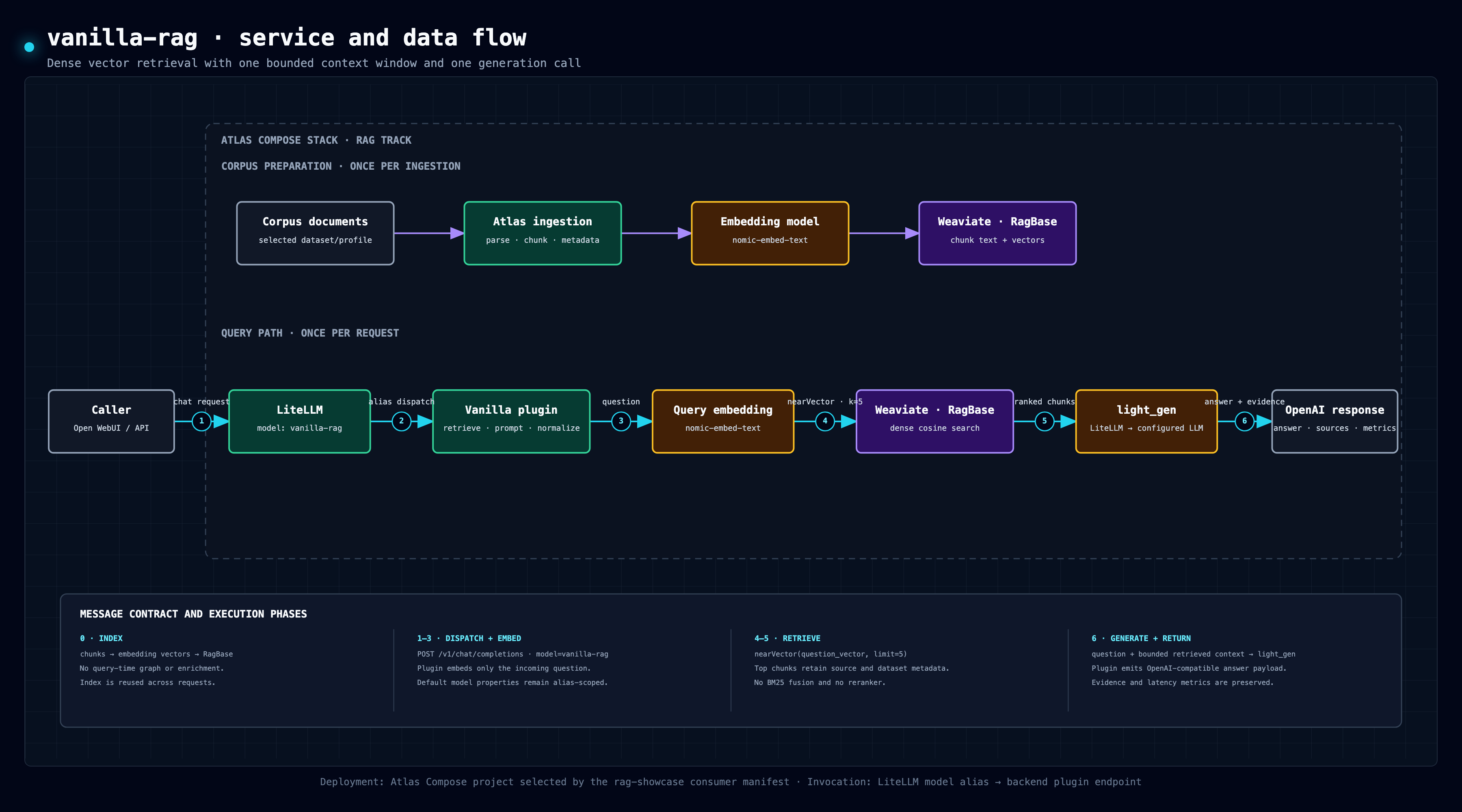
vanilla-rag is the control path: pure dense vector retrieval over plain chunks,
followed by one answer-generation call.
3.2 Service and Data Flow
Open the full-resolution interactive diagram
3.3 Internal Steps
- Read the latest user message.
- Embed the question through LiteLLM.
- Search the selected profile's Weaviate collection
RagBase_<profile>withnear_vector. - Retrieve the top
K=5chunks. - Stuff those chunks into the shared answer prompt.
- Call the
light_genmodel once. - Return the answer plus the retrieved chunk titles/snippets.
3.4 Dependencies
- LiteLLM embedding route.
- Atlas-ingested Weaviate collection
RagBase_<profile>. - LiteLLM chat route for
light_gen.
3.5 Models Used
- Query embedding:
embedrole, defaultnomic-embed-text. - Answer generation:
light_genrole, defaultqwen3.8:latest. - External evaluation: Atlas scores eligible stored contexts through the Ragas endpoint; the manifest-configured judge panel scores stored answers separately.
3.6 Tuning Surface
| Knob | Current value | Exposed as env? | Notes |
|---|---|---|---|
K |
5 | Via flavor | Default 5 in vanilla.py; overridable per flavor via k (e.g. vanilla-rag-wide uses 8). |
| Collection | RagBase_<profile> |
Yes, profile-selected | Uses Atlas-ingested plain chunks only. |
| Chunk size / overlap | 800 / 100 | Manifest profile | Changing the profile revision requires re-ingestion. |
| Prompt template | shared stuff prompt |
No | Shared with hybrid/contextual. |
| Generation model | roles.yaml light_gen |
Yes, via roles file | Per-model request defaults come from Atlas's model catalog. |
3.7 Observed Behavior
Fast and competitive throughout this bounded run. It won baseline at 4.17, ranked third on graph-native at 4.06, and tied for second on cyber at 3.00. Dense top-k remains vulnerable when the required path is absent from the selected chunks, but the generation model can synthesize explicit relation dossiers well.
4. hybrid-rag
4.1 Purpose
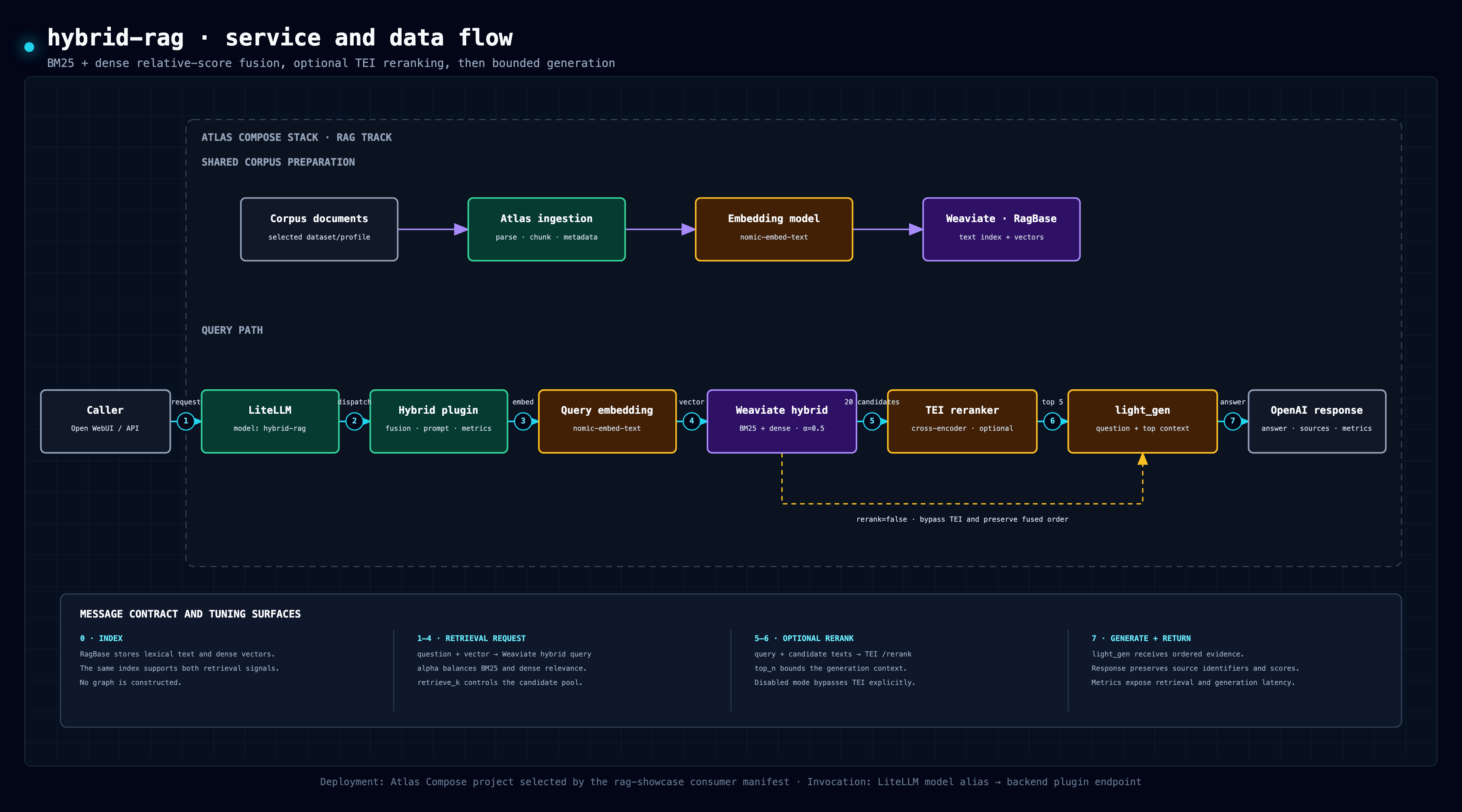
hybrid-rag tests whether better text retrieval is enough: it combines keyword
and dense retrieval over plain chunks, then reranks candidates before generation.
It does not query LightRAG or use extracted graph entities/relations.
4.2 Service and Data Flow
Open the full-resolution interactive diagram
4.3 Internal Steps
- Read the latest user message.
- Embed the question through LiteLLM.
- Search
RagBase_<profile>with native hybrid search: BM25 keyword matching + dense vector search. - Use Weaviate's default relative score fusion with
alpha=0.5. - Retrieve
RETRIEVE_K=20candidates. - Send those candidates to the TEI cross-encoder reranker.
- Keep
TOP_N=5reranked chunks. - Stuff those chunks into the shared answer prompt.
- Call the
light_genmodel once. - Return the answer plus reranked sources and TEI scores.
4.4 Dependencies
- LiteLLM embedding route.
- Atlas-ingested Weaviate collection
RagBase_<profile>. - Weaviate BM25 + vector indexes.
- TEI reranker endpoint.
- LiteLLM chat route for
light_gen.
4.5 Models Used
- Query embedding:
embedrole, defaultnomic-embed-text. - Reranking: Atlas TEI reranker service, default endpoint
http://tei-reranker:80. - Answer generation:
light_genrole, defaultqwen3.8:latest. - External evaluation: Atlas scores eligible stored contexts through the Ragas endpoint; the manifest-configured judge panel scores stored answers separately.
4.6 Tuning Surface
| Knob | Current value | Exposed as env? | Notes |
|---|---|---|---|
RETRIEVE_K |
20 | Via flavor | Candidate pool before rerank; overridable via retrieve_k (e.g. hybrid-rag-high-recall uses 40). |
TOP_N |
5 | Via flavor | Final chunks sent to generation; overridable via top_n (e.g. hybrid-rag-high-recall uses 8). |
Hybrid alpha |
0.5 | Via flavor | Equal BM25/vector weighting in vectors.search_hybrid; overridable via alpha. |
| Rerank | on | Via flavor | TEI cross-encoder rerank; disable via rerank: false (e.g. hybrid-rag-fast). |
| Fusion type | Weaviate default | No | Current code relies on Weaviate default relative score fusion. |
| TEI endpoint | http://tei-reranker:80 |
Yes, TEI_RERANKER_ENDPOINT |
Reranker quality/model can materially affect results. |
| Collection | RagBase_<profile> |
Yes, profile-selected | Plain chunks only. |
4.7 Observed Behavior
The canonical route scored 4.00, 3.62, and 2.92 across the three rungs. Its high-recall flavor won graph-native at 4.19, while its fast flavor won cyber at 3.67. That does not mean either used a graph; candidate fanout and reranking changed which supporting chunks reached generation.
5. contextual-rag
5.1 Purpose
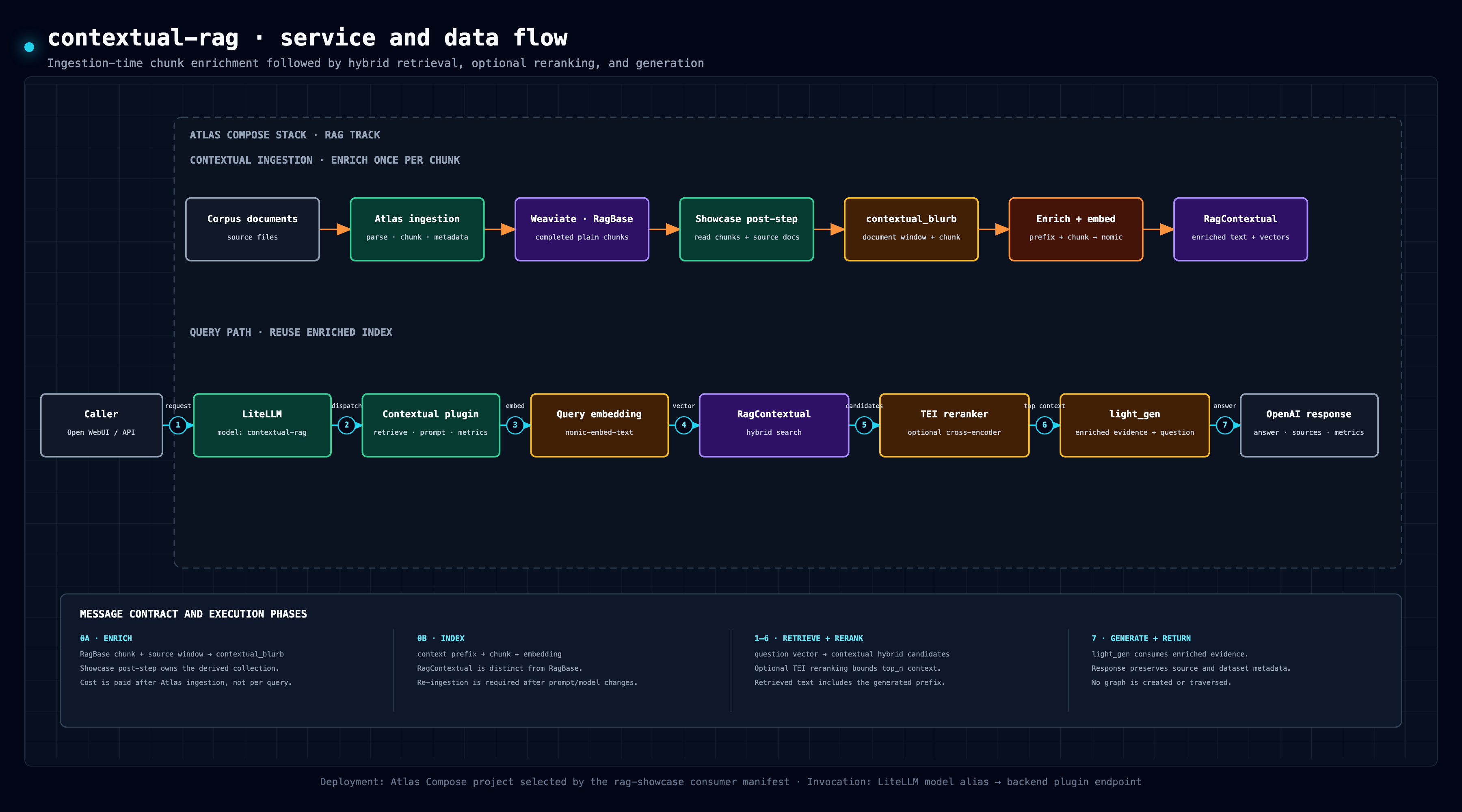
contextual-rag follows Anthropic-style Contextual Retrieval. It enriches each
chunk at ingest time with a short context blurb, then uses the same hybrid+rerank
query path as hybrid-rag.
5.2 Service and Data Flow
Open the full-resolution interactive diagram
5.3 Internal Steps
Ingest-time:
- Read the plain chunks produced by the completed Atlas ingestion job.
- For each chunk, send a 6000-character document window centered on the chunk
(document-prefix fallback when the chunk isn't found verbatim) plus the chunk
to the
contextual_blurbmodel. - Generate a 1-2 sentence context blurb.
- Prefix the chunk with that blurb.
- Embed and store the result in
RagContextual_<profile>.
Query-time:
- Embed the user question.
- Search
RagContextual_<profile>with Weaviate hybrid search. - Retrieve
RETRIEVE_K=20candidates. - Rerank with TEI.
- Keep
TOP_N=5. - Stuff selected context-prefixed chunks into the shared prompt.
- Call
light_genonce.
5.4 Dependencies
- LiteLLM embedding route.
- LiteLLM chat route for
contextual_blurbat ingest time. - Showcase-derived Weaviate collection
RagContextual_<profile>. - TEI reranker endpoint.
- LiteLLM chat route for
light_gen.
5.5 Models Used
- Ingest-time contextualization:
contextual_blurbrole, defaultqwen3.8:latest. - Query embedding:
embedrole, defaultnomic-embed-text. - Reranking: Atlas TEI reranker service, default endpoint
http://tei-reranker:80. - Answer generation:
light_genrole, defaultqwen3.8:latest. - External evaluation: Atlas scores eligible stored contexts through the Ragas endpoint; the manifest-configured judge panel scores stored answers separately.
5.6 Tuning Surface
| Knob | Current value | Exposed as env? | Notes |
|---|---|---|---|
| Context blurb model | roles.yaml contextual_blurb |
Yes, via roles file | Quality/speed tradeoff. |
| Context prompt | fixed | No | Prompt asks for 1-2 situating sentences. |
| Document context cap | 6000 chars | No | _DOC_WINDOW in contextual.py; window centered on the chunk, prefix fallback. |
RETRIEVE_K |
20 | Via flavor | Same as hybrid-rag; overridable via retrieve_k (e.g. contextual-rag-high-recall uses 40). |
TOP_N |
5 | Via flavor | Same as hybrid-rag; overridable via top_n (e.g. contextual-rag-high-recall uses 8). |
Hybrid alpha |
0.5 | Via flavor | Same search helper as hybrid-rag; overridable via alpha. |
| Rerank | on | Via flavor | Same TEI rerank as hybrid-rag; disable via rerank: false. |
5.7 Observed Behavior
This route scored 3.92 on baseline, 4.19 on graph-native, and won cyber at 3.17. It also produced the highest cyber answer-relevancy mean at 0.891. It benefits when individual chunks are ambiguous without their document-level context, at the cost of extra ingest-time model work and slower high-recall queries.
6. graph-rag
6.1 Purpose
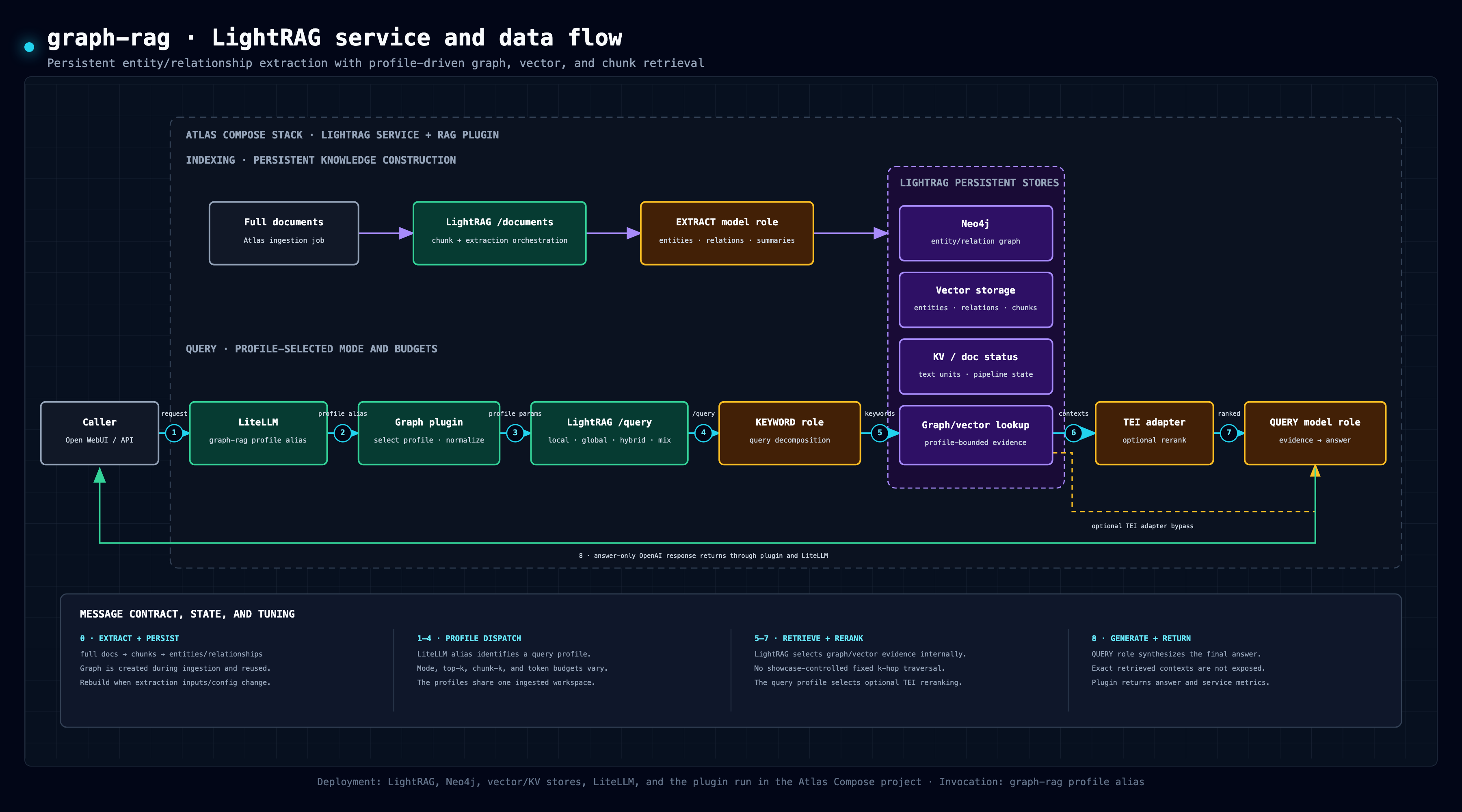
graph-rag delegates query answering to Atlas's LightRAG service. LightRAG builds
a knowledge graph during indexing and queries over extracted entities,
relationships, and vector context.
6.2 Service and Data Flow
Open the full-resolution interactive diagram
6.3 Internal Steps
Ingest-time:
- Full document text is uploaded to LightRAG.
- LightRAG chunks and extracts entities/relationships.
- LightRAG stores graph data through its configured stores, including Neo4j.
- LightRAG embeds graph/chunk artifacts for query-time retrieval.
Query-time:
- The wrapper sends the user question to LightRAG
/query. - The selected model alias becomes an Atlas LightRAG query profile (for example,
graph-rag-fastselects thelocalprofile). - Atlas applies the profile's
mode,enable_rerank,top_k,chunk_top_k, andmax_total_tokens, with explicit request values taking precedence. - LightRAG performs its graph/vector retrieval and generation internally.
- The wrapper returns LightRAG's answer and selected profile metadata. The compatibility source marker describes the graph path but is not treated as a retrieved text context by evaluation.
6.4 Dependencies
- Atlas LightRAG service.
- LightRAG's configured graph/vector stores, including Neo4j.
- LightRAG role models for EXTRACT, KEYWORD, and QUERY.
- LightRAG embedding model.
6.5 Models Used
- Graph extraction: Atlas LightRAG EXTRACT role, setup default
qwen3.8:latestwith Atlas-scoped thinking disabled. - Graph keyword/query decomposition: Atlas LightRAG KEYWORD role, setup default
qwen3.8:latestwith Atlas-scoped thinking disabled. - Graph answer generation: Atlas LightRAG QUERY role, setup default
qwen3.8:latestwith Atlas-scoped thinking disabled. - LightRAG embeddings: setup default
nomic-embed-text. - External evaluation: operational and judge metrics remain available. The current
LightRAG response lacks retrievable contexts, so context-dependent Ragas metrics
are recorded as
not_evaluable.
These LightRAG role models are configured through Atlas LIGHTRAG_* inputs, not
through this plugin's roles.yaml extraction entry. The shipped default uses a
non-reasoning Mistral model for the high-volume entity/relationship phase, then
reuses Atlas's thinking-disabled Qwen model for strict keyword output and final
answers. Live validation found that assigning Mistral to KEYWORD could produce
thousands of tokens instead of the requested compact structure.
6.6 Tuning Surface
| Knob | Current value | Exposed as env? | Notes |
|---|---|---|---|
| Query mode | hybrid canonical |
Atlas query profile | graph-rag-fast selects local; profiles live in atlas.consumer.yml. |
| Rerank | off canonical | Atlas query profile | graph-rag-rerank enables Atlas's LightRAG-to-TEI adapter without changing the shared graph. |
top_k / LIGHTRAG_QUERY_TOP_K |
10 canonical | Atlas query profile; env fallback | Knowledge-graph candidate fanout; wide uses 30. |
chunk_top_k / LIGHTRAG_QUERY_CHUNK_TOP_K |
5 canonical | Atlas query profile; env fallback | Chunk context fanout; wide uses 12. |
max_total_tokens / LIGHTRAG_QUERY_MAX_TOTAL_TOKENS |
12000 canonical | Atlas query profile; env fallback | Query prompt/context budget; wide uses 24000. |
LIGHTRAG_EXTRACT_LLM_MODEL |
qwen3.8:latest |
Yes, Atlas .env |
Extraction model choice has large quality/latency impact; model metadata supplies think:false. |
LIGHTRAG_KEYWORD_LLM_MODEL |
qwen3.8:latest |
Yes, Atlas .env |
Keyword/query decomposition role; model metadata supplies think:false. |
LIGHTRAG_QUERY_LLM_MODEL |
qwen3.8:latest |
Yes, Atlas .env |
Final graph answer model; model metadata supplies think:false. |
LIGHTRAG_EXTRACT_MAX_ASYNC_LLM |
1 | Yes, Atlas .env |
Stability vs throughput. |
LIGHTRAG_EXTRACT_LLM_TIMEOUT |
900 | Yes, Atlas .env |
Prevents slow extraction calls from failing too early. |
| Ollama role context caps | 8192 defaults when native Ollama binding is used | Yes | Passed through overlay as *_OLLAMA_LLM_NUM_CTX. |
6.7 Observed Behavior
graph-rag is operational: it indexed all three datasets and answered every
query cell. It did not win an aggregate, but won three baseline questions and a
rerank flavor won one graph-native question. Canonical mean latency was 12.61,
12.47, and 21.20 seconds. The complete profile tier confirms sensitivity to
mode, fanout, and reranking rather than a single uniformly best setting.
6.8 Untested Fine-Tuning Opportunities
The current results should not be read as the ceiling for LightRAG. We have not yet swept:
- LightRAG query modes beyond the
local/hybridalready sampled by flavors. top_k,chunk_top_k, andmax_total_tokensswept systematically.- Using a stronger QUERY model while keeping a cheaper EXTRACT model.
- Different graph extraction models and extraction concurrency.
- More graph-native datasets with harder relationship/path constraints.
7. agentic-rag
7.1 Purpose
agentic-rag tests whether an LLM-controlled ReAct loop can decide when to use
vector search or graph search, instead of following a fixed retrieval path.
7.2 Service and Data Flow
Open the full-resolution interactive diagram
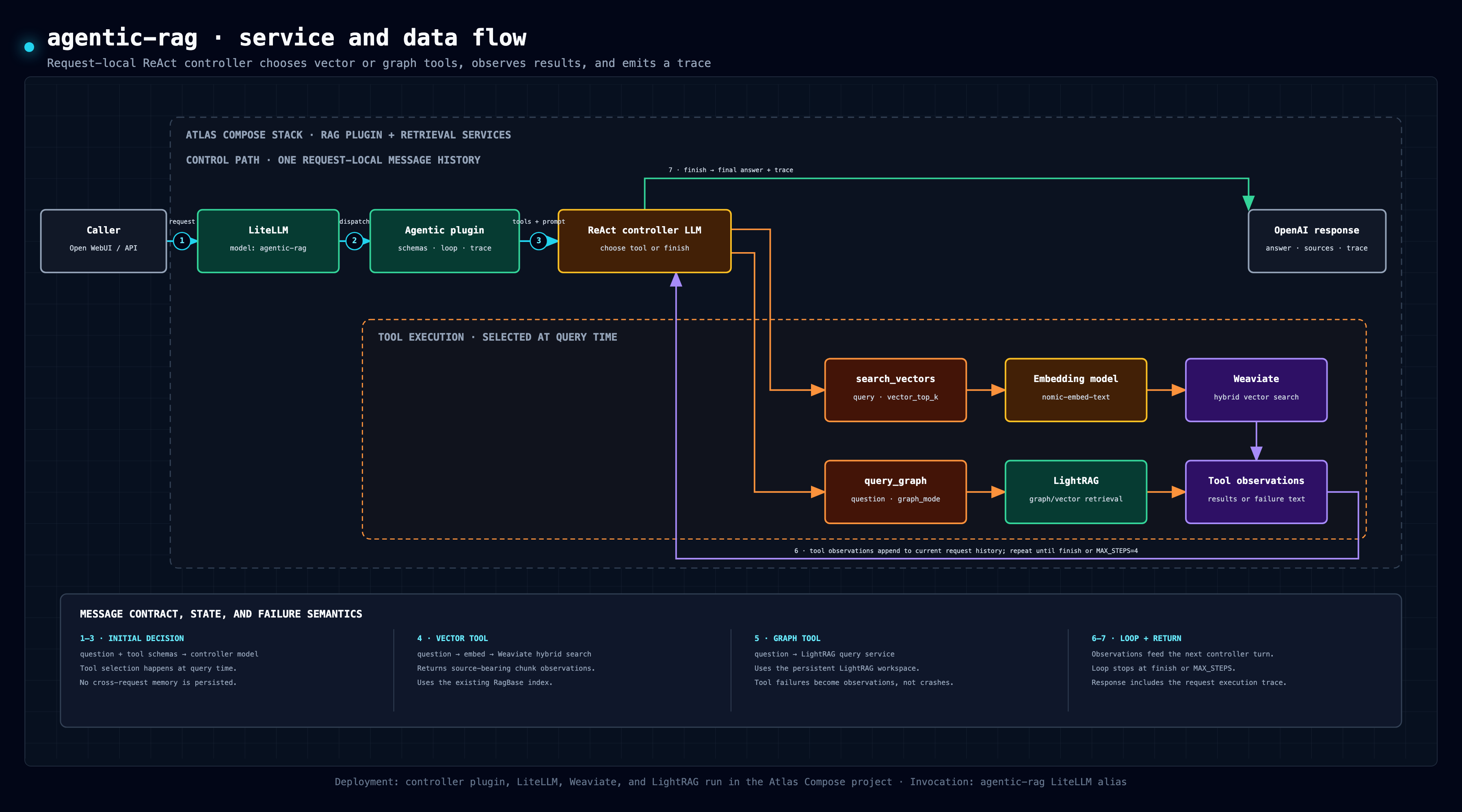
7.3 Internal Steps
- Start with a system prompt telling the model to gather evidence before answering.
- Give the model two tools:
search_vectors(query): hybrid search overRagBase_<profile>.query_graph(query): LightRAG query in hybrid mode.- Run up to
MAX_STEPS=4model turns. - For each tool call, execute the tool and append an observation.
- Stop when the model returns an answer with no tool calls.
- If the loop exhausts, return the explicit MAX_STEPS fallback.
- Include the tool trace as the source block.
7.4 Dependencies
- LiteLLM chat route for
agentic. - LiteLLM embeddings for vector tool calls.
- Atlas-ingested Weaviate
RagBase_<profile>. - LightRAG for graph tool calls.
7.5 Models Used
- Agent controller:
agenticrole, defaultqwen3.8:latest. - Vector tool embedding:
embedrole, defaultnomic-embed-text. - Graph tool: LightRAG EXTRACT, KEYWORD, and QUERY use Atlas's
thinking-disabled
qwen3.8:latestsetup default. - External evaluation: Atlas scores eligible tool evidence through the Ragas endpoint; the manifest-configured judge panel scores stored answers separately.
7.6 Tuning Surface
| Knob | Current value | Exposed as env? | Notes |
|---|---|---|---|
MAX_STEPS |
4 | Via flavor | Major quality limiter; overridable via max_steps (e.g. agentic-rag-deeper uses 8). |
| Vector tool candidate count | 5 | Via flavor | Default 5; overridable via vector_top_k (e.g. agentic-rag-deeper uses 8). |
| Graph tool mode | hybrid |
Via flavor | Default hybrid; overridable via graph_mode. |
| Tool descriptions | fixed | No | Affects model's routing/tool choice. |
| System prompt | fixed | No | Affects whether it searches, answers early, or loops. |
| Agent model | roles.yaml agentic |
Yes, via roles file | Larger/cheaper/non-reasoning choices change behavior. |
7.7 Observed Behavior
The agent occasionally won individual multi-step questions, but the hard step limit caused frequent incomplete answers. It also became the slowest approach on graph-native because each tool loop adds model/tool calls.
8. n8n-adaptive-rag
8.1 Purpose
n8n-adaptive-rag demonstrates low-code routing. It classifies the query as simple
or complex, sends it to another approach, then normalizes the response.
8.2 Service and Data Flow
Open the full-resolution interactive diagram
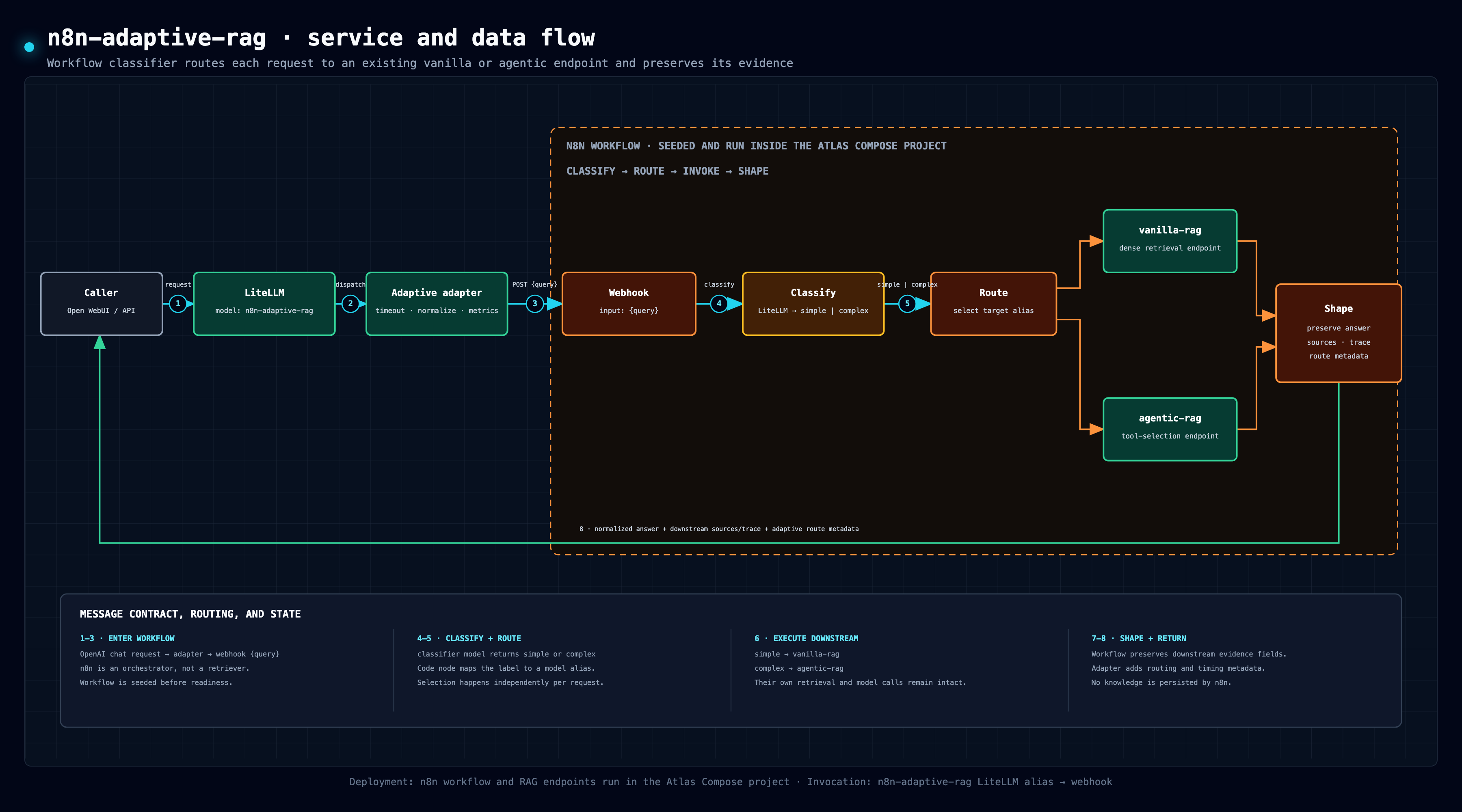
8.3 Internal Steps
- The plugin POSTs
{ "query": ... }to the n8n production webhook. - n8n calls LiteLLM to classify the query as
simpleorcomplex. - The workflow routes:
simple->vanilla-ragcomplex->agentic-rag- n8n calls the selected backend approach route.
- n8n shapes
{ answer, route, approach, rag_showcase }, preserving the delegated route's structured evidence. - The plugin wraps that response, counts the classifier call, and records route metadata separately from delegated grounding contexts.
8.4 Dependencies
- n8n container and active
adaptive-ragworkflow. - LiteLLM from inside n8n for classification.
- Atlas backend approach routes.
8.5 Models Used
- Workflow classifier:
qwen3.8:latestinn8n/adaptive-rag.workflow.json. - Downstream answer model: inherited from the selected route. In the current
workflow,
simpleroutes tovanilla-ragandcomplexroutes toagentic-rag. - External evaluation: Atlas scores normalized downstream contexts when available; the manifest-configured judge panel scores stored answers separately.
8.6 Tuning Surface
| Knob | Current value | Exposed as env? | Notes |
|---|---|---|---|
| Webhook URL | http://n8n:5678/webhook/adaptive-rag |
Yes, N8N_ADAPTIVE_WEBHOOK_URL |
Plugin wrapper setting. |
| Classifier model | qwen3.8:latest |
Workflow JSON | Change in n8n/adaptive-rag.workflow.json. |
| Classifier prompt | fixed | Workflow JSON | Determines simple/complex routing. |
| Route map | simple -> vanilla, complex -> agentic | Workflow JSON | Could route graph-native questions to hybrid or graph instead. |
| Approach-call timeout | 175000 ms | Workflow JSON | Workflow HTTP node timeout. |
| Workflow activation/import | startup script | Yes, via checked-in workflow | start-all.sh imports active workflow and restarts n8n. |
8.7 Observed Behavior
Its latency depends on the classifier's route and cache state: it averaged 2.80, 5.30, and 11.07 seconds. It is not a better retriever by itself; its quality is bounded by the classifier and selected downstream route.
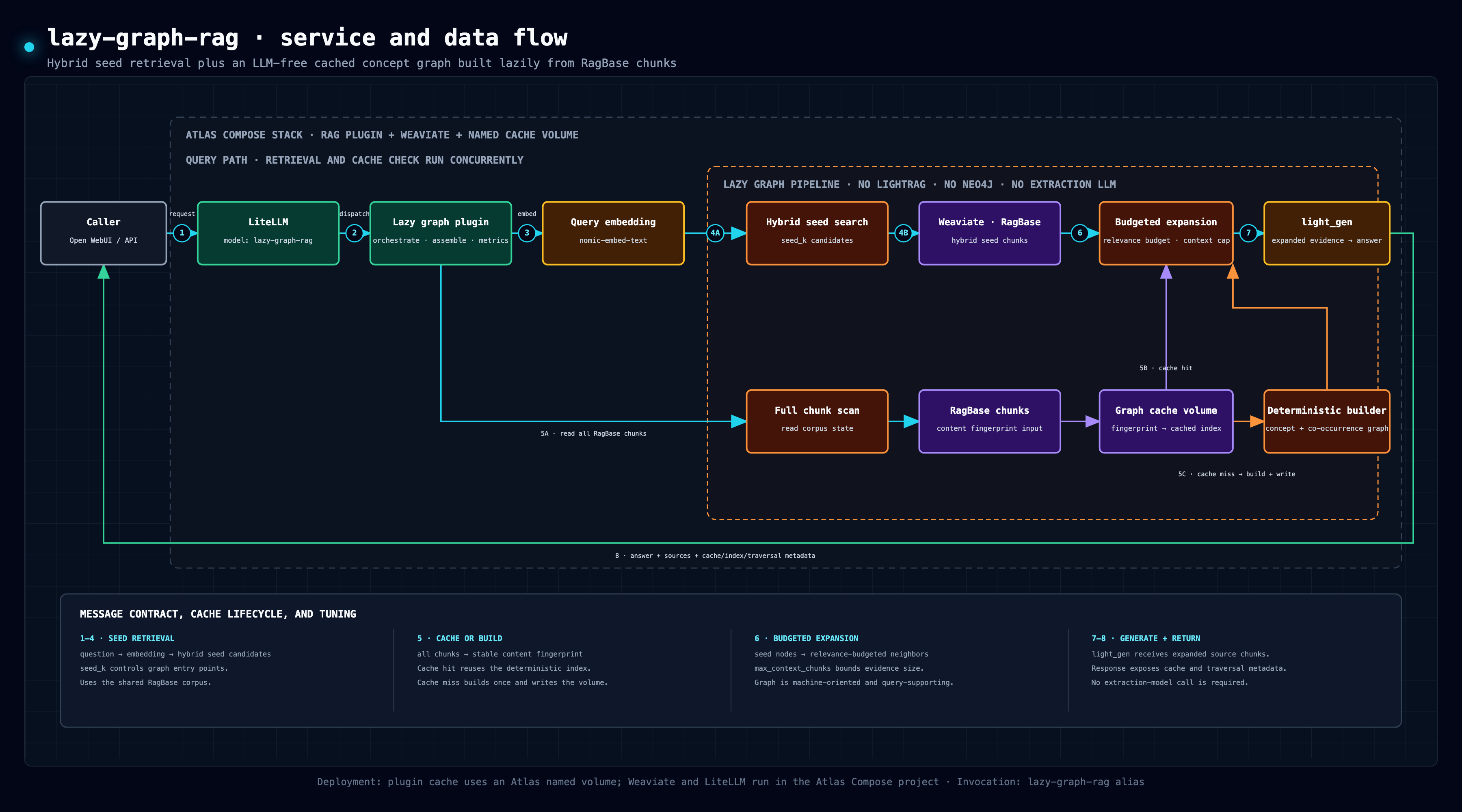
9. Experimental lazy-graph-rag
9.1 Purpose
lazy-graph-rag is a seventh, explicitly selected prototype. It builds a
deterministic concept/co-occurrence graph from the existing RagBase chunks,
uses hybrid vector retrieval for seeds, expands concepts under a hard relevance
budget, and performs one shared light_gen call over the selected chunks. It
does not use LightRAG or Neo4j and it makes no LLM calls while indexing.
The graph is persisted in a named Compose volume and invalidated by a corpus
content fingerprint. Fast, balanced, and wide flavors tune
relevance_budget, seed_k, max_context_chunks, and graph density. It is
excluded from the six canonical defaults but was selected explicitly in the
2026-07-17 ladder. It tied for third on baseline, ranked first on graph-native,
and tied for second on cyber-threat data. See
lazy-graph-rag.md for its full design, phases, metadata
contract, limitations, and measured results.
9.2 Service and Data Flow
Open the full-resolution interactive diagram
10. Cross-Approach Comparison
| Question | Best current answer |
|---|---|
| Cheapest useful baseline? | vanilla-rag |
| Best current default? | contextual-rag |
| Best measured graph-native aggregate? | hybrid-rag-high-recall flavor; contextual-rag among canonical defaults |
| True knowledge-graph path? | graph-rag |
| Best place to test tool-use/multi-hop planning? | agentic-rag |
| Best low-code routing demonstration? | n8n-adaptive-rag |
| Experimental LLM-free graph expansion? | lazy-graph-rag (measured, off by default) |
11. Tuning Priorities
The current results are a measured baseline, not the end of the search space. The highest-leverage tuning work is:
- Keep
graph-rag-rerankopt-in: it improved judge score on the cyber rung but increased latency and reduced answer relevancy; the measured tradeoff does not justify making it the canonical default. - Sweep
hybrid-ragandcontextual-ragretrieve_k,top_n, and hybridalphaby dataset — all already flavor-overridable. - Sweep
agentic-ragmax_stepsandvector_top_k(already flavor-overridable) and improve the tool prompt. - Tune the n8n route map so graph-native queries can route to
hybrid-ragorgraph-rag, not onlyvanilla-ragoragentic-rag. - Treat chunk size/overlap and contextual blurb model/prompt as dataset-level tuning variables.