6.3. Command Families
6.3.1. When To Use It
Use the command family when behavior should be executable, bindable, and reactively re-evaluated without baking that behavior into the VM hierarchy itself.
Start with RelayCommand; add composition or confirmation only when the
workflow needs it.
6.3.2. Shape And Ownership
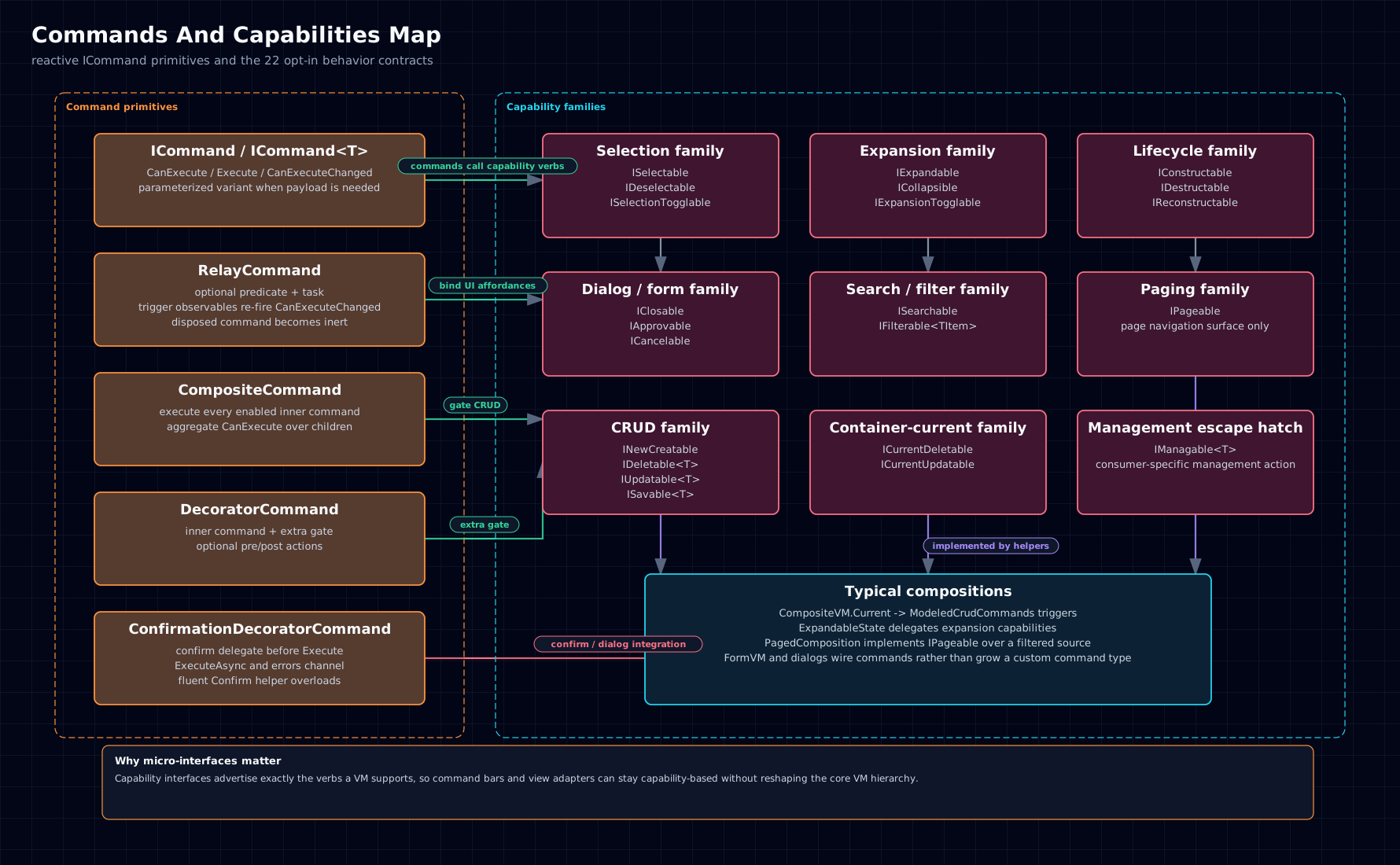
The shipped command surface breaks down into a few layers:
RelayCommand, parameterizedRelayCommand<T>, andAsyncRelayCommand- decorators:
CompositeCommand,DecoratorCommand,ConfirmationDecoratorCommand - fluent helpers:
Confirm,PrecedeWith,SucceedWith,WrapWith ModeledCrudCommandsfor selection-driven create/update/delete bundles
Commands own their predicates, tasks, trigger subscriptions, and disposal inertness. They do not own VM lifecycle.
The fluent helpers apply to any command, so each one's result chains further.
In Rust they come from the CommandExt trait (use vmx::CommandExt;), which
every Command + Clone + 'static implements; RelayCommand keeps the same
methods inherently, so its existing calls need no import. A command that is not
Clone, or an Arc<dyn Command>, uses the helpers through an Arc. Pass
NO_PREDICATE or NO_HOOK for an absent wrap_with argument:
use vmx::{AsyncValue, CommandExt, NO_HOOK, NO_PREDICATE};

let command = save
    .confirm(|| AsyncValue::ready(true))
    .wrap_with(NO_PREDICATE, Some(begin_busy), Some(end_busy))
    .succeed_with(refresh);
Each helper moves its receiver into the wrapper it returns; VMx command clones share state, so keep a clone to keep using the receiver directly.
AsyncRelayCommand is also a base command in every flavor (IAsyncCommand :
ICommand), so it can be stored wherever a command is expected and wrapped by the
composite and decorator commands. Through that base surface, Execute starts
fire-and-forget execution without waiting for the async body; failures surface on
the command's error channel. In Rust this is impl Command for AsyncRelayCommand,
usable as Arc<dyn Command> or as the inner command of DecoratorCommand and
ConfirmationDecoratorCommand.
Rust's error channel is error_stream(), a hot CommandErrorStream that
delivers each fire-and-forget failure once as the original VmxError and
completes on disposal. A panic caught by ConfirmationDecoratorCommand arrives
as VmxError::Other carrying the panic message, because a panic payload is not a
clonable error; execute_async().join() still returns the payload itself. The
older errors() hubs carry only an "error" marker and are deprecated
(ADR-0137). A confirmation AsyncValue produced by a panicking map or
and_then callback ends execute_async().join() with that panic instead of
blocking, and fire-and-forget execute publishes it on error_stream()
(ADR-0138).
6.3.3. Lifecycle And Messaging
Commands become interesting when triggers are involved:
- predicates are pure gates for
CanExecute - tasks run only when predicates allow execution
- trigger emissions force re-evaluation and raise
CanExecuteChanged - imperative raise methods notify bindings when a predicate depends on non-observable host state
- disposed commands, including composite, decorator, and confirmation wrappers,
become inert and report
CanExecute == false - fire-and-forget confirmation flows surface asynchronous failures on an error observable instead of swallowing them
Repeated command disposal, including during an in-flight async operation, follows the Disposal Contract: cancellation and terminal completion occur at most once.
A disposed wrapper also admits no inner work that has not started yet. A
composite runs no later child after one of its children disposes it. A
decorator disposed by its predicate or pre-action skips the inner command, but
once the pre-action has run, its post-action still runs exactly once. A
confirmation that resolves after disposal, whether it confirms, declines, or
fails, runs nothing and emits nothing on errors. Wrappers never dispose their
inner commands, which stay owned by their creator (ADR-0134).
6.3.4. Cross-Language Surface
Representative naming differences:
| Concept | C# | Python | TypeScript | Swift | Rust |
|---|---|---|---|---|---|
| Builder entry | RelayCommand.Builder() |
RelayCommand.builder() |
RelayCommand.builder() |
RelayCommand.builder() |
RelayCommand::builder() |
| Trigger setter | Triggers(...) |
triggers(...) |
triggers(...) |
triggers(...) |
trigger(...) |
| Imperative raise | RaiseCanExecuteChanged() |
raise_can_execute_changed() |
raiseCanExecuteChanged() |
raiseCanExecuteChanged() |
raise_can_execute_changed() |
| Confirm helper | extension Confirm(...) |
confirm(...) helper |
confirm(...) helper |
confirm(...) helper |
confirm(...) |
6.3.5. Triggers Or Imperative Raise?
Use a trigger when the predicate dependency already has an observable stream.
The command owns that subscription and every trigger emission publishes one
CanExecuteChanged notification.
Use the imperative method when host state changes through a non-observable API, or when a binding adapter explicitly knows that a predicate may have changed. The method publishes one notification only: it does not call the predicate, execute the task, or start an async command.
isDirty = true;
saveCommand.RaiseCanExecuteChanged();
is_dirty = True
save_command.raise_can_execute_changed()
isDirty = true;
saveCommand.raiseCanExecuteChanged();
isDirty = true
saveCommand.raiseCanExecuteChanged()
is_dirty.store(true, Ordering::SeqCst);
save_command.raise_can_execute_changed();
Repeated calls and trigger emissions remain additive. The same operation is available on parameterized and async relay commands, including while an async execution is in flight. Calls after disposal are safe no-ops.
The operation belongs to concrete relay commands. CompositeCommand and the
decorators forward inner CanExecuteChanged notifications but do not expose a
synthetic raise method. Retain the owning relay reference when decorating a
command that needs imperative invalidation.
6.3.6. Example
Canonical relay-command shape:
const save = RelayCommand.builder()
  .predicate(() => form.isDirty && form.isValid)
  .task(() => {
    void form.approveAsync();
  })
  .triggers(currentChanged)
  .build();
The same normative command structure appears across all catalog-complete source flavors with casing and trait-import changes. Rust's command-disposal and thread-free confirmation convergence is recorded in the completed Rust parity ledger. The Notes Workspace editor and delete flows are concrete examples.
6.3.7. Common Pitfalls
- Depending on mutable state in
CanExecutewithout a trigger that raisesCanExecuteChangedor an explicit imperative raise at the mutation site. - Polling every command on every UI render instead of subscribing to
CanExecuteChangedand invalidating only when the predicate may have changed. - Swallowing async confirmation or approve failures instead of observing their error channels.
- Re-implementing pre/post/confirm composition manually instead of using the decorator and fluent surfaces.