6.2.7. Forwarding & Wrapper Family
6.2.7.1. When To Use It
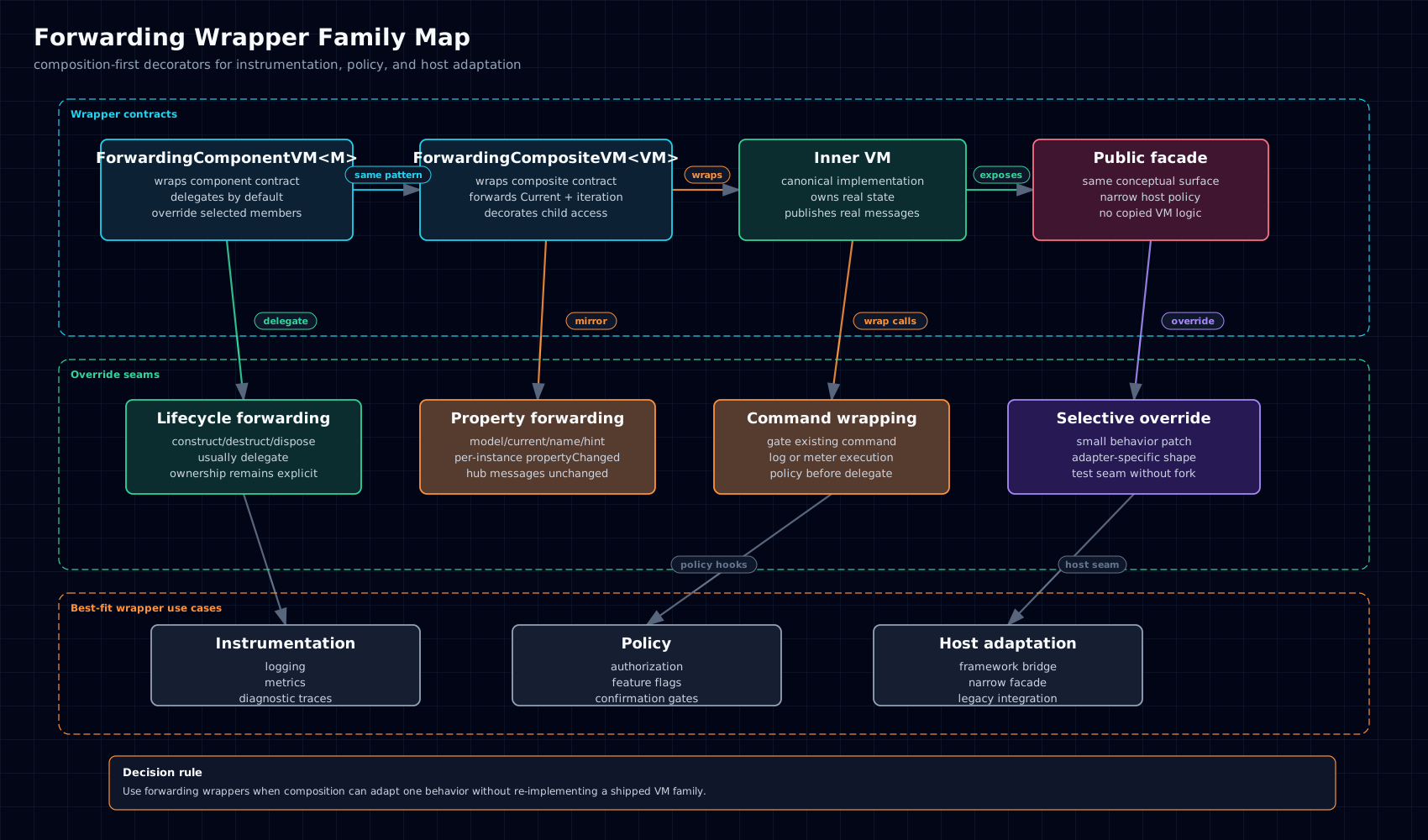
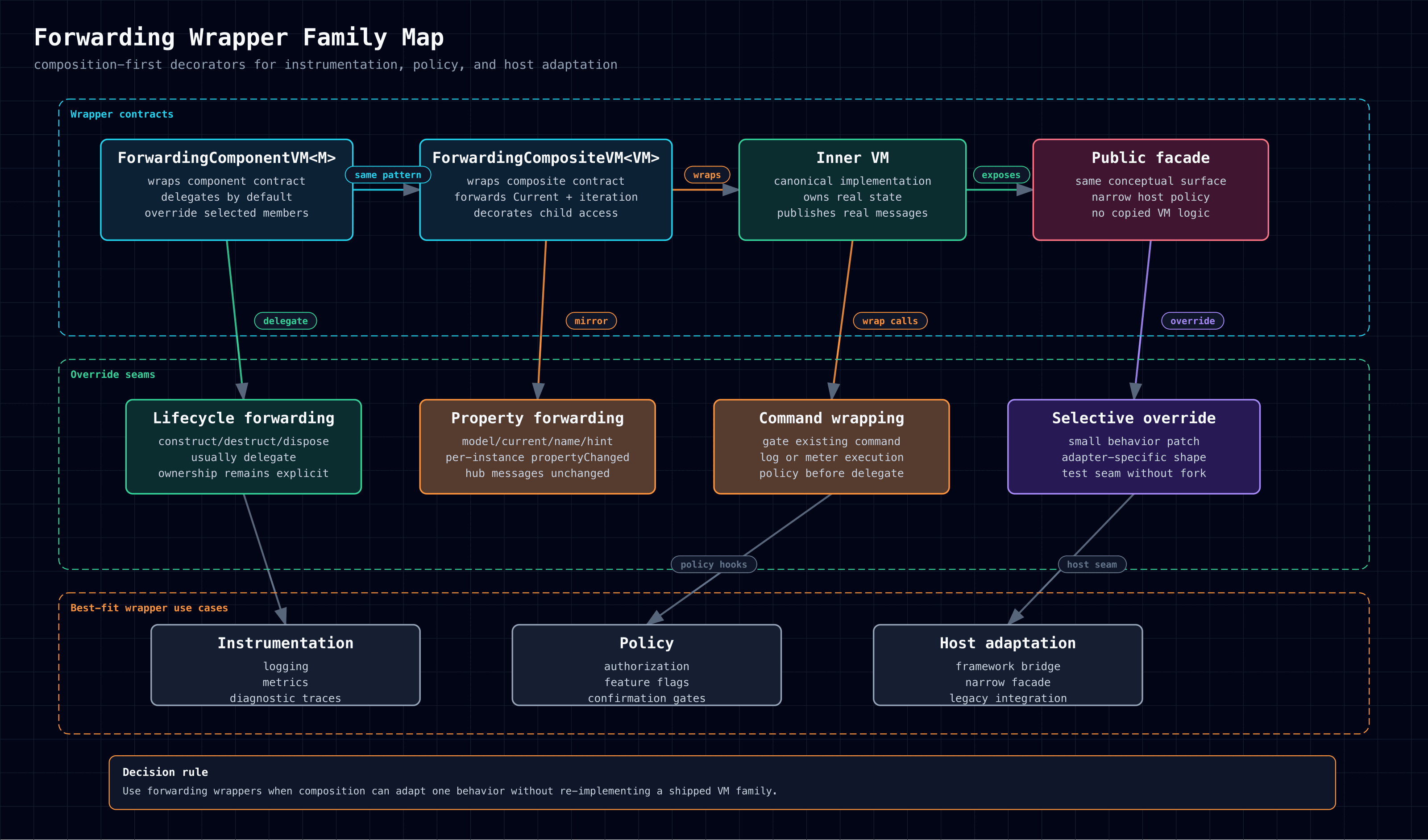
Use forwarding wrappers when you need to instrument, adapt, or selectively override a shipped VM without rewriting its whole surface. Logging, policy checks, caching, and host-specific decoration are the common cases.
6.2.7.2. Shape And Ownership
VMx ships two forwarding families:
ForwardingComponentVM<M>around a component-shaped inner VMForwardingCompositeVM<VM>around a composite-shaped inner VM
By default every property, method, command, and iterator call delegates to the wrapped instance. You override only the members you need to change.
The wrapped component and every decorator around it have one canonical
ownership identity. Adding a decorator to a composite or group first removes
the wrapped identity from its previous container, even when that container
retained the bare component or a different decorator. The destination retains
the exact decorator it was given. This makes decoration transparent to
lifecycle and selection ownership without hiding which public child a consumer
added (FWD-004, ADR-0124).
6.2.7.3. Lifecycle And Messaging
Forwarding decorators do not add their own lifecycle semantics. They inherit the inner VM's behavior unless an override changes it. In practice this means:
- property-changed and status behavior still originate from the wrapped VM
- iteration over forwarded composites still reflects the wrapped child list
dispose()should usually forward so lifetime ownership remains explicit
6.2.7.4. Cross-Language Surface
| Concept | C# | Python | TypeScript | Swift | Rust |
|---|---|---|---|---|---|
| Component wrapper | ForwardingComponentVM<M> |
ForwardingComponentVM[M] |
ForwardingComponentVM<M> |
ForwardingComponentVM<Model> |
ForwardingComponentVm<M> |
| Composite wrapper | ForwardingCompositeVM<VM> |
ForwardingCompositeVM[VM] |
ForwardingCompositeVM<VM> |
ForwardingCompositeVM<Child> |
ForwardingCompositeVm<VM> |
| Canonical wrapped contract | IComponentVM<M> / ICompositeVM<VM> |
component/composite protocols | component/composite base shapes | component/composite base classes | component/composite traits and stable IDs |
6.2.7.5. Example
The key design point is that the wrapper changes behavior by composition, not by copying or re-implementing the wrapped VM:
private sealed class HintOverrideVM : ForwardingComponentVM<string>
{
    public HintOverrideVM(IComponentVM<string> inner) : base(inner) { }
    public override string Hint => "OVERRIDE";
}
class HintOverrideVM(ForwardingComponentVM[str]):
    @property
    def hint(self) -> str:
        return "OVERRIDE"
class HintOverrideVM extends ForwardingComponentVM<string> {
  override get hint(): string {
    return "OVERRIDE";
  }
}
final class ModeledHintOverrideVM: ForwardingComponentVM<String> {
    override var modeledHint: String { "OVERRIDE" }
}
let inner = ComponentVm::with_model(
    "inner",
    "model",
    MessageHub::new(),
    NullDispatcher::new(),
);
let first = ForwardingComponentVm::new(inner)
    .with_hint_override(|| Some("OVERRIDE".to_string()));
let forwarding = ForwardingComponentVm::wrap(first);

assert_eq!(forwarding.hint().as_deref(), Some("OVERRIDE"));
Swift is the explicit divergence here: name and hint are stored let
properties on ComponentVMBase, so the nearest overridable analog is
modeledHint, not hint.
6.2.7.6. Common Pitfalls
- Re-implementing the entire VM instead of forwarding and overriding the one member that actually differs.
- Forgetting to forward disposal when the wrapper does not own an independent lifetime.
- Treating two decorators around one component as independent children. Adding the later decorator transfers the one canonical wrapped identity.
- Treating forwarding as a new hierarchy root. It is a wrapper around an existing contract, not a separate primitive family.
6.2.7.7. Conformance
FWD-001— transparent member, lifecycle, command, and selection delegationFWD-002— selective override without reimplementing the wrapped surfaceFWD-003— forwarded composite iteration preserves wrapped orderFWD-004— bare and multiply decorated aliases retain one transferable owner