6.2.6. Hierarchical Family
6.2.6.1. When To Use It
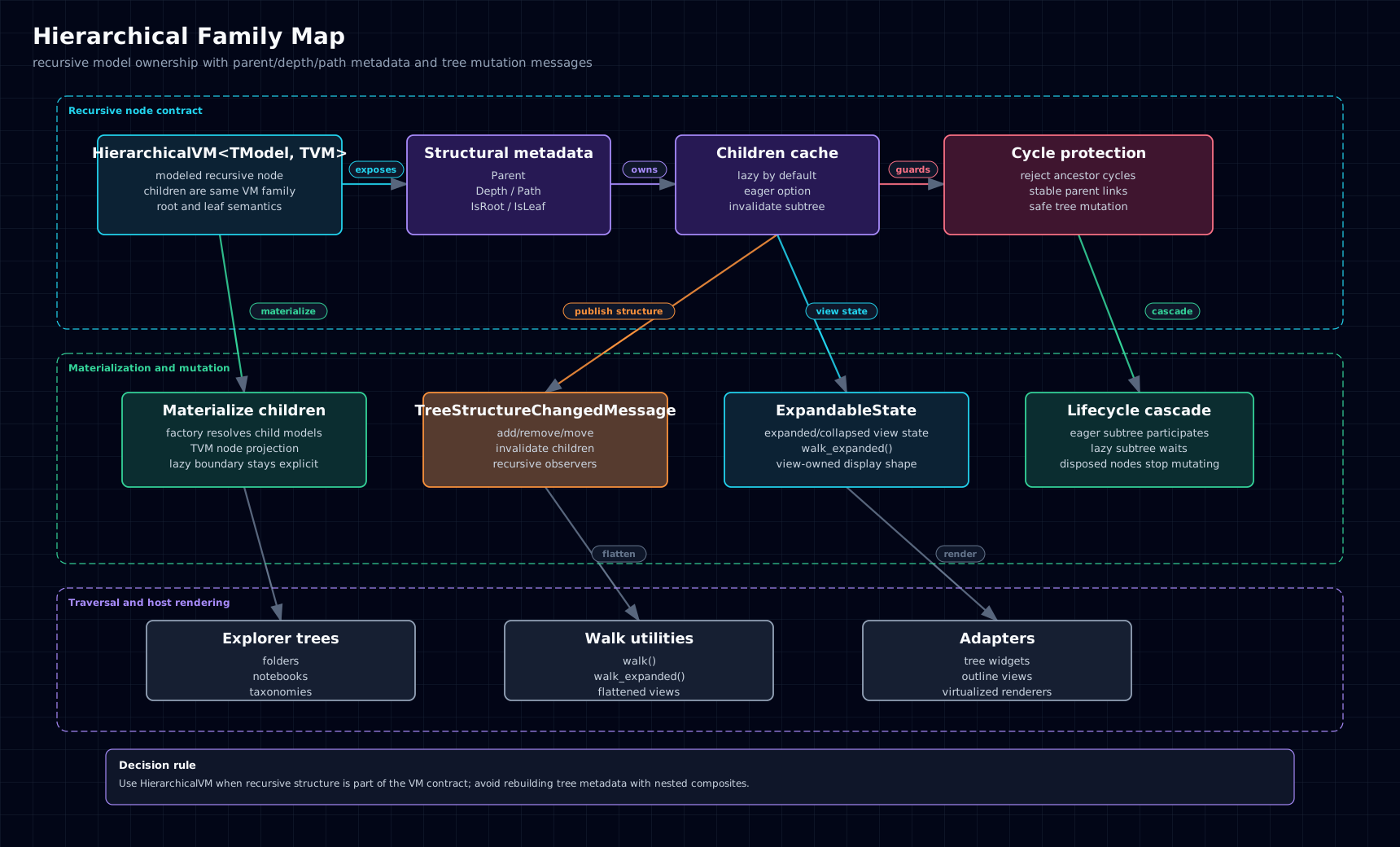
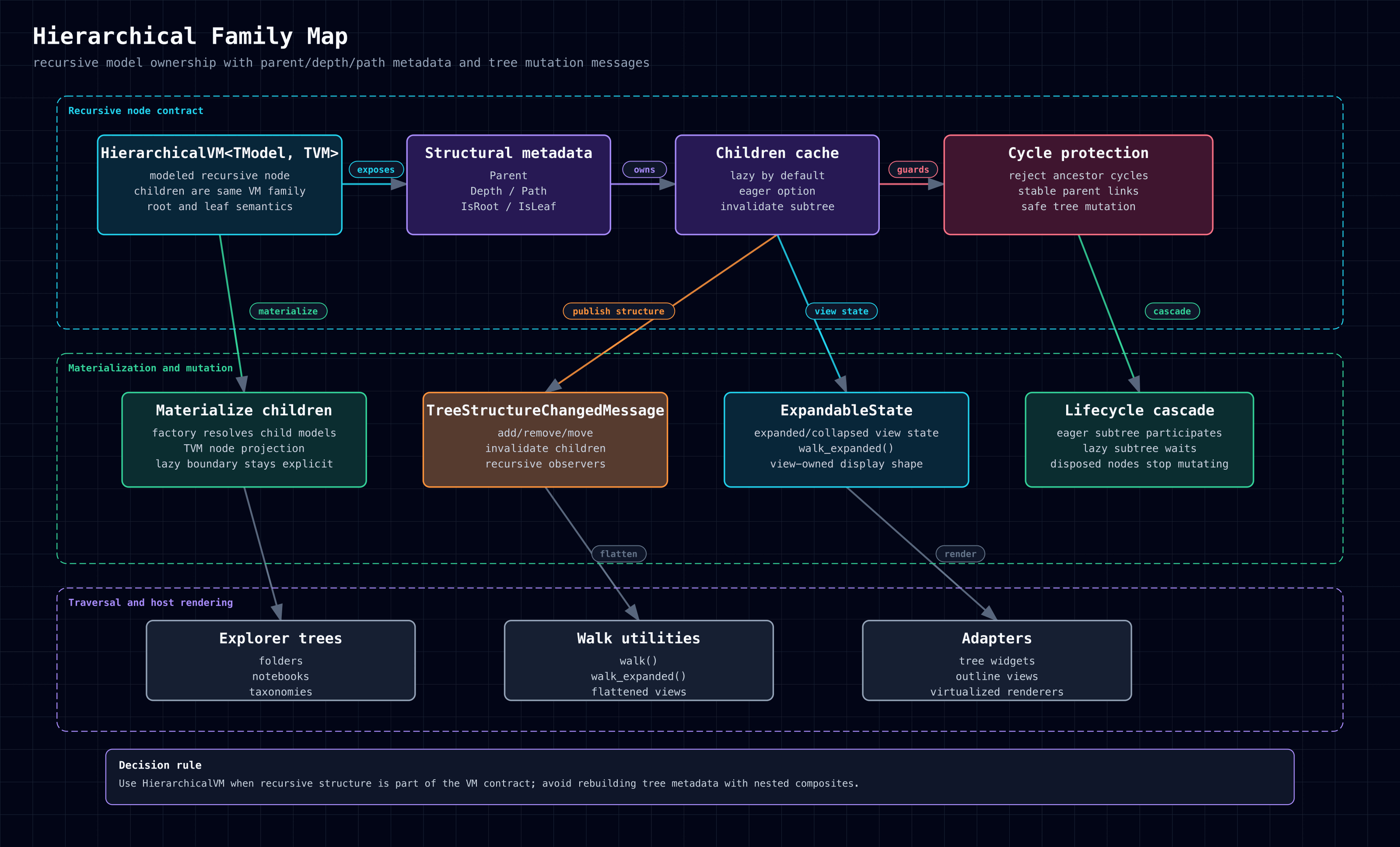
Use HierarchicalVM<TModel, TVM> when the domain is intrinsically recursive:
folders, notebooks, comment threads, taxonomies, or any tree whose nodes need
parent, depth, and path semantics.
This family exists so you do not have to manually recurse a CompositeVM and
rebuild tree bookkeeping in every app.
6.2.6.2. Shape And Ownership
A hierarchical node owns:
- its
Model - its recursive
Children - structural metadata such as
Parent,Depth,Path,IsRoot, andIsLeaf
Children are lazy by default and can be materialized eagerly where the host needs the whole tree available during construct.
The structural root also owns a small pending set for attachMany batch
hydration. Pending nodes are not part of Children until their selected parent
is materialized.
6.2.6.3. Lifecycle And Messaging
The important differences from manual recursive composites are:
- eager trees construct depth-first across the full subtree
- lazy children do not participate until materialized
- structural mutations publish
TreeStructureChangedMessage - cache invalidation publishes property-changed for the children property
The family integrates directly with walk and walk_expanded.
6.2.6.4. Progressive Batch Hydration
Use attachMany / AttachMany / attach_many when windows can overlap or
arrive out of order. The consumer supplies the domain key and parent-key
selectors; VMx owns fixpoint ordering, deduplication, orphan policy, and the
existing parent/path/message invariants.
const result = canvasRoot.attachMany(windowNodes, {
  keyOf: (node) => node.model.id,
  parentKeyOf: (node) => node.model.parentId, // null means canvasRoot
  onMissingParent: MissingParentPolicy.Park,
});

for (const rejection of result.rejections) {
  diagnostics.record(rejection.item, rejection.reason);
}
The root indexes only itself and already-materialized descendants, so batch attachment never expands a lazy subtree just to search for a parent. It scans the active nodes to a fixpoint: a parent added later in the input unlocks its earlier children on the next pass, while sibling order remains the original input order.
The result separates added, duplicates, orphans, and typed rejections.
Same-key nodes never replace an existing VM. park retains only genuine
missing-parent items for the next call; reject returns them without retaining
them. Cycles, already-attached nodes, and selector/attachment failures are
terminal structured results rather than batch-stopping exceptions. Disposing
the root clears its parked set.
6.2.6.5. Tableau Pilot Result
The issue's motivating Tableau helper was piloted in a temporary clone at
0b53010065f71277d5c3504120e23442a46e30cb, using the local VMx 3.8 source and
without pushing any Tableau change. The pilot used real HexNode instances,
passed the @tableau/view-model typecheck, and passed all 8 canvas plus 5
progressive-load tests.
The measurement corrects the proposal's optimistic “about 10 lines remain” estimate:
| Measurement | Existing helper | VMx pilot |
|---|---|---|
| Total function lines | 49 | 55 |
| Nonblank function lines | 47 | 51 |
Direct attachMany configuration lines |
— | 4 |
VMx removes the hand-written fixpoint and identity-key replacement logic, but
Tableau still needs domain adaptation for four facts that the generic tree
primitive must not own: its canvas is a forest held by CompositeVM, coordinate
uniqueness is independent of cell ID, persisted parent IDs may resolve through
an alias, and fetched documents must become registered/constructed HexNode
instances. Those account for roughly 47 nonblank domain/integration lines in
the pilot. Adopting a single synthetic hierarchy root could reduce that adapter,
but would change Tableau's public root/path semantics and was deliberately not
performed in an external repository.
6.2.6.6. Cross-Language Surface
| Concept | C# | Python | TypeScript | Swift | Rust |
|---|---|---|---|---|---|
| Core type | HierarchicalVM<TModel, TVM> |
HierarchicalVM[TModel, TVM> |
HierarchicalVM<TModel, TVM> |
HierarchicalVM<TModel, TVM> |
HierarchicalVm<M> |
| Builder | HierarchicalVMBuilder<TModel, TVM> |
HierarchicalVMBuilder[TModel, TVM> |
HierarchicalVMBuilder<TModel, TVM> |
HierarchicalVM<TModel, TVM>.builder() |
HierarchicalVm::builder() |
| Eager flag | EagerChildren(true) |
eager_children(True) |
eagerChildren(true) |
eagerChildren(true) |
eager_children(true) |
| Invalidate subtree | InvalidateSubtree() |
invalidate_subtree() |
invalidateSubtree() |
invalidateSubtree() |
invalidate_subtree() |
| Batch attach | AttachMany(...) |
attach_many(...) |
attachMany(...) |
attachMany(...) |
attach_many(...) |
| Root parent key | BatchParentKey<TKey>.Root |
None |
null |
nil |
None |
| Parked count | ParkedAttachCount |
parked_attach_count |
parkedAttachCount |
parkedAttachCount |
parked_attach_count() |
6.2.6.7. Example
The current Notes Workspace examples do not subclass HierarchicalVM in
any flavor. Each NotebooksRootVM owns a flat notebook collection plus
roots / childrenOf / walk projections and republishes
TreeStructureChangedMessage, which gives the host tree-shaped state without
making the VM itself a recursive node tree.
Use HierarchicalVM when the VM graph should actually be recursive:
These concise examples show the canonical builder path per flavor. C#, Swift,
and TypeScript supply a TestNode factory for their concrete recursive node;
Python can build plain HierarchicalVM directly and uses vm_factory(...) only
when a subclass is required.
var root = HierarchicalVMBuilder<string, TestNode>.Empty
    .Model("root")
    .ChildrenFactory(_ => Array.Empty<TestNode>())
    .Services(hub, dispatcher)
    .VmFactory(ctx => new TestNode(
        ctx.Model, ctx.ChildrenFactory, ctx.Hub, ctx.Dispatcher,
        ctx.Name, ctx.Hint, ctx.EagerChildren))
    .Build();
root = (
    HierarchicalVMBuilder()
    .model("root")
    .children_factory(lambda _parent: [])
    .services(hub, dispatcher)
    .build()
)
const root = new HierarchicalVMBuilder<string, TestNode>()
  .model("root")
  .childrenFactory((_parent) => [])
  .services(hub, dispatcher)
  .vmFactory((ctx) => new TestNode(ctx))
  .build();
let root = try HierarchicalVM<String, TestNode>.builder()
    .model("root")
    .childrenFactory { _ in [] }
    .services(hub: hub, dispatcher: dispatcher)
    .vmFactory { model, childrenFactory, hub, dispatcher, name, hint, eager in
        TestNode(
            model: model,
            childrenFactory: childrenFactory,
            hub: hub,
            dispatcher: dispatcher,
            name: name,
            hint: hint,
            eagerChildren: eager
        )
    }
    .build()
That split is the practical rule: use the tree primitive when the tree is real, not simply because the UI displays indentation.
6.2.6.8. Common Pitfalls
- Recursing
CompositeVMinstead of using the tree primitive and then having to rebuildParent,Depth, andPathyourself. - Expecting lazy children to exist during construct without materializing them.
- Treating cache invalidation as structural mutation. It is a refresh contract, not an add/remove event.
- Reparenting a node under itself or its descendants. The contract rejects these cycles.
- Using a mutable or call-dependent batch key selector. Parked nodes are retried with the next call's selectors, so key semantics must stay stable.
- Treating
parkas a general retry queue. Only missing-parent items park; duplicates, cycles, and invalid links are terminal results.