3. Lakehouse Architecture
data-eng-lab runs an Apache Iceberg lakehouse on MinIO, cataloged by an Iceberg REST catalog with a Postgres backend. All data lives in S3-compatible object storage; compute (Spark, Trino) accesses data through the catalog.
The lakehouse follows the medallion pattern: bronze (raw landing) → silver (clean, deduplicated, validated) → gold (business-level aggregated marts). Iceberg's ACID transactions, time travel, Write-Audit-Publish branches, and system procedures enable zero-downtime schema evolution and data maintenance across all three layers.
The platform is orchestrated by Airflow, orchestrated from notebooks (Jupyter/PySpark and Zeppelin/Scala Spark), queried via Trino BI, and extended with streaming through Redpanda (Kafka API).
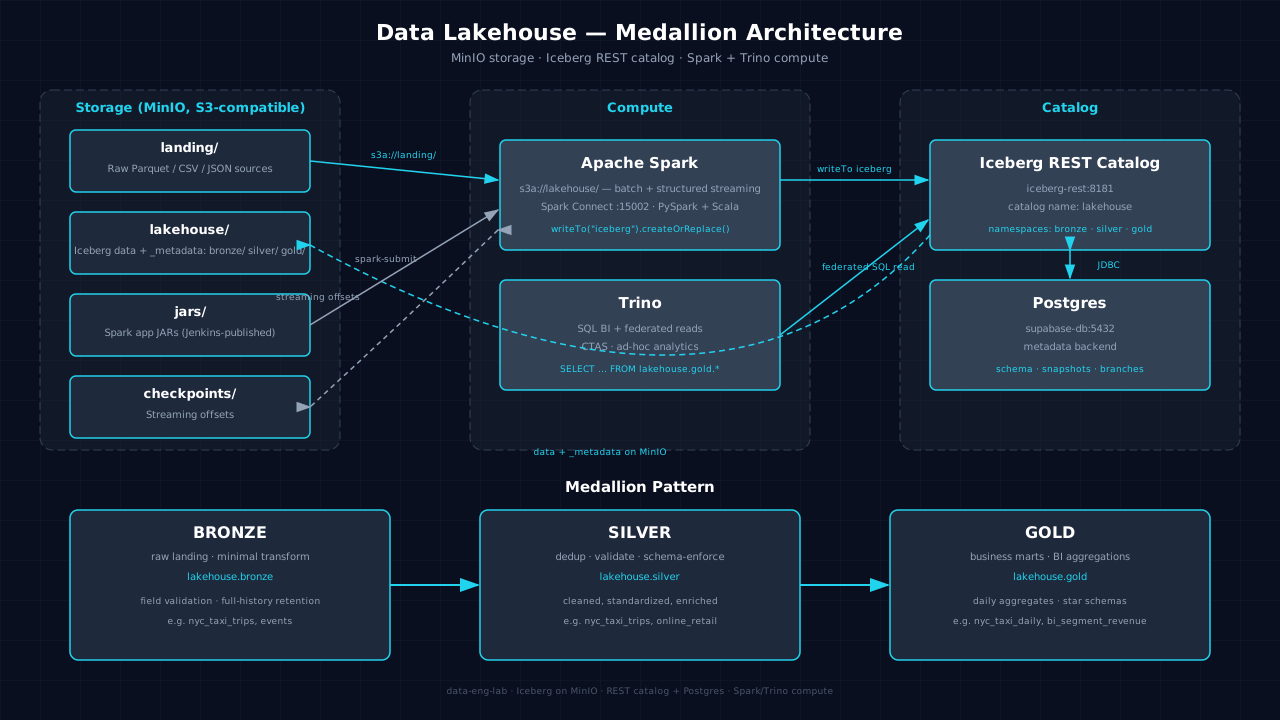
1. Storage Layer
All data persists in MinIO, an S3-compatible object storage service. MinIO provides four dedicated buckets:
| Bucket | Purpose |
|---|---|
landing/ |
Raw dataset files from external sources (NYC Taxi Parquet, MovieLens CSV, GH Archive JSON, TPCH Parquet). Ingested via make datasets or external producers. |
lakehouse/ |
Iceberg table data and metadata. Contains bronze/, silver/, and gold/ directories. Each table has a Parquet data directory and Iceberg _metadata + snapshot files. |
jars/ |
Compiled Spark application JARs (e.g. nyc-taxi-etl/0.1.0/app.jar). Published by Jenkins CI. Consumed by Airflow DAGs via spark-submit. |
checkpoints/ |
Structured streaming checkpoint state. The checkpoint retention runbook defines exact ownership, leases, manual-only reviewed exact-leaf deletion, and the disabled automatic-scheduling boundary from issue #86. |
Spark clients address storage as s3a://lakehouse/ (S3A scheme); the REST catalog backend uses s3://lakehouse/ (native S3).
2. Catalog
The Iceberg REST catalog (iceberg-rest:8181) is backed by a Supabase Postgres database. It stores table metadata (schema, partition spec, snapshots, branch info) in Postgres while the actual data lives on MinIO.
- Catalog name:
lakehouse - JDBC connection:
jdbc:postgresql://supabase-db:5432/iceberg - Catalog type: REST (Iceberg 1.11.0)
- Namespaces:
bronze,silver,gold
The Iceberg REST catalog is built from apache/iceberg-rest-fixture:1.10.1 with the Postgres JDBC driver layered onto the classpath.
3.2.1 Namespaces
| Namespace | Purpose | Contains |
|---|---|---|
lakehouse.bronze |
Raw landing, minimal transformation | nyc_taxi_trips, events, gh_events, stream_events, windowed_events |
lakehouse.silver |
Deduplicated, validated, schema-enforced | nyc_taxi_trips (cleaned), gh_events_flattened, online_retail, online_retail_cdc |
lakehouse.gold |
Business marts, BI-ready aggregations | nyc_taxi_daily, bi_segment_revenue, ml_user_features, ml_movie_features, trino_payment_summary |
Namespaces are not pre-seeded by Atlas. They are created at bootstrap by scripts/register_iceberg.py (idempotent — safe to re-run). Apps may also self-create namespaces with CREATE NAMESPACE IF NOT EXISTS.
3. The Medallion Pattern
3.3.1 Bronze
The bronze layer is the raw ingestion layer. Data is loaded from the landing bucket with minimal cleaning — only field-level validation (e.g. dropping rows with null fare amounts), compatibility normalization required for a stable table schema (the NYC Taxi passenger_count field is canonicalized to double before files are unioned), and column addition (e.g. trip_date, ingested_at). Bronze tables preserve the full historical record and form the foundation for all downstream processing.
Examples: nyc_taxi_trips (raw taxi trips), events (real-time Kafka stream), gh_events (file-source streaming), gh_events_flattened (flattened JSON from GH Archive).
3.3.2 Silver
The silver layer applies quality rules, deduplication, and schema enforcement. Duplicate rows are removed, inconsistent fields are standardized, and new columns from schema evolution are populated — old rows receive NULLs for newly added columns, maintaining backward compatibility.
Examples: nyc_taxi_trips (deduplicated and validated), gh_events (deduplicated events), online_retail (merged CDC upserts), online_retail_cdc (real-time CDC stream).
3.3.3 Gold
The gold layer contains business-level marts and pre-aggregated metrics. These tables are optimized for BI and analytics queries, with star-schema fact/dimension tables, daily aggregations, and ML feature engineering outputs. They are consumed by Trino for SQL BI, and by ML pipelines via Spark MLlib.
Examples: nyc_taxi_daily (daily trip aggregations), bi_segment_revenue (TPCH revenue by market segment), ml_user_features and ml_movie_features (collaborative filtering features), order_fact + customer_dim (TPCH star schema).
4. Integration Matrix (Preflight Layer 2)
| Client | Capabilities | Storage/Target |
|---|---|---|
| Spark Connect (JupyterHub) | PySpark, PyIceberg, streaming | s3a://lakehouse/ + Iceberg catalog |
| Zeppelin (Scala) | Spark Scala, %trino interpreter for Trino queries |
s3a://lakehouse/ + Iceberg catalog |
| Trino | SQL queries, CTAS, federated reads over Iceberg REST | Reads lakehouse.* tables (bronze/silver/gold) |
| Airflow | SparkSubmitOperator (cluster mode) + RestConfirmingSparkHook adapter, DAG orchestration | s3a://jars/ for JARs, s3a://lakehouse/ for Iceberg |
| Jenkins CI | Maven build, JAR publishing to MinIO | Publishes to s3a://jars/ |
| Spark → Redpanda | Structured Streaming writeStream to Kafka API topics | redpanda:9092 topics |
5. Bronze Smoke Test
Validate the lakehouse is end-to-end operational:
This script loads a landing dataset (NYC Taxi) into lakehouse.bronze.* via Spark Connect, confirming that the full path — MinIO → Spark → Iceberg catalog → MinIO data — is functional.
6. Iceberg Features in Use
| Feature | Scenarios That Use It |
|---|---|
MERGE INTO (upserts/CDC) |
incremental_upsert-online_retail-spark-iceberg, scd2-online_retail-spark-iceberg, cdc_streaming-online_retail-spark-iceberg |
Snapshots / VERSION AS OF |
time_travel-nyc_taxi-spark-iceberg |
Rollback (system.rollback_to_snapshot) |
time_travel-nyc_taxi-spark-iceberg |
| Branch/tag (WAP) | time_travel-nyc_taxi-spark-iceberg |
system.rewrite_data_files (compaction) |
table_maintenance-nyc_taxi-spark-iceberg |
system.expire_snapshots |
table_maintenance-nyc_taxi-spark-iceberg |
system.remove_orphan_files |
table_maintenance-nyc_taxi-spark-iceberg |
| Schema evolution (ADD/RENAME columns) | schema_evolution-gh_archive-spark-iceberg |
from_json / explode (JSON flatten) |
json_flatten-gh_archive-spark-iceberg |
Structured streaming (readStream.format) |
streaming_ingest-events-spark-iceberg, streaming_ingest-gh_archive-spark-iceberg, streaming_windows-events-spark-iceberg, cdc_streaming-online_retail-spark-iceberg |
| Window + watermark functions | streaming_windows-events-spark-iceberg, sessionization-gh_archive-spark-iceberg |
CTAS (CREATE TABLE AS SELECT) |
bi_query-tpch-trino-iceberg, federated_query-nyc_taxi-trino-iceberg |
7. See Also
- Getting Started
- Atlas Expectations
- Datasets
- Atlas Go-Live Findings
- Checkpoint Retention — issue #86 manual-only enforcement is live-accepted; automatic and scheduled destructive apply remain disabled
8. Scenarios Using Lakehouse
Bronze-layer scenarios
- batch_ingest-nyc_taxi-spark-iceberg
- streaming_ingest-events-spark-iceberg
- streaming_ingest-gh_archive-spark-iceberg
Silver-layer scenarios
- data_quality-nyc_taxi-spark-iceberg
- json_flatten-gh_archive-spark-iceberg
- incremental_upsert-online_retail-spark-iceberg
- scd2-online_retail-spark-iceberg
- streaming_windows-events-spark-iceberg
- cdc_streaming-online_retail-spark-iceberg
- schema_evolution-gh_archive-spark-iceberg
- time_travel-nyc_taxi-spark-iceberg
- table_maintenance-nyc_taxi-spark-iceberg
- sessionization-gh_archive-spark-iceberg
Gold-layer scenarios
- medallion-nyc_taxi-spark-iceberg
- star_schema-tpch-spark-iceberg
- feature_engineering-movielens-spark-iceberg
- bi_query-tpch-trino-iceberg
- federated_query-nyc_taxi-trino-iceberg
- join_optimization-tpch-spark-iceberg