5.10. star_schema-tpch-spark-iceberg
Builds fact and dimension tables from the TPC-H dataset using star schema dimensional modeling, creating dim_customer and fct_orders in the gold layer.
1. Purpose
Star schema design is the foundation of dimensional data warehousing. This scenario demonstrates how to implement a star schema in Spark over a lakehouse: joining source tables (orders, customer, lineitem) into a structured dimensional model optimized for analytical queries and BI tool consumption. The dimension table (dim_customer) and fact table (fct_orders) serve as the canonical data model for downstream queries.
2. Data Model
2.1 Input Source
Source: TPC-H Parquet objects from one resolver-verified immutable generation published by make datasets.
orders table (orders.parquet in the resolved generation):
| Column | Type | Notes |
|---|---|---|
o_orderkey |
long | Order key (FK in fact) |
o_custkey |
long | Customer key (FK to dimension) |
o_totalprice |
decimal(15,2) | Order total |
o_orderstatus |
string | Order status |
customer table (customer.parquet in the resolved generation):
| Column | Type | Notes |
|---|---|---|
c_custkey |
long | Customer key (PK) |
c_name |
string | Customer name |
c_mktsegment |
string | Market segment |
lineitem table (lineitem.parquet in the resolved generation):
| Column | Type | Notes |
|---|---|---|
l_orderkey |
long | Order key (FK) |
l_quantity |
decimal(15,2) | Line item quantity |
l_extendedprice |
decimal(15,2) | Line item extended price |
2.2 Output Tables
| Table | Layer | Key Columns |
|---|---|---|
lakehouse.gold.dim_customer |
Gold (dimension) | c_custkey, c_name, c_nationkey, c_mktsegment |
lakehouse.gold.fct_orders |
Gold (fact) | o_orderkey, o_custkey, o_orderdate, revenue, line_count |
3. Architecture
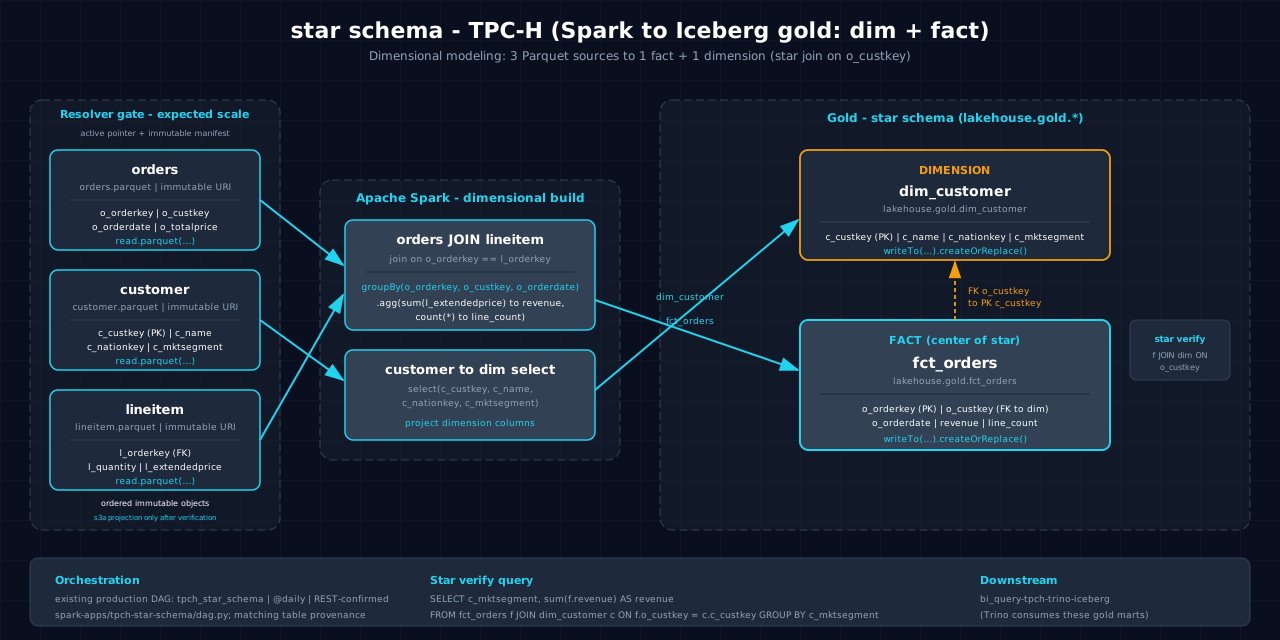
Airflow resolves one complete immutable eight-object TPC-H publication. The Spark application validates customer, orders, and lineitem keys, projects the customer dimension, aggregates line revenue per order, and atomically replaces each gold table with matching source-generation properties.
4. Notebooks
- Zeppelin (Scala):
zeppelin/notebook.zpln— Sections: Overview, Read Sources (3 Parquet tables), Join Orders+Lineitems, Join + Customer, Create Dimensions, Create Fact Table, Write to Gold, Verify - Jupyter (PySpark):
jupyter/notebook.ipynb— Same 8 sections; same dimensional modeling logic using PySpark DataFrame joins, dimension construction, fact table aggregation
Both languages implement identical star schema logic: source ingestion, multi-table joins, dimension/fact table creation, and verification of schema and row counts.
Production trust boundary: The notebooks are not a production write path. They directly replace the same two tables without the application's complete-publication, key, serialization, or provenance checks and can invalidate downstream #83. Use the
tpch_star_schemaDAG/application for production writes; use notebooks only in an isolated educational environment whose outputs may be overwritten by a subsequent production run.
5. Orchestration
Classification: existing production DAG. spark-apps/tpch-star-schema/dag.py runs tpch_star_schema daily through the Atlas REST-confirming Spark submission contract. Manual runs accept an explicit dataset_scale; max_active_runs=1 serializes the non-atomic two-table replacement. The notebooks remain the educational parity surface; downstream Trino child #83 must compare both tables' exact five Iceberg provenance properties before querying them.
6. Usage
- Ensure the
goldIceberg namespace exists:scripts/register_iceberg.py - Populate the TPC-H dataset:
make datasetsto download Parquet files to S3 - Publish
s3a://jars/tpch-star-schema/0.1.0/app.jarthrough Jenkins. - Trigger
tpch_star_schemawith{"dataset_scale":"tiny"}. Open either notebook only for isolated education, never as an equivalent production write. - Verify output:
bash
   spark-sql -e "SELECT COUNT(*) FROM lakehouse.gold.dim_customer"
   spark-sql -e "SELECT COUNT(*) FROM lakehouse.gold.fct_orders"
7. Dependencies
- Dataset: resolver-verified immutable TPC-H Parquet (
orders.parquet,customer.parquet,lineitem.parquet) - Atlas services: A1-A4 (Spark, Iceberg, S3 catalog, lakehouse catalog)
- Other: None
- Note: Reads the resolver-returned immutable S3 objects directly — no medallion intermediate layers
8. Known Issues & Caveats
Notebook execution and Scala/PySpark parity are live-gated on Atlas A1-A4. The gold namespace must exist in the Iceberg REST catalog; run scripts/register_iceberg.py before executing standalone. make datasets is required to populate the TPC-H landing zone before the notebook can read data.
9. See Also
- Downstream: bi_query-tpch-trino-iceberg — Queries gold marts via Trino
- Downstream: join_optimization-tpch-spark-iceberg — Uses gold tables for join optimization demos
- Datasets
- Lakehouse Architecture