5.11. feature_engineering-movielens-spark-iceberg
Builds deterministic per-user and per-movie rating aggregates in Iceberg. The production path is the Maven Scala application at spark-apps/movielens-feature-pipeline and the serialized Airflow DAG movielens_feature_pipeline.
1. Purpose
The scenario preserves the paired notebooks as educational Scala/PySpark examples while productionizing their two groupBy aggregations. Production accepts exactly one resolver-verified immutable MovieLens publication, validates the ratings schema, replaces both Gold tables, and reads back schemas, rows, measures, and generation provenance.
2. Data Model
2.1 Input
The complete publication crosses the application boundary in the scale-specific registry order. The application reads only ratings.csv with the exact schema userId long, movieId long, rating double, timestamp long; all fields are required and ratings must be finite. Duplicate rating rows intentionally count separately in both averages and counts.
2.2 Outputs
| Table | Ordered schema | Key |
|---|---|---|
lakehouse.gold.ml_user_features |
userId long, avg_rating double, num_ratings long |
unique, non-null userId |
lakehouse.gold.ml_movie_features |
movieId long, movie_avg double, popularity long |
unique, non-null movieId |
Both tables carry the same five data_eng_lab.dataset* Iceberg properties for dataset, scale, plan ID, publication ID, and manifest SHA-256. Both count sums equal the number of input rating rows.
3. Architecture
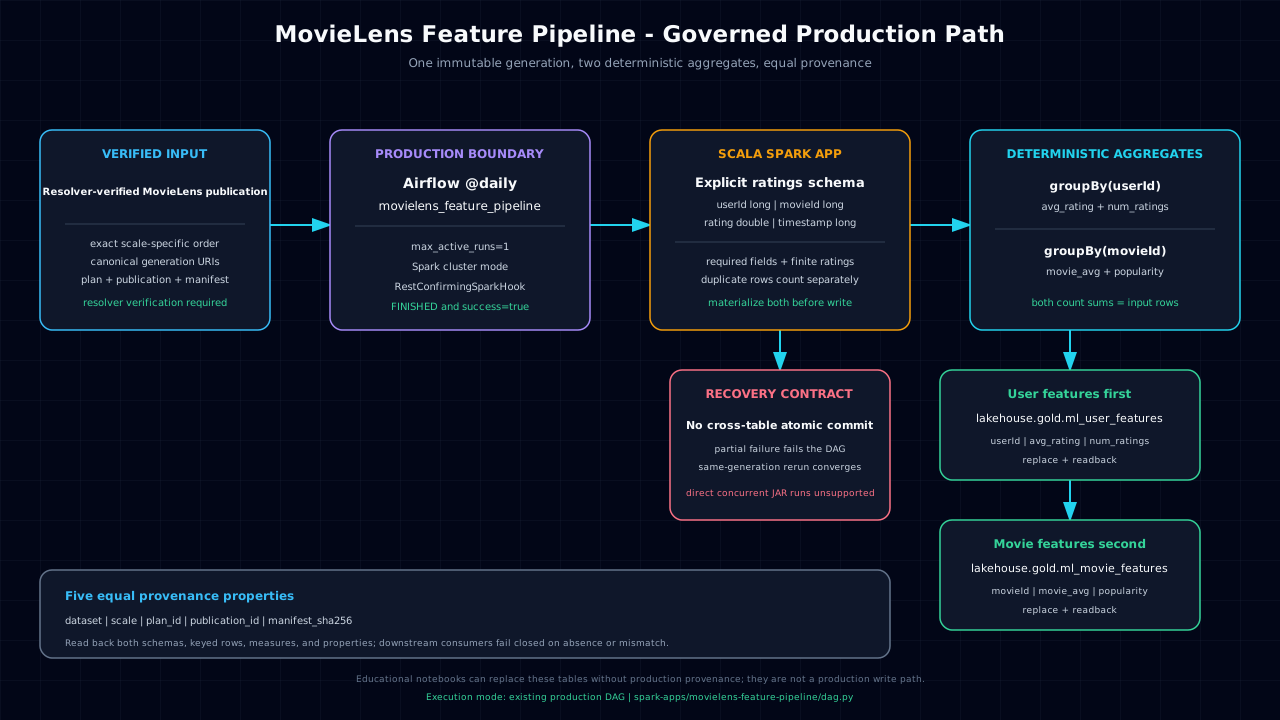
Airflow resolves and verifies a complete generation, then submits the reviewed JAR in Spark standalone cluster mode through Atlas's REST-confirming adapter. Spark validates and materializes both aggregates, replaces the user table first and movie table second, and verifies both outputs before success.
4. Notebooks
The paired Zeppelin (zeppelin/notebook.zpln) and Jupyter (jupyter/notebook.ipynb) notebooks implement the same two aggregations for education and language parity.
5. Orchestration
Classification: existing production DAG. spark-apps/movielens-feature-pipeline/dag.py schedules movielens_feature_pipeline @daily, accepts an explicit manual dataset_scale, and sets max_active_runs=1. Success requires both Airflow success and Spark FINISHED with success=true.
Iceberg has no cross-table atomic commit. A failure between writes leaves a partial generation; the supported recovery is a deterministic same-generation rerun. Airflow serialization prevents supported runs from interleaving. Concurrent direct JAR invocations are unsupported.
6. Usage
- Publish and verify the requested MovieLens scale with the supported dataset tooling.
- Build and publish the reviewed
spark-apps/movielens-feature-pipelineJAR through Jenkins. - Trigger
movielens_feature_pipeline, optionally with{"dataset_scale":"tiny|small|medium"}. - Verify both table schemas, row counts, count sums, and all five properties.
7. Dependencies
-
81 resolver-verified immutable MovieLens publication
- Atlas Airflow, Spark standalone, Iceberg REST catalog, and S3A runtime
- Jenkins-published
s3a://jars/movielens-feature-pipeline/0.1.0/app.jar
8. Known Issues & Caveats
There is no cross-table atomic commit. The Airflow task fails on either write or readback error; recover a partial generation by rerunning the same verified immutable publication. Do not run the notebooks against shared production Gold tables.
9. Notebook Trust Boundary
The paired Zeppelin and Jupyter notebooks demonstrate equivalent aggregations, but they are not a supported production write path. They infer schema and directly replace the same two tables without complete-publication validation, production provenance, serialization, or readback checks. Running a notebook against production tables can invalidate provenance for downstream consumers; use movielens_feature_pipeline for production writes.