5.13. time_travel-nyc_taxi-spark-iceberg
Demonstrates Iceberg snapshot history and branch creation on a scenario-owned NYC taxi table; time-travel and rollback commands are documented examples, not executed cells.
1. Purpose
The paired notebooks create nyc_taxi_tt, append filtered Bronze rows to create another snapshot, create an audit branch, and inspect the table's history metadata. They include commented examples for VERSION AS OF and rollback_to_snapshot; neither example executes.
2. Data Model
2.1 Input Source
Source: lakehouse.bronze.nyc_taxi_trips, copied into the scenario-owned lakehouse.silver.nyc_taxi_tt table. The Bronze prerequisite originates from a resolver-verified immutable generation.
| Column | Type | Notes |
|---|---|---|
VendorID |
double | Vendor identifier |
tpep_pickup_datetime |
timestamp | Pickup timestamp |
tpep_dropoff_datetime |
timestamp | Dropoff timestamp |
passenger_count |
double | Number of passengers (canonicalized in Bronze) |
trip_distance |
double | Trip distance in miles |
fare_amount |
double | Fare amount |
total_amount |
double | Total amount |
PULocationID |
int | Pickup location ID |
DOLocationID |
int | Dropoff location ID |
2.2 Output Tables
| Table | Layer | Key Columns |
|---|---|---|
lakehouse.silver.nyc_taxi_tt |
Silver | Scenario-owned snapshot-history and branch target |
3. Architecture
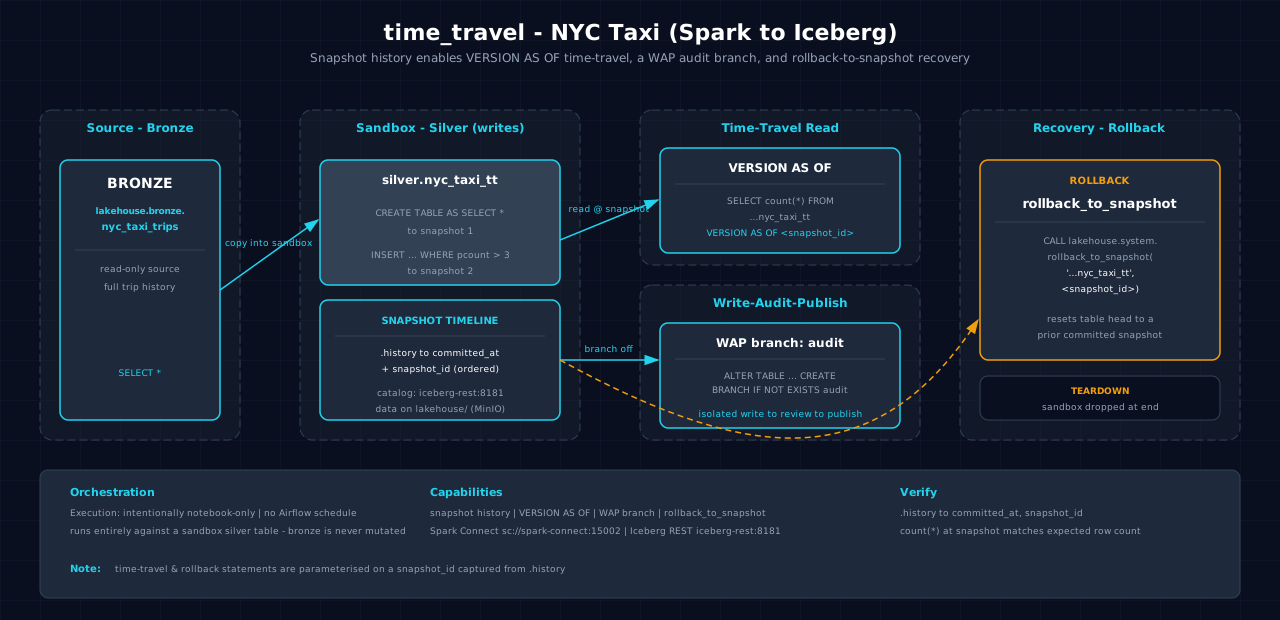
NYC taxi trip data is copied into nyc_taxi_tt, then a filtered append creates another snapshot. The notebooks create an audit branch and query the history metadata table. Commented examples show how a future operator could query or roll back a chosen snapshot.
4. Notebooks
- Zeppelin (Scala):
zeppelin/notebook.zpln— creates snapshots and theauditbranch, then inspects history; query and rollback examples are comments - Jupyter (PySpark):
jupyter/notebook.ipynb— executes the same snapshot, branch, and history operations with the same commented examples
Both languages implement equivalent snapshot creation, branch creation, and history inspection.
5. Orchestration
Classification: intentionally notebook-only. No Airflow DAG or schedule exists. Snapshot inspection and branch operations are operator-selected demonstrations restricted to the isolated nyc_taxi_tt table.
6. Usage
- Ensure the
silverIceberg namespace exists:scripts/register_iceberg.py - Open either notebook on the Atlas stack.
- Verify:
7. Dependencies
- Dataset: scenario-owned NYC Taxi rows in
lakehouse.silver.nyc_taxi_tt - Atlas services: A1-A4 (Spark, Iceberg, S3 catalog, lakehouse catalog)
- Other: Iceberg time travel must be enabled (default configuration)
8. Known Issues & Caveats
Notebook execution and Scala/PySpark parity are live-gated on Atlas A1-A4. The silver namespace must exist; run scripts/register_iceberg.py first. The notebook does not execute the commented time-travel or rollback statements and does not publish the audit branch.
9. See Also
- Related: batch_ingest-nyc_taxi-spark-iceberg — Produces the bronze source data
- Related: table_maintenance-nyc_taxi-spark-iceberg — Demonstrates compaction and snapshot cleanup on a separate scenario table
- Related: medallion-nyc_taxi-spark-iceberg — Full medallion pipeline
- Datasets
- Lakehouse Architecture