5.19. json_flatten-gh_archive-spark-iceberg
Reads GitHub Archive nested JSON events, extracts and flattens nested fields, casts timestamps, and writes to a flat Iceberg silver table.
1. Purpose
Handling semi-structured nested data is a common ETL pattern in data engineering. This scenario demonstrates converting messy JSON into well-typed columns using Spark's built-in get_json_object and col dot-notation for extracting deeply nested fields (like actor.login and repo.name), casting created_at to a proper timestamp, and writing the result as a flat Iceberg table for downstream consumption.
2. Data Model
2.1 Input Source
Source: compressed GitHub Archive JSON objects from one resolver-verified immutable generation published by make datasets.
| Column | Type | Source |
|---|---|---|
id |
string | JSON: id; required but not a primary key |
type |
string | JSON: type |
actor_login |
string | JSON: actor.login |
repo_name |
string | JSON: repo.name |
created_at |
timestamp | JSON: created_at (cast from string) |
2.2 Output Tables
| Table | Layer | Key Columns |
|---|---|---|
lakehouse.silver.gh_events |
Silver | id, type, actor_login, repo_name, created_at |
3. Architecture
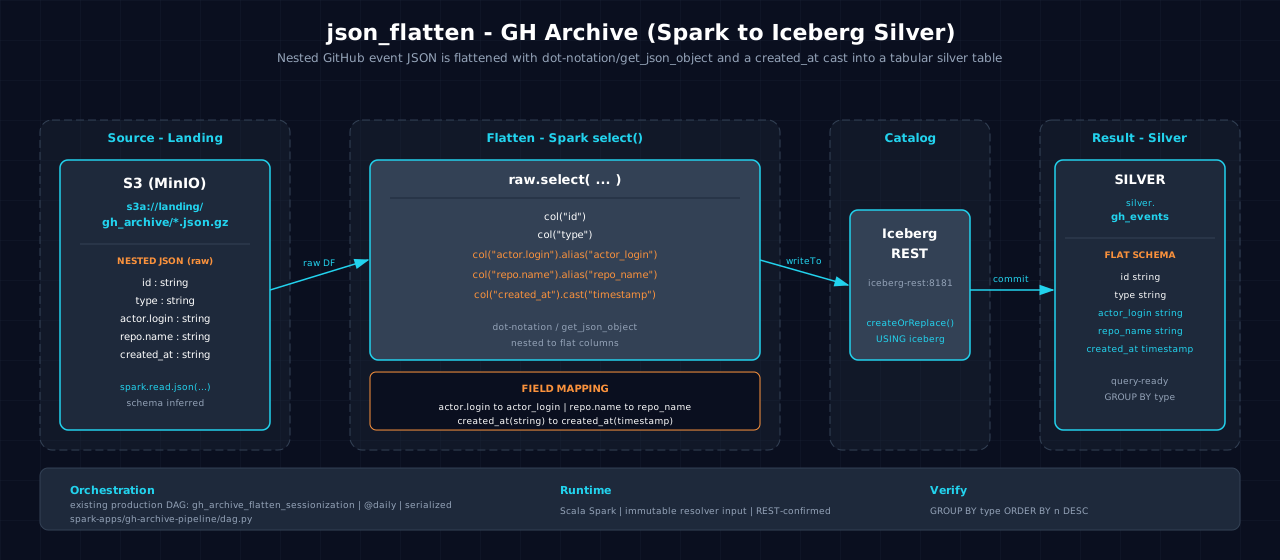
Exact duplicate flattened records remain distinct. Conflicting records sharing an id fail the production stage before replacement.
4. Notebooks
- Zeppelin (Scala):
zeppelin/notebook.zpln— Sections: Overview, Read JSON from S3, Extract Nested Fields, Cast Timestamps, Write to Iceberg, Verify - Jupyter (PySpark):
jupyter/notebook.ipynb— Same sections; same JSON flatten logic usingcol("actor.login")syntax andtoTimestamp
Both languages implement identical JSON flatten logic with source read, field extraction, type casting, and sink write.
5. Orchestration
Classification: existing production DAG. spark-apps/gh-archive-pipeline/dag.py schedules
gh_archive_flatten_sessionization @daily, accepts an explicit manual dataset_scale, and uses
max_active_runs=1. The flatten task is the first of two independently REST-confirmed Spark stages.
6. Usage
- Ensure the
silverIceberg namespace exists:scripts/register_iceberg.py - Populate the landing zone:
make datasets - Trigger
gh_archive_flatten_sessionizationfor production output, or open a notebook for an isolated educational run. - Verify output:
bash
   spark-sql -e "SELECT COUNT(*) FROM lakehouse.silver.gh_events"
7. Dependencies
- Dataset: resolver-verified immutable GitHub Archive compressed JSON
- Atlas services: A1-A4 (Spark, Iceberg, S3 catalog, lakehouse catalog)
- Other: None
8. Known Issues & Caveats
Notebook execution and Scala/PySpark parity are live-gated on Atlas A1-A4. The notebooks directly
replace the same table but do not validate or write the production five-key provenance and are not
serialized with sessionization. Running them can invalidate production consumers; use the DAG/app
for production writes and isolate educational runs. The silver namespace and a verified dataset
publication must exist.
9. See Also
- Related: schema_evolution-gh_archive-spark-iceberg — Another GitHub Archive processing scenario
- Related: sessionization-gh_archive-spark-iceberg — Consumes flattened events from this scenario
- Related: streaming_ingest-gh_archive-spark-iceberg — Streaming version of JSON ingest
- Datasets
- Lakehouse Architecture