5.20. sessionization-gh_archive-spark-iceberg
Detects user sessions from GitHub Archive events using window functions and gap-based sessionization with a 30-minute inactivity threshold.
1. Purpose
Sessionization is a foundational pattern in event-driven analytics, used to understand user behavior patterns, engagement, and activity flows. This scenario showcases advanced window function techniques: partitioning events by actor_login, ordering by timestamp, detecting inactivity gaps exceeding 30 minutes using the LAG window function, and assigning session IDs via a cumulative sum over gap indicators.
2. Data Model
2.1 Input Source
Source: lakehouse.silver.gh_events from the matching production flatten stage. The educational
notebooks read this typed table directly.
| Column | Type | Notes |
|---|---|---|
id |
string | Required source identifier; not a primary key |
actor_login |
string | Partition key for session detection |
created_at |
timestamp | Used for ordering and gap detection |
type |
string | Event type |
repo_name |
string | Repository name |
2.2 Output Tables
| Table | Layer | Key Columns |
|---|---|---|
lakehouse.silver.gh_sessions |
Silver | id, type, actor_login, repo_name, created_at, previous_created_at, new_session, session_id |
3. Architecture
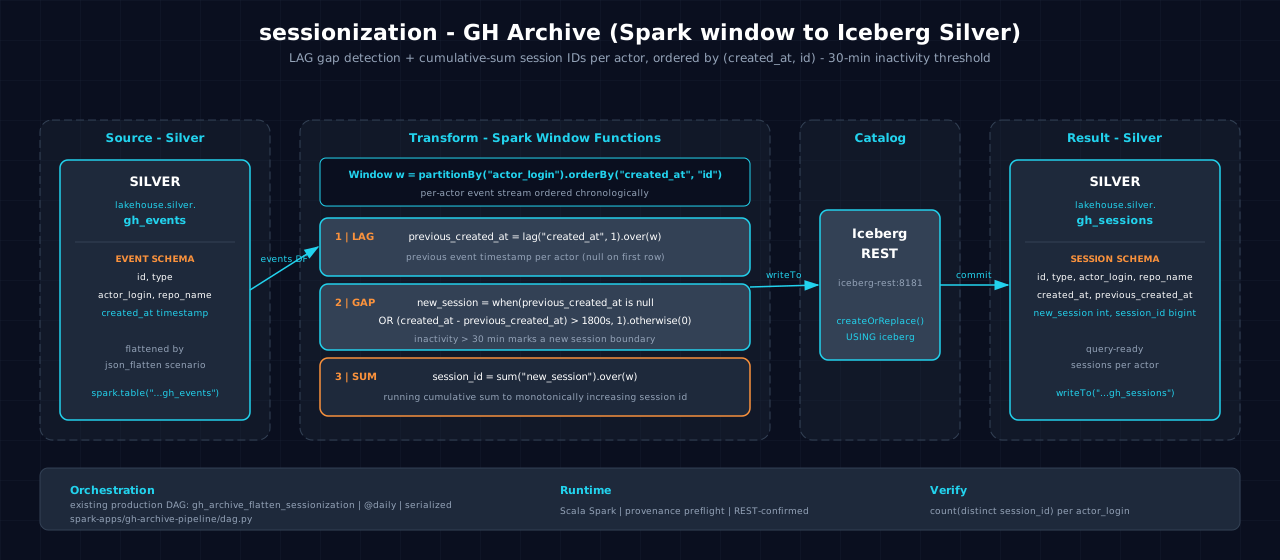
Production reads the five provenance properties before the event rows and fails closed on any generation mismatch. Direct concurrent JAR execution is unsupported; Airflow serialization is the production boundary.
4. Notebooks
- Zeppelin (Scala):
zeppelin/notebook.zpln— Sections: Overview, Read Events, Compute LAG, Detect Gaps (> 30 min), Assign Session IDs, Write to Iceberg, Verify - Jupyter (PySpark):
jupyter/notebook.ipynb— Same sections; same sessionization logic usinglag(),when(), andsum().over()window operations in PySpark
Both languages implement identical sessionization logic with gap detection, session assignment, and verification.
5. Orchestration
Classification: existing production DAG. spark-apps/gh-archive-pipeline/dag.py schedules
gh_archive_flatten_sessionization @daily. It runs sessionization only after a successful matching
flatten task and serializes runs with max_active_runs=1.
6. Usage
- Ensure the
silverIceberg namespace exists:scripts/register_iceberg.py - Run the production flatten stage through
gh_archive_flatten_sessionization, or prepare an isolated educationalgh_eventstable. - Open either notebook only for the educational path.
- Verify:
bash
   spark-sql -e "SELECT actor_login, COUNT(DISTINCT session_id) AS num_sessions FROM lakehouse.silver.gh_sessions GROUP BY actor_login LIMIT 10"
7. Dependencies
- Dataset: GitHub Archive events (via
lakehouse.silver.gh_events) - Atlas services: A1-A4 (Spark, Iceberg, S3 catalog, lakehouse catalog)
- Other: None
8. Known Issues & Caveats
The 30-minute gap threshold is fixed at 1,800 seconds. Both notebooks directly replace
lakehouse.silver.gh_sessions; they do not write production provenance or participate in Airflow
serialization and can invalidate downstream generation checks. Production writes must use
gh_archive_flatten_sessionization. The notebook consumes gh_events and therefore requires the
typed flatten table to exist.
9. See Also
- Related: json_flatten-gh_archive-spark-iceberg — Produces a separate flattened-events table from the same source dataset
- Related: schema_evolution-gh_archive-spark-iceberg — Another GitHub Archive processing scenario
- Datasets
- Lakehouse Architecture