5.5. streaming_ingest-gh_archive-spark-iceberg
Demonstrate Iceberg ingestion via Structured Streaming with a file source: read JSON files incrementally from S3 landing, parse with schema, cast the timestamp column, and write to Iceberg with checkpoints for exactly-once semantics. No Kafka or external messaging queue required.
1. Purpose
This scenario demonstrates Structured Streaming to Iceberg using a simple file source (not Kafka), which enables exactly-once ingestion semantics and checkpointing for fault tolerance. It is useful when the data source is a directory of files rather than a message queue, and it does not require Atlas A9 (Redpanda).
2. Data Model
2.1 Input Source
Source: compressed GitHub Archive JSON objects from one resolver-verified immutable generation published by make datasets.
| Column | Type | Notes |
|---|---|---|
id |
string | Event ID |
type |
string | Event type (e.g., PushEvent, CreateEvent) |
created_at |
timestamp | Event creation time (casted from string) |
| Other nested fields | varied | Extracted via dot notation (actor.login → actor_login, repo.name → repo_name) |
Checkpoint: s3a://checkpoints/gh_events_file/<scale>/<publication-id>/<manifest-sha256>
Checkpoint policy (#85)
Checkpoint ID streaming-gh-archive-file-v1 is owned by Streaming Data Engineering Education and classified as generation reproducibility state. Its concrete leaf binds the exact resolver generation by scale, publication ID, and manifest SHA-256. While active or uncertain it is retained; a completed or stopped leaf waits 14 days. Recovery must re-resolve that exact resolver generation and reset lakehouse.bronze.gh_events_stream before replay. Manual exact-leaf retention is available through issue #86's reviewed plan/prepare/apply protocol. Automated and scheduled deletion remain disabled pending stronger MinIO cross-process CAS and conditional delete proof.
2.2 Output Tables
| Table | Layer | Key Columns |
|---|---|---|
lakehouse.bronze.gh_events_stream |
Bronze | id, type, created_at, actor_login, repo_name |
3. Architecture
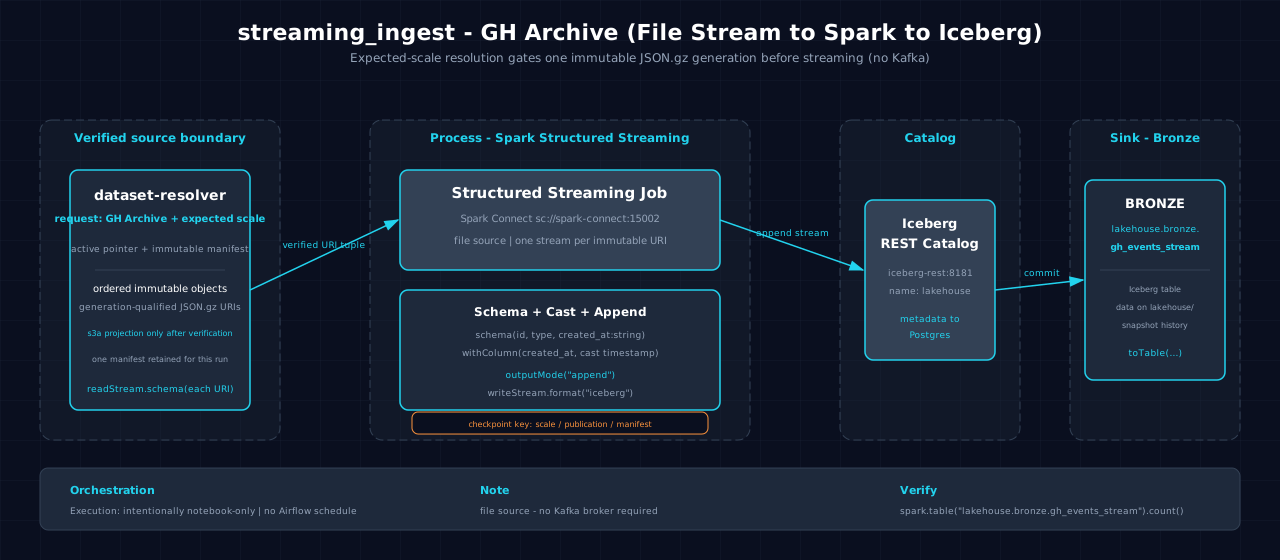
Data flows from the resolver-ordered immutable object URIs through Spark Structured Streaming with one file stream per URI, unioned within the run. The stream defines a schema, casts created_at to timestamp, and writes to Iceberg with a checkpoint path scoped by scale, publication, and manifest identity.
4. Notebooks
- Zeppelin (Scala):
zeppelin/notebook.zpln— Sections: Overview, Setup, Read (file source), Transform (schema + cast), Write (Iceberg), Verify - Jupyter (PySpark):
jupyter/notebook.ipynb— Sections: Overview, Setup, Read (file source), Transform (schema + cast), Write (Iceberg), Verify
Both notebooks implement identical streaming ingest logic with file source, schema definition, field extraction, and sink write.
5. Orchestration
Classification: intentionally notebook-only. No Airflow DAG or schedule exists. This finite resolver-locked file set demonstrates checkpointed file discovery but waits as a stream, so an operator bounds either paired notebook run explicitly.
6. Usage
- Ensure the
bronzeIceberg namespace exists:scripts/register_iceberg.py - Populate the landing zone:
make datasets - Open either notebook on the Atlas stack.
- Verify output:
7. Dependencies
- Dataset: GitHub Archive compressed JSON (via
make datasets) - Atlas services: A1-A4 (Spark, Iceberg, S3 catalog, lakehouse catalog)
- Other: None; uses file source, does not require Atlas A9 (Redpanda)
Requires lakehouse.bronze namespace to exist before running.
8. Known Issues & Caveats
Notebook execution and Scala/PySpark parity are live-gated on Atlas A1-A4. This scenario uses a file source, not Kafka, so it does not require Atlas A9. Run scripts/register_iceberg.py and make datasets before executing standalone.
9. See Also
- Downstream: json_flatten-gh_archive-spark-iceberg — Also consumes GitHub Archive data
- Downstream: sessionization-gh_archive-spark-iceberg — Consumes stream events
- Datasets
- Lakehouse Architecture