5.16. bi_query-tpch-trino-iceberg
Queries gold-layer marts via Trino SQL, demonstrating Trino as a lightweight SQL-only analytics engine over Iceberg tables produced by Spark.
1. Purpose
Trino provides a lightweight, SQL-only query path over lakehouse data that complements Spark's programmatic ETL. Production reads fct_orders and dim_customer, validates that they represent one immutable TPC-H generation, and returns a bounded revenue-by-segment result without writing Iceberg. The paired notebooks retain their direct CTAS cells only as an educational comparison.
2. Data Model
2.1 Input Source
Source: lakehouse.gold tables written by the upstream star_schema-tpch-spark-iceberg scenario.
From lakehouse.gold.fct_orders:
| Column | Type | Notes |
|---|---|---|
o_orderkey |
long | Order key |
o_custkey |
long | Customer FK |
o_orderdate |
date | Order date |
revenue |
decimal(25,2) | Sum of line extended prices |
line_count |
bigint | Number of lines in the order |
From lakehouse.gold.dim_customer:
| Column | Type | Notes |
|---|---|---|
c_custkey |
long | Customer PK |
c_name |
string | Customer name |
c_mktsegment |
string | Market segment |
2.2 Output Artifact
| Table | Layer | Key Columns |
|---|---|---|
| Airflow metadata-DB XCom | Run artifact | market_segment, total_revenue, line_count, order_count |
3. Architecture
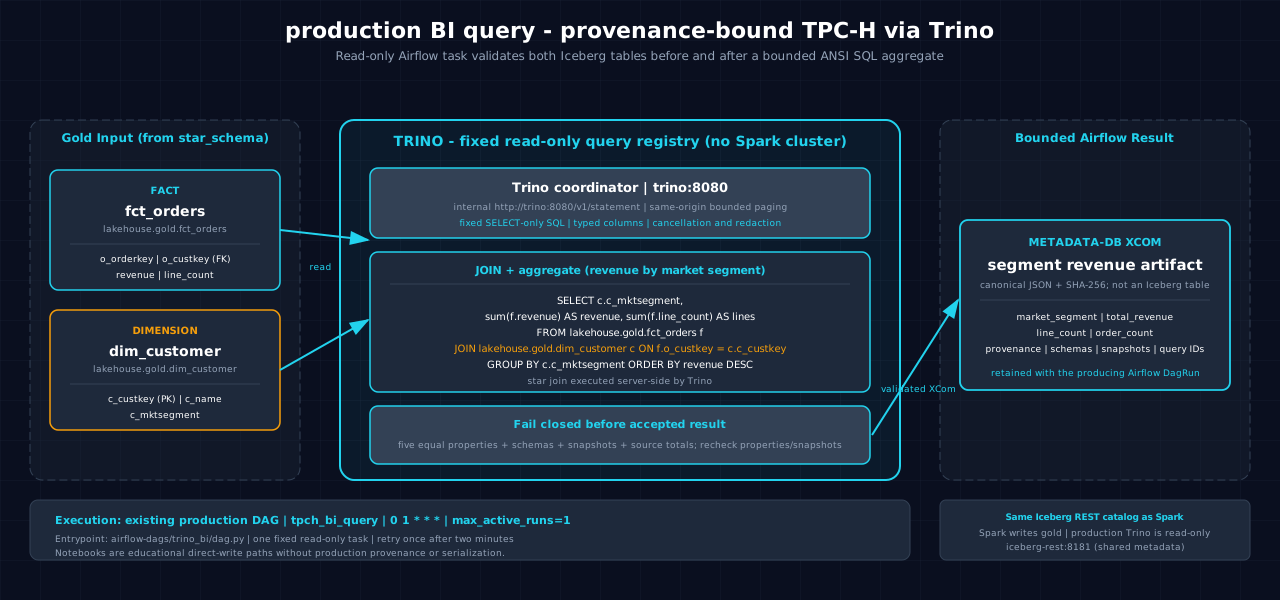
Data flows from gold-layer Iceberg tables (fct_orders, dim_customer) through fixed read-only Trino SQL. The production task reads both $properties tables before BI SQL, validates schemas and source measures, executes the aggregate, then rereads properties and snapshots before returning a canonical XCom artifact. No Spark or Iceberg write occurs.
4. Notebooks
- Zeppelin (Scala,
%trino): Sections: Overview, Read Gold Tables, Join + Aggregate, Write Summary, Verify; identical SQL to PySpark - Jupyter (Py,
trinoclient): Sections: Overview, Read Gold Tables, Join + Aggregate, Write Summary, Verify; identical SQL executed via the Trino Python client connecting totrino:8080
Both notebooks run the same SQL queries to demonstrate cross-engine parity. Their CTAS cells are an educational direct-write path that does not enforce production provenance, snapshot checks, or serialization. Use the Airflow DAG for production BI queries and durable BI artifacts; the production path itself is read-only and stores the artifact in Airflow metadata.
5. Orchestration
Classification: existing production DAG at airflow-dags/trino_bi/dag.py. tpch_bi_query runs daily at 01:00 UTC with max_active_runs=1, one retry, and a two-minute delay. Its bounded canonical metadata-DB XCom is retained with the Airflow metadata database and is not an Iceberg table; retrieve it from the task instance XCom view or API before configured metadata retention removes the DagRun.
Before any BI SQL, the task queries lakehouse.gold."dim_customer$properties" and lakehouse.gold."fct_orders$properties". It requires exactly equal nonblank data_eng_lab.dataset, data_eng_lab.dataset.scale, data_eng_lab.dataset.plan_id, data_eng_lab.dataset.publication_id, and data_eng_lab.dataset.manifest_sha256 values and will fail closed before BI SQL on absence, duplication, malformed identity, or mismatch.
6. Usage
- Run the prerequisite scenario:
star_schema-tpch-spark-iceberg(createsfct_ordersanddim_customer) - Ensure the
goldIceberg namespace exists:scripts/register_iceberg.py - For production, run
airflow dags test tpch_bi_query <logical-date> --use-executorfrom the scheduler or let the daily schedule run. - Retrieve
run_bounded_bi_query'sreturn_valueXCom through Airflow's task-instance view/API. - Use either paired notebook only for the educational direct-query/CTAS walkthrough.
7. Dependencies
- Dataset: TPC-H gold tables (
fct_orders,dim_customer) fromlakehouse.gold - Atlas services: A5-A7 (Trino, Trino coordinator, Iceberg REST catalog)
- Other:
trinoPython client (Jupyter notebook)
8. Known Issues & Caveats
Atlas provides the Trino coordinator and the %trino Zeppelin interpreter. Production accepts only fixed registry SQL through internal http://trino:8080; no host fallback or arbitrary DagRun SQL exists. The catalog is currently unauthenticated/ALLOW_ALL, so the application-level read-only registry is a workload boundary, not a claim of catalog security. Requires the upstream star_schema-tpch-spark-iceberg to run first.
9. See Also
- Upstream: star_schema-tpch-spark-iceberg — Populates the gold tables this scenario queries
- Related: join_optimization-tpch-spark-iceberg — Another TPC-H query optimization scenario
- Datasets
- Lakehouse Architecture