5.2. batch_ingest-nyc_taxi-spark-iceberg
Batch ingestion: resolve and read one verified immutable NYC Taxi Parquet generation, then write to an Iceberg bronze table. Scala (Zeppelin) and PySpark (Jupyter) notebooks implement the same logic.
1. Purpose
This is the first step in the medallion architecture — ingesting raw Parquet data into Iceberg with full history retention and schema enforcement. The bronze layer preserves source records while applying the minimum compatibility normalization needed for a stable table schema.
2. Data Model
2.1 Input Source
Source: resolver-ordered NYC Taxi Parquet URIs from one immutable generation published by make datasets.
| Column | Type | Notes |
|---|---|---|
VendorID |
double | Vendor identifier |
tpep_pickup_datetime |
timestamp | Pickup timestamp |
tpep_dropoff_datetime |
timestamp | Dropoff timestamp |
passenger_count |
double | Number of passengers; canonicalized from each source file before union |
trip_distance |
double | Trip distance in miles |
RatecodeID |
double | Rate code |
store_and_fwd_flag |
string | Store and forward flag |
PULocationID |
int | Pickup location ID |
DOLocationID |
int | Dropoff location ID |
payment_type |
double | Payment type |
fare_amount |
double | Fare amount |
extra |
double | Extra charges |
mta_tax |
double | MTA tax |
tip_amount |
double | Tip amount |
tolls_amount |
double | Tolls amount |
improvement_surcharge |
double | Improvement surcharge |
total_amount |
double | Total amount |
congestion_surcharge |
double | Congestion surcharge |
2.2 Output Tables
| Table | Layer | Key Columns |
|---|---|---|
lakehouse.bronze.nyc_taxi_trips |
Bronze | Source columns, with passenger_count canonicalized to double |
3. Architecture
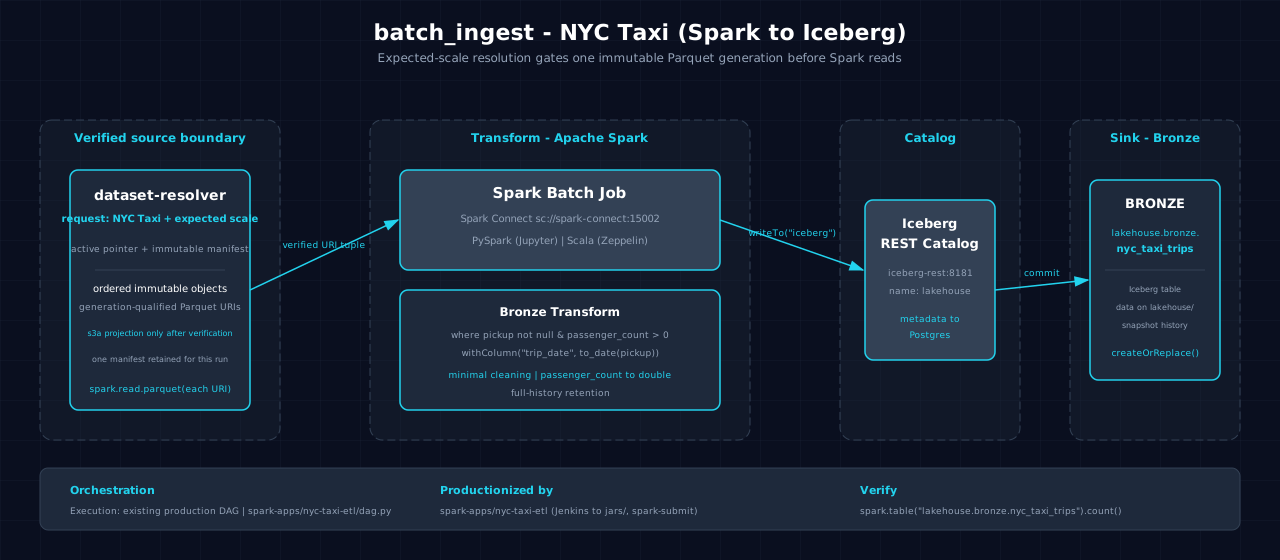
Raw Parquet trip data flows from one resolver-verified generation through Spark batch processing into an Iceberg bronze table in the lakehouse.bronze namespace. The notebooks request tiny, small, or medium, retain the returned ordered URI set, normalize passenger_count to double per file, and then union by name. This preserves source records while avoiding the known March INT64 / double incompatibility.
4. Notebooks
- Zeppelin (Scala):
zeppelin/notebook.zpln— Sections: Overview, Read Raw Parquet, Write to Iceberg, Verify - Jupyter (PySpark):
jupyter/notebook.ipynb— Same sections; same batch ingest logic using PySpark DataFrame reader and writer
Both languages implement identical ingestion logic with source read, Iceberg write, and verification sections.
5. Orchestration
Classification: existing production DAG. The production entrypoint is spark-apps/nyc-taxi-etl/dag.py (nyc_taxi_etl), scheduled @daily with manual runs and an explicit dataset_scale supported. The paired notebooks remain the interactive teaching surface; the deleted scenario-local no-op is superseded.
6. Usage
- Ensure the
bronzeIceberg namespace exists:scripts/register_iceberg.py - Publish the expected tier with
make datasets SCALE=<tier>. Set the Zeppelindataset_scaleinput or Jupyterdataset_scale_overridefor an explicit override; otherwiseDATASET_SCALE, thensmall, applies. - Open either notebook on the Atlas stack.
- Verify:
7. Dependencies
- Dataset: resolver-verified immutable NYC Taxi Trips Parquet
- Atlas services: A1-A4 (Spark, Iceberg, S3 catalog, lakehouse catalog)
- Other: None
8. Known Issues & Caveats
Notebook execution and Scala/PySpark parity are live-gated on Atlas A1-A4. The bronze namespace must exist; run scripts/register_iceberg.py first. At scale, the inline seed can be replaced by the registered CSV dataset. Drop the target table first for a clean demo if re-running.
9. See Also
- Related: table_maintenance-nyc_taxi-spark-iceberg — Table maintenance patterns
- Related: data_quality-nyc_taxi-spark-iceberg — Quality checks on ingested data
- Related: medallion-nyc_taxi-spark-iceberg — Medallion transforms downstream
- Related: time_travel-nyc_taxi-spark-iceberg — Iceberg time travel on ingested tables
- Production Spark app: nyc-taxi-etl — Phase-3a JAR productionizes this scenario for Airflow
- Datasets
- Lakehouse Architecture