2.1 System & context view
This page describes the repository as a notebook-driven ML lab rather than as a deployable
service. The primary runtime objects are experiment directories under notebooks/, the notebook
execution tiers owned by the Makefile, the validation scripts under scripts/, and the three
documentation surfaces derived from the manifest-declared canonical source set. That set spans
the documentation tree under docs/ and direct-root governance Markdown such as SECURITY.md.
2.1.1 System architecture
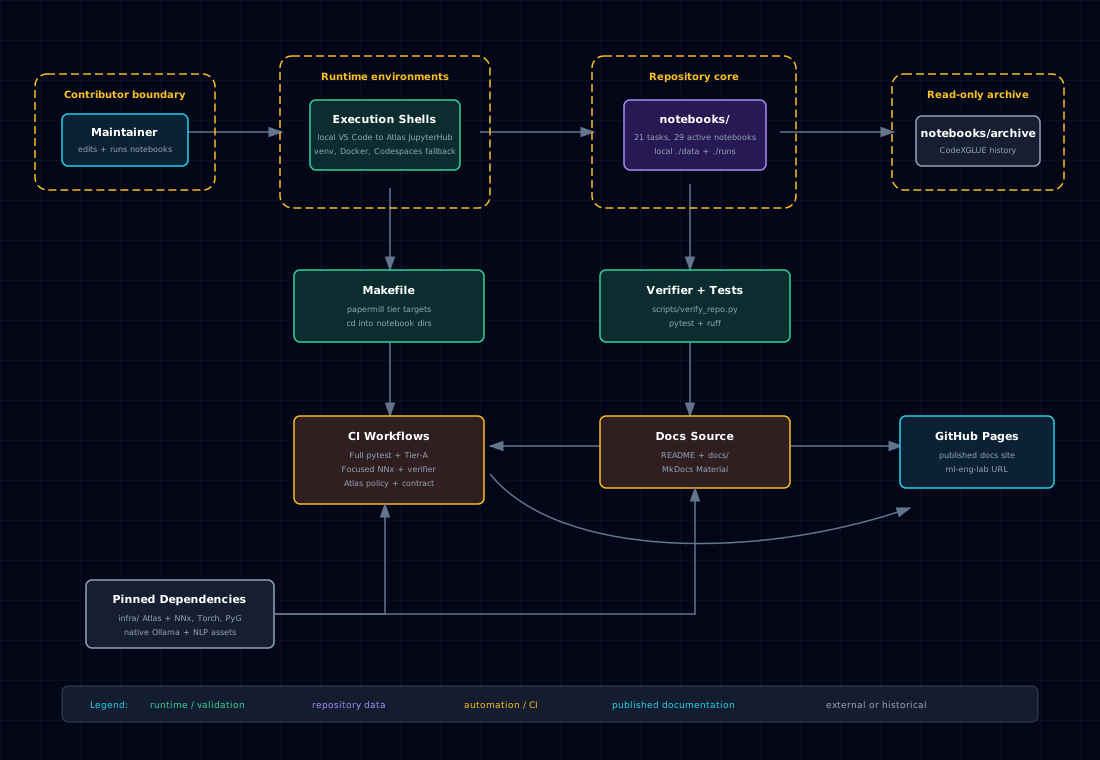
The system view establishes the ownership boundary: this repository owns notebook tasks, consumer configuration, and verification, while NNx and Atlas remain separately versioned upstream dependencies.
2.1.2 Three-surface documentation pipeline
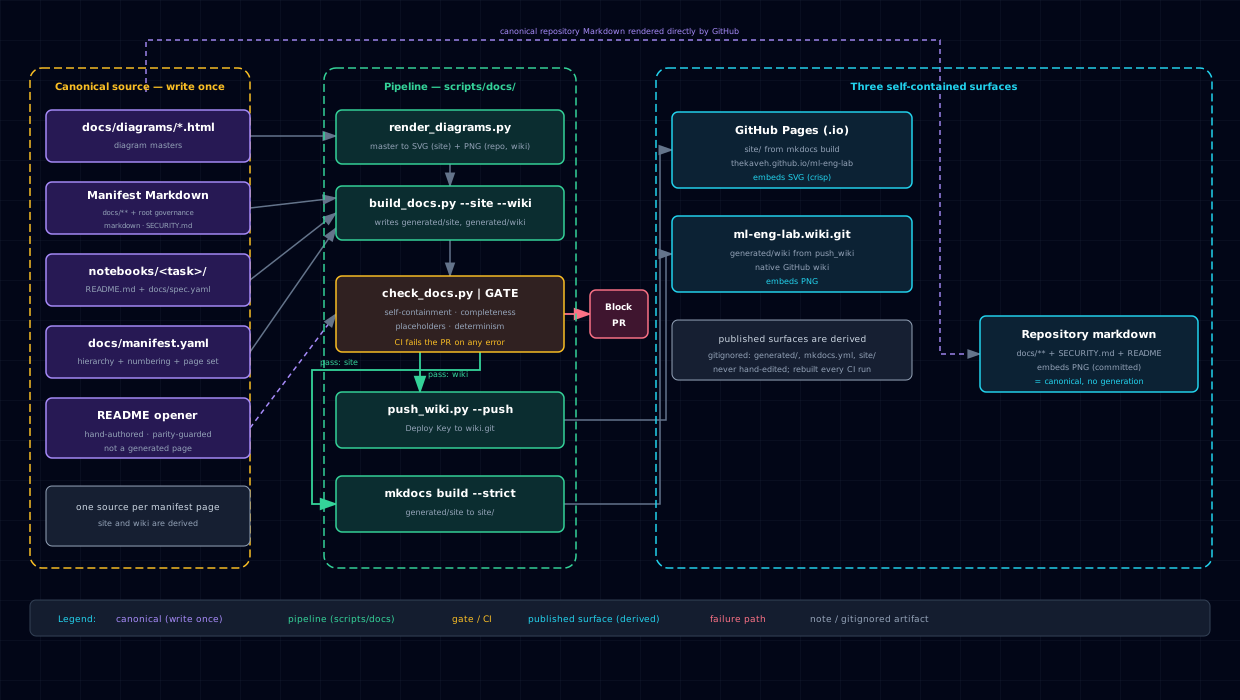
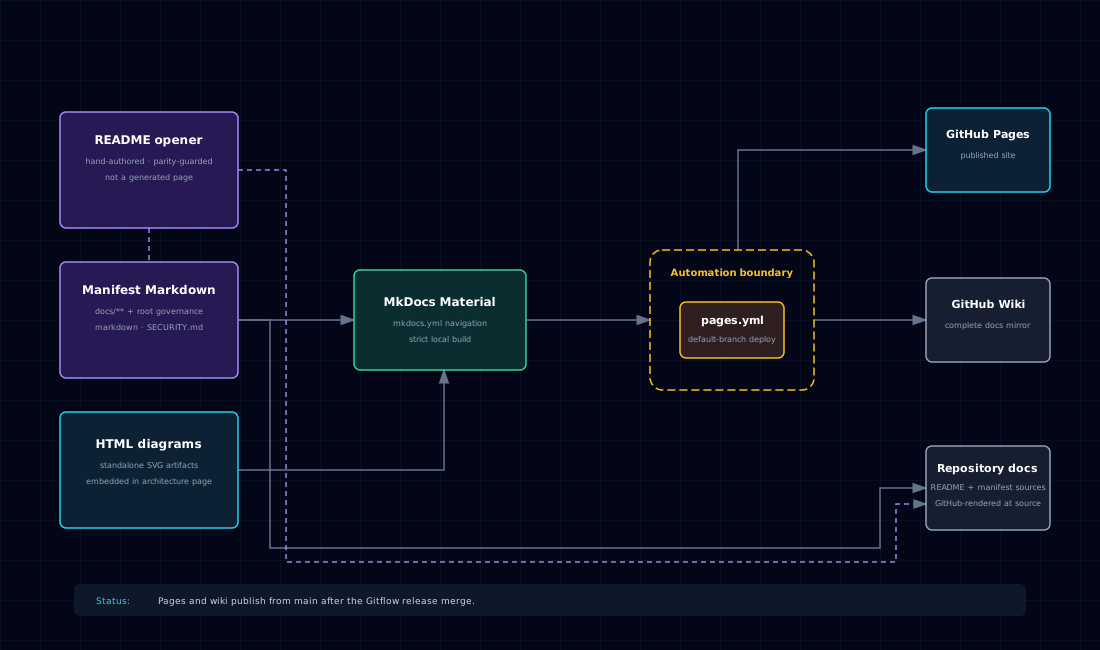
The documentation system is the cleanest worked example of the lab's "canonical source + derived surface" discipline. One manifest-declared canonical source set feeds three surfaces:
- Manifest.
docs/manifest.yamldeclares the hierarchy, numbering, notebook specs, diagram masters, Markdown underdocs/, and direct-root governance pages such asSECURITY.md. It is the single source of truth for the generated page set — if a page is not in the manifest, it does not appear in the generated site or wiki. - Site generation.
scripts/docs/build_docs.py --sitereads the manifest, applies the per-surface transforms inscripts/docs/transforms.py(forbidden-link stripping, path rewriting, image-asset rewriting), and writesgenerated/site/plus a generatedmkdocs.yml. MkDocs Material then builds the published site fromgenerated/site/. - Wiki generation.
scripts/docs/build_docs.py --wikiapplies the wiki surface transform (slugified numbered filenames,Home.md/_Sidebar.md/_Footer.mdconvention) and writesgenerated/wiki/.scripts/docs/push_wiki.pymirrors it to the GitHub wiki using a dedicated deploy key. - Diagram rendering.
scripts/docs/render_diagrams.pyrasterizes each manifest-declared HTML master to SVG (for the site) and PNG (committed underdocs/diagrams/img/for the repository and wiki). - CI gate.
scripts/docs/check_docs.pyenforces self-containment (no cross-surface HTTP links), completeness (every manifest entry has a source file), placeholder-freeness, and generation determinism. It exits non-zero on any error.
The transforms guarantee that a link written once in a canonical source resolves correctly on every surface: relative canonical paths are rewritten to per-surface output paths, image references are rewritten to the surface-appropriate asset format, and any link that would cross a surface boundary (a site page linking to a GitHub source view, for example) is stripped to bare text.
The root README.md opener is hand-authored and parity-guarded against docs/index.md;
it is not a manifest-generated page. The repository renders both that opener and the canonical
manifest sources directly, while the site and wiki contain only manifest-projected pages.
2.1.3 Runtime entry paths
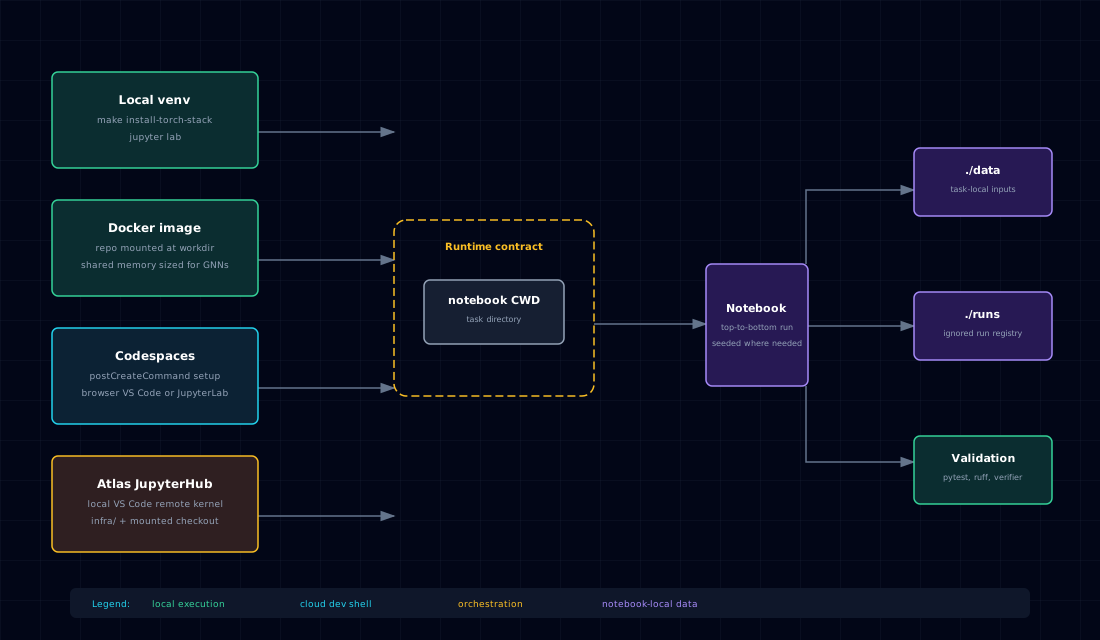
A contributor opens the repository through one of four supported entry paths — local VS Code with
the Atlas JupyterHub kernel, a local venv, the Docker image, or GitHub Codespaces — and runs or
edits an experiment under notebooks/<task>/. The Atlas path uses the pinned infra/ submodule,
the ml-eng track, and a parent-owned checkout mount; local VS Code remains the default editor.
Notebook-local ./data/ and ./runs/ paths resolve inside each experiment directory; Makefile
targets execute notebooks by changing into each notebook directory before invoking papermill, so
the task-local path invariant holds.
The validation path keeps Atlas parent policy distinct from direct submodule validation. The
unconditional atlas-consumer-policy job is intended to be a required gate on every pull request;
it ShellChecks the parent wrappers and runs make test-atlas-consumer without live services. The
path-scoped atlas-contract remains the non-required direct recursive-submodule validator for
declared Atlas inputs.
The unconditional dependency-audit job is an isolated dependency-audit signal: it runs
make audit-advisories against the reviewed JSON policy without starting Atlas or any service.
It remains separate from pytest-repository and atlas-consumer-policy so a live advisory-feed
failure is attributable and isolated. The final GitHub ruleset controller update makes it the
third required context alongside those existing two; that external setting is Task 5 work, not a
local documentation change.
scripts/verify_repo.py, the complete make test / pytest-repository contract, the focused NNx
and Ruff job, documentation checks, and notebook execution tiers retain their separate checks of
structure, documentation, library surfaces, and executable notebook behavior before changes are
merged.
Every local, CI, Docker, and Codespaces runtime enters through the four-stage canonical installer, performs its last asset install, then freezes package state across pip-check, Torch verification, NNx verification, and workload. No repository container starts Jupyter, Atlas, Ollama, or ComfyUI as part of Issue #62.
requirements/lock-policy.toml is the machine-readable authority for human inputs, exact package
sources, three supported targets, allowed direct-URL/sdist exceptions, and generated locks. CI and
Codespaces select the matching hash-required lock; the Docker image creates
/home/jovyan/.venvs/ml-eng-lab, puts it first on PATH, and sets
CONDA_AUTO_ACTIVATE_BASE=false so the Jupyter startup hook cannot replace the reviewed runtime
with ambient conda packages. Image source references are exact tag-plus-index digests from
requirements/image-lock.json. Offline verification proves committed coherence; networked lock
and image checks prove external freshness.
2.1.4 Boundary decisions
notebooks/archive/is preserved as read-only historical material and excluded from active notebook validation.thekaveh-nnx[lm]==0.2.0is consumed from PyPI; shared library changes land upstream inthekaveh/NNxbefore this repo bumps the pin.- The quantization notebook is Tier B under Issue #66. Its bounded execution proves complete PTQ, QAT conversion, exact checkpoint reconstruction, and a machine-readable semantic result.
infra/is a reviewed Atlas gitlink. Consumer configuration remains outside the submodule, and host-native Ollama is mandatory; a containerized Ollama service is not an approved runtime.- Atlas CI preserves the ownership boundary: unconditional
atlas-consumer-policyenforces the intended-required parent policy, while path-scoped, non-requiredatlas-contractvalidates the pinned submodule directly. Neither check starts or contacts Atlas, JupyterHub, Ollama, ComfyUI, Docker Compose, or unrelated containers. - Dependency audit preserves the same boundary: its parent-owned Atlas contract does not initialize
Atlas or start services. Issue #63 owns
requirements/lock-policy.tomland the committed locks; Issue #65 still owns the Atlas runtime itself. - The manifest-declared canonical source set under
docs/and at approved root governance paths is the documentation source of truth; the generated site and wiki are never edited by hand.