8.16 Text generation — TinyShakespeare decoder-only transformer¶
A comprehensive walk-through of notebooks/text_generation-tinyshakespeare-transformer-pytorch/
— the first in-repo exercise of the nnx megamerge's decoder-only transformer fork:
TransformerNN + GenerativeNNModel.generate + the nnx.tokenizer BPE trainer + the
nnx.generation sampling stack. This page is the deep-dive companion to the task notebook: it
states the problem, builds the math (softmax + cross-entropy, scaled-dot-product attention, RoPE),
dissects the architecture, reads the code top to bottom, reports the measured loss trajectory and
sample generations, and catalogues the pitfalls and extensions that govern the pattern.
The notebook is Tier-A — CPU re-runs in about eight seconds and it is re-executed end-to-end in CI on every pull request. The model is deliberately tiny (114 752 parameters, 64-dim residual stream, 32-token context) so the whole transformer call chain runs on a laptop. The result is not coherent Shakespeare — at 114 k parameters trained on 14 KB of text for 5 epochs you get plausible-distribution gibberish — and that is the point. The notebook is an executable correctness reference for the generative-API surface; fluent generation is a scale lever, discussed in §8.16.8.
8.16.1 Problem & motivation¶
Autoregressive language modeling is the task that swallowed NLP: predict the next token given the preceding tokens, iterate, and you have a text generator. The decoder-only transformer is the architecture behind every modern generative LM (GPT family, Llama, Mistral). This notebook lands the smallest possible end-to-end instance of that recipe in the lab: a two-layer, 64-dim decoder-only transformer trained from scratch on an embedded Shakespeare corpus, then sampled to produce text.
The notebook exists for three reasons:
- First in-repo exercise of the
nnxtransformer fork. The megamerge (thekaveh/NNx#29) added a full decoder-only transformer stack:TransformerNN+NNTransformerParams+ theNets.TRANSFORMERenum +GenerativeNNModel.generate+ thennx.tokenizerBPE trainer (train_bpe) + thennx.generationsampling filters (RepetitionPenalty,TemperatureScaling,TopKFilter,TopPFilter). This notebook walks every piece of that stack on a single self-contained corpus, on CPU, in well under a minute. - Executable reference for the generative call chain. Tokenizer training, dataset windowing,
the custom LM train step that flattens
(B, T, V)forcross_entropy, checkpoint saving, and sampling viagenerate(prompt, temperature=, top_k=, seed=)are all first-class. A reader who understands this notebook has the skeleton every larger generative task (TinyStories, real fine-tuning) will build on. - A correctness smoke test, not a quality benchmark. At 114 k parameters + 14 KB corpus + 5 epochs the model overfits the embedded text but cannot produce fluent prose. The §8.16.6 prose owns this trade-off explicitly; the loss trajectory and the shape of the generated tokens are the pedagogical signal, not the literary quality.
The falsifiable hypothesis tested by the notebook is that the training loop drives next-token cross-entropy monotonically downward and that the sampler then emits token distributions that locally resemble Shakespeare (right vocabulary fragments, repetition structure) even when the sequence is globally incoherent.
8.16.2 Concepts¶
| Concept | Where it shows up |
|---|---|
| Autoregressive next-token LM | y = x.roll(-1) shifted targets; one logit per vocab token per position |
| Decoder-only transformer | Nets.TRANSFORMER via TransformerNN — causal masking, no encoder/cross-attention |
| Scaled-dot-product attention | The core attention block; causal mask enforces left-to-right dependency |
| Rotary positional embeddings (RoPE) | Rotates Q/K pairs by angle proportional to position; rope_base=10000.0 default |
| Tied input/output embeddings | tie_embeddings=True — the output projection reuses the input embedding matrix |
| Byte-pair encoding (BPE) tokenizer | train_bpe(...) learns a 256-token vocabulary; NNTokenizerParams.of(...) wraps it |
| Softmax + cross-entropy | The training objective over the flattened (B*T, V) logits |
| Temperature / top-k sampling | generate(temperature=0.8, top_k=20) sharpens and truncates the next-token distribution |
| Gradient clipping | grad_clip_norm=1.0 on the optimizer tames early-step loss spikes |
The nnx surface consumed: GenerativeNNModel, NNTransformerParams, NNTokenizerParams,
NNModelParams, NNTrainParams, NNOptimParams, NNEvaluationDataPoint, train_bpe, plus the
enums Devices, Losses, Nets, Optims and the module-level nnx.set_seed. The custom LM
train step is passed via the train_step_fn= hook on model.train(...) — the same hook the DPO
notebook (§8.19) reuses to swap in a contrastive loss.
8.16.3 Mathematical formulation¶
The model maps a sequence of token ids \(x = (x_1, \dots, x_T)\) to a sequence of logits \(z \in \mathbb{R}^{T \times V}\), one \(V\)-vector per position. At each position the next-token distribution is the softmax:
The training objective is the per-token cross-entropy between the predicted distribution and the ground-truth next token \(x_{t+1}\), averaged (well, summed — see pitfalls) over the batch and sequence:
The core computation inside each transformer block is scaled-dot-product attention. For query, key, value matrices \(Q, K, V \in \mathbb{R}^{T \times d}\) the attention output is
where \(d_k\) is the per-head dimension (\(d_{\mathrm{model}} / n_{\mathrm{heads}} = 64/4 = 16\)), the \(1/\sqrt{d_k}\) factor keeps the pre-softmax variance near unity as depth grows, and \(M\) is the causal mask that forbids position \(t\) from attending to positions \(> t\) (add \(-\infty\) above the diagonal). RoPE encodes position by rotating the \(i\)-th query/key pair at offset \(t\) by angle \(t \cdot 10000^{-2i/d}\); this makes attention a function of relative position without an explicit positional embedding table.
Sampling applies temperature \(\tau\) and top-\(k\) truncation to the next-token logits:
Lower \(\tau\) sharpens the distribution toward the argmax; top-\(k\) zeros the tail to suppress long-shot tokens. The notebook uses \(\tau = 0.8\) and \(k = 20\).
8.16.4 Architecture¶
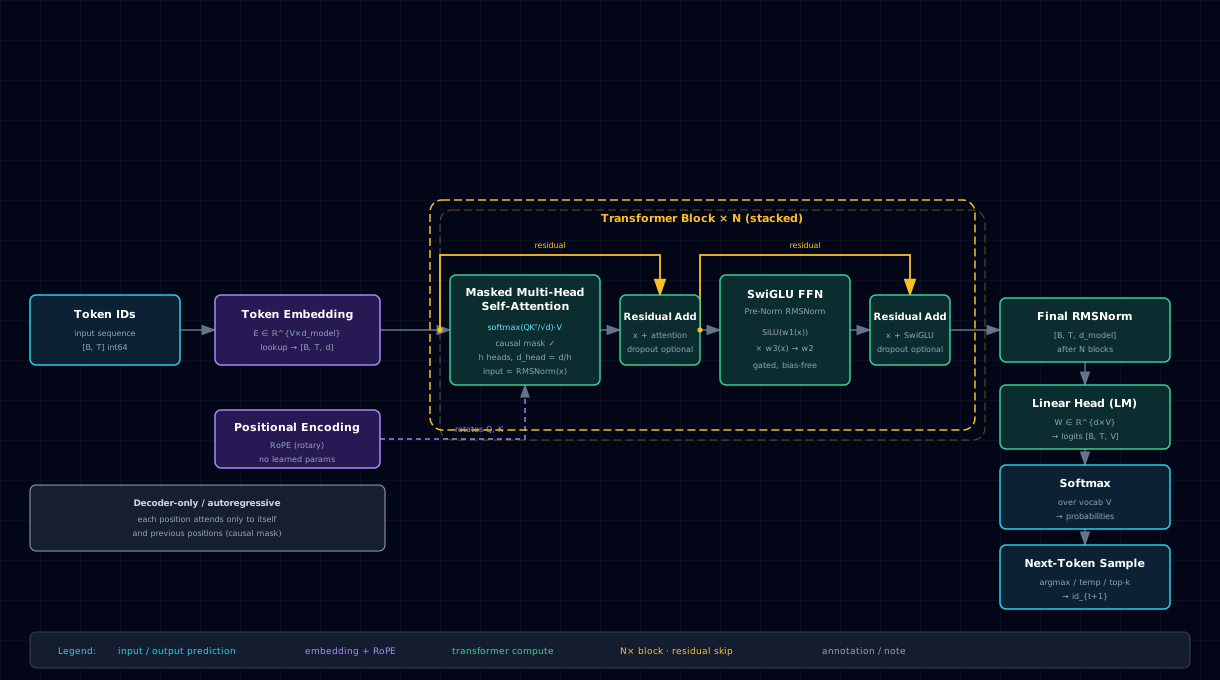
The network family is Nets.TRANSFORMER (nnx.TransformerNN): a decoder-only stack with tied
input/output embeddings, RoPE positional encoding, and causal self-attention. The exact contract:
| Knob | Value | Role |
|---|---|---|
n_layers |
2 |
Two transformer blocks (attention + FFN each) |
d_model |
64 |
Residual-stream width |
n_heads |
4 |
Four attention heads, \(d_k = 16\) each |
max_seq_len |
32 |
Context window — inputs and targets are 32-token windows |
ffn_mult |
4 |
FFN hidden width \(= 4 \times 64 = 256\) |
dropout_prob |
0.0 |
Disabled — tiny model + short training, no regularization needed |
vocab_size |
256 |
BPE-trained vocabulary |
tie_embeddings |
True (default) |
Output projection shares the input embedding weights |
Recorded parameter count: 114 752.
The shared contract — everything held constant:
- Net:
Nets.TRANSFORMER - Loss:
Losses.CROSS_ENTROPY(applied in the customlm_train_step, not the default head) - Optimizer:
Optims.ADAM,max_lr=3e-4,momentum=(0.9, 0.95),weight_decay=0.0,grad_clip_norm=1.0 - Device:
Devices.CPU - Epochs:
5(full run) or1(SMOKE_TEST=1for CI) - Batch size:
4 - Seed:
0
The data pipeline: the embedded Shakespeare text (49 unique lines from Romeo & Juliet, Hamlet,
Macbeth, Julius Caesar, plus the As You Like It "All the world's a stage" monologue) is tiled
CORPUS_REPEAT=8 times to 392 lines / 14 416 characters. train_bpe learns a 256-token vocabulary
over the tiled corpus. The encoded id stream (5 616 tokens) is sliced into fixed-length 32-token
windows; the target for each window is the same window rolled by one (y = x.roll(-1)), the
canonical next-token-shift trick. This yields 175 windows, batched 4-at-a-time → 43 batches/epoch.
8.16.5 Code walkthrough¶
8.16.5.1 Tokenizer training¶
tk = train_bpe(
    texts=CORPUS,
    vocab_size=VOCAB_SIZE,
    special_tokens=["<unk>", "<pad>", "<bos>", "<eos>"],
)
tokenizer = NNTokenizerParams.of(tokenizer=tk, path=tk_path)
train_bpe wraps HuggingFace's Rust-backed tokenizers library (pulled in via nnx's [lm] extra).
The four special tokens reserve ids 0–3; the remaining 252 ids are byte-pair merges learned from
frequency over the tiled corpus. NNTokenizerParams.of(...) binds the trained tokenizer to a
on-disk path so it can round-trip through a checkpoint.
8.16.5.2 Model construction¶
net_params = NNTransformerParams(
    input_dim=tokenizer.vocab_size, output_dim=tokenizer.vocab_size,
    dropout_prob=0.0, vocab_size=tokenizer.vocab_size,
    n_layers=N_LAYERS, n_heads=N_HEADS, d_model=D_MODEL,
    ffn_mult=4, max_seq_len=SEQ_LEN,
)
model_params = NNModelParams(net=Nets.TRANSFORMER, device=DEVICE, loss=Losses.CROSS_ENTROPY)
model = GenerativeNNModel(net_params=net_params, params=model_params, tokenizer=tokenizer)
input_dim/output_dim/vocab_size all bind to the tokenizer's learned vocab so the embedding
and output projection stay in lockstep. GenerativeNNModel (not the plain NNModel) is the
generative subclass — it carries the tokenizer and exposes model.generate(...).
8.16.5.3 The custom LM train step¶
def lm_train_step(ctx):
    m = ctx.model
    m.net.train()
    opt = ctx.optimizer
    if (ctx.batch_idx % ctx.accumulate_grad_batches) == 0:
        m.net.zero_grad()
    X, Y = ctx.batch
    X = X.to(m.device); Y = Y.to(m.device)
    logits = m.net(X)
    b, t, v = logits.shape
    loss = torch.nn.functional.cross_entropy(logits.reshape(b * t, v), Y.reshape(b * t))
    (loss / ctx.accumulate_grad_batches).backward()
    ...
    return NNEvaluationDataPoint(loss=float(loss.detach()), error=float(loss.detach()), ...)
This is the load-bearing detail. torch.nn.functional.cross_entropy expects shape (N, V) logits
against (N,) targets, but the transformer emits (B, T, V). The reshape
logits.reshape(b * t, v) flattens the batch and sequence axes into one big "token" axis so the
built-in cross-entropy applies along the vocab dimension directly. The returned
NNEvaluationDataPoint records error = loss so the loss trajectory flows into run.idps and the
convergence plot; the classification metrics (accuracy/f1/…) are set to zero because they are
meaningless for next-token prediction.
8.16.5.4 Training¶
run = model.train(
    params=NNTrainParams(
        n_epochs=N_EPOCHS, train_loader=train_loader,
        optim=NNOptimParams(name=Optims.ADAM, max_lr=LR,
                            momentum=(0.9, 0.95), weight_decay=0.0,
                            grad_clip_norm=1.0),
        seed=0,
    ),
    train_step_fn=lm_train_step,
)
train_step_fn= is the substitution seam: the default step assumes a classification head, so the
notebook swaps in lm_train_step for the LM objective. The same seam is what the DPO notebook
(§8.19) uses to inject a contrastive loss. The run executes 43 batches/epoch × 5 epochs = 215
iterations and the resulting NNRun is checkpointed to ./runs/<run-id>.
8.16.5.5 Sampling¶
prompts = ["To be", "Friends", "All the world"]
for p in prompts:
    out = model.generate(prompt=p, max_new_tokens=32, temperature=0.8, top_k=20, seed=42)
generate(...) runs the KV-cache-augmented forward pass token by token, applies temperature
sharpening then top-\(k\) truncation at each step, and decodes the resulting ids back to text via
the bound tokenizer. The per-call seed=42 overrides the global set_seed(0) so the sampler is
deterministic and reproducible across re-runs.
8.16.6 Results & analysis¶
On the recorded Tier-A run (SMOKE_TEST=0, 5 epochs, 215 iterations) the loss trajectory is:
| Iteration | Train loss (error) |
|---|---|
| 0 (first) | 63.6201 |
| 43 (end epoch 1) | 54.8132 |
| 86 (end epoch 2) | 24.9475 |
| 130 (end epoch 3) | 11.4439 |
| 172 (end epoch 4) | 9.3422 |
| 215 (final) | 7.5602 |
The trajectory is a clean monotonic decrease — the model is learning the next-token distribution of the embedded corpus. The absolute scale (~63 → ~8) is a per-batch sum of cross-entropy over \(B \times T = 4 \times 32 = 128\) token positions, not a per-token mean, so it is not directly comparable to the bits-per-character or perplexity numbers in the LM literature (see pitfalls).
The three sample generations, recorded verbatim:
'To be'         -> 'To be th p ld ld ld ld s done m m ld ld ld o o ter ter ter , and s ur ur out out out out out esar esar esar esar'
'Friends'       -> 'Frie nd s f m m m m m s done m m ld ld ld o o ter ter ter , and s ur ur out out out out out esar esar esar esar'
'All the world' -> 'All the w or ld ld p ld ld ld ld s done m m ld ld , f s ter ter ter , and s ur ur out out out out out esar esar esar esar'
Three observations:
- The vocabulary is right but the syntax is gone. The sampler emits Shakespeare fragments
(
ld,ter,esarare BPE merges of substrings from the corpus) and even a real word (done,and) but cannot string them into grammar. This is the expected signature of a tiny model trained to overfit: it has memorized local token statistics but not long-range structure. - The three prompts collapse to nearly the same tail. Because the context window is only 32 tokens and the corpus is 8×-tiled repeats, after the prompt is exhausted the model falls into the same repetitive attractor regardless of the seed prompt. This is the §8.16.7 "no repetition penalty" pitfall made visible.
- The loss is the cleaner metric than the prose. The 63 → 7.5 trajectory is the load-bearing evidence that the training loop is correct; the generations are a sanity check that the sampler is wired up, not a quality claim.
8.16.7 Pitfalls & edge cases¶
- The reported loss is a per-batch sum, not a per-token mean. Because
lm_train_stepcallscross_entropyon the flattened(B*T, V)tensor with the defaultreduction='mean', the number reported is averaged over the 128 token positions of the batch — but then it is recorded per batch, so the absolute scale drifts with batch size. The trajectory shape is the pedagogical signal; do not compare 7.56 directly to a published perplexity. Divide by \(B \times T\) and exponentiate for bits-per-character. drop_last=Trueplus a tiny corpus can yield zero batches. WithBATCH_SIZE=4and ~175 windows/epoch the loader drops at most 3 windows — fine here. But an earlier version of this notebook, before the corpus was tiled 8×, had so few windows that the loader yielded zero batches andmodel.train(...)raisedIndexError: list index out of rangefrom an emptyidpslist at the final aggregation step.CORPUS_REPEAT=8is load-bearing for exactly this reason.- No validation loader. This is autoregressive LM on a tiny corpus — train loss is the only
signal worth tracking, so
NNTrainParams.val_loader=None. Real LM training would slice off a held-out chunk for perplexity tracking; overfitting is invisible without one. seed=42ingenerate(...)overrides the global seed. The notebook pinsnnx.set_seed(0)for training but samples withseed=42. Both are deliberate; just don't expect the sampler's RNG state to match the trainer's.- The embedded corpus is not real TinyShakespeare. The full Karpathy TinyShakespeare is ~1 MB — about 70× the embedded slice. Switching to it would mean a network download in CI, which the repo deliberately dodges after issue #3 (CI hangs on dataset downloads). The embedded form keeps the notebook self-contained for nbviewer viewers too.
en_core_web_sm-style model downloads are not at issue here, but the BPE trainer is. ThetokenizersRust backend comes via nnx's[lm]extra (thekaveh-nnx[lm]==0.2.0); a barepip install thekaveh-nnxwithout[lm]will fail attrain_bpewith anImportError.
8.16.8 Extensions & references¶
- Scale the corpus to real TinyShakespeare or TinyStories. The dominant quality lever. Real
TinyShakespeare (~1 MB) via a cached download, or HuggingFace
datasets.load_dataset(
  "roneneldan/TinyStories")
, would let the model learn grammar rather than memorize repeats. At 114 k parameters you would still get gibberish; at 10 M+ you start getting coherent prose. - Swap the sampling filters.
nnx.generationshipsRepetitionPenalty,TopPFilter(nucleus), andTemperatureScalingin addition toTopKFilter. Wirerepetition_penalty=1.2andtop_p=0.9intogenerate(...)and the repetitive attractor in §8.16.6 dissolves. - Add a held-out perplexity curve. Slice the last 10% of the id stream into a val loader,
track
val lossper epoch alongside train loss, and watch the gap open as the model overfits — the canonical LM-overfitting diagnostic this notebook skips. - Per-token-mean loss reporting. Patch
lm_train_stepto divide the loss by \(B \times T\) before recording, so the trajectory is directly comparable to bits-per-character (\(\mathrm{bpc} = \mathrm{loss}_{\mathrm{mean}} / \ln 2\)) or perplexity (\(\mathrm{ppl} = e^{\mathrm{loss}_{\mathrm{mean}}}\)). - Reference reading. Vaswani et al., "Attention Is All You Need" (2017) for the scaled-dot-
product attention block; Su et al., "RoFormer" (2021) for rotary positional embeddings; Karpathy's
nanoGPTfor the reference minimal decoder-only implementation this stack mirrors. The nnx examples directory (nnx/examples/11_tinystories_lm.py) is the in-repo reference thelm_train_stepwas adapted from.