5 Repository conventions¶
This page is the canonical reference for how the ml-eng-lab repository is
organized, how its notebooks are kept runnable, which gates a change must pass,
and how commits and documentation flow. It expands README §7 and
CONTRIBUTING.md into a single self-contained reference; the two root files
remain the quick-start summaries, this page is the durable detail. For
environment-specific runtime paths see env-setup.md; for the
dependency ledger behind the pins referenced here see
dependency-contracts.md; for the system view of the
documentation pipeline see architecture.md.
5.1 Task-folder layout & naming¶
Every active experiment lives in its own self-contained directory directly
under notebooks/, named with the four-segment convention:
notebooks/<task>-<dataset>-<model>-<framework>/
For example image_classification-mnist-ffnn-numpy/,
node_classification-reddit-gnn-pyg/, or
text_classification-agnews-spacy-mlp-pytorch/. The four segments are
lower-snake-case and joined with single dashes; the framework segment is the
concrete toolkit (pytorch, pyg, numpy, sklearn), not a family name.
The layout rules that follow from this:
- No
tasks/subdirectory. Active task folders sit directly undernotebooks/. Family-prefixed groupings (vision/,nlp/,gnn/) are explicitly forbidden — the task name itself carries the family. - No local shared-code directory. Shared library code lives in the
thekaveh-nnxpackage installed from PyPI (see §5.5 of the README and dependency-contracts.md §6.1.6). A former in-repocommon/was removed during the 2026-06-14 PyPI migration;scripts/verify_repo.pyenforces its absence via theS7.forbidden_toplevelstructure check. Notebooks import supported symbols through the public facade, for examplefrom nnx import NNModel, NNParams; equivalent deep package paths are not notebook-facing API. - Self-contained folders. Each task folder carries its own
README.md(purpose, dataset, what's in the notebook(s)) and one or more notebooks. Multi-notebook tasks (e.g. the reddit GNN task) keepphase1-*/phase2-*/phase3-*notebooks together in the same folder. - Notebook source hierarchy. A standard task notebook opens with a top
markdown cell stating purpose and dataset, then follows the canonical
§1–§6 sections: Overview / Setup / Data / Model / Training / Evaluation &
Results. Phase-1 exploration notebooks use a variant: §1, §2, §3 Dataset
deep-dive.
scripts/verify_repo_config.yaml'srequired_sectionsmap pins the expected section list per notebook; the structure check enforces it. - nbviewer rendering tip. GitHub's notebook renderer fails on cells with
large embedded matplotlib PNGs. Each task README includes a tip block
pointing to the nbviewer mirror (
https://nbviewer.org/github/thekaveh/ml-eng-lab/blob/main/notebooks/<folder>/<notebook>.ipynb), or to the folder view for multi-notebook tasks. notebooks/archive/is read-only. It holds preserved Aug-2023 codexglue summarization experiments. Never edit or re-execute its notebooks.
5.1.1 Adding a new task folder¶
The recipe (condensed from CONTRIBUTING.md §3) is:
- Survey
thekaveh/NNx'ssrc/nnx/for reusable primitives before writing any new library code. - If new primitives are needed, land them upstream in
thekaveh/NNxfirst (PR + smoke test), wait for the next NNx PyPI release, then bump thethekaveh-nnx[lm]==X.Y.Zpin inrequirements.txthere. Do not fork nnx behavior into the notebook. - Scaffold
notebooks/<task>-<dataset>-<model>-<framework>/with aREADME.md(usenotebooks/node_classification-reddit-gnn-pyg/README.mdas the template) and the notebook(s), including the nbviewer tip. - Register every active notebook in
required_sectionsinscripts/verify_repo_config.yaml(copy the canonical six-section block for a standard task). - If the notebook is Tier-A, also add its path to
tier_a_notebooksin the same YAML and to theTIER_Alist inMakefile. CI mirrors that list under/tmp/ml-tier-a/before upload; keep the transformed workflow list in sync as well. - Add the task to the root README's active task table (§4.1).
- Tick the matching roadmap entry in README §8.
- YAGNI on nnx: only land a library feature when a concrete task needs it.
5.2 Notebook execution tiers¶
Notebooks are tiered by execution cost, and the tier decides both the local
re-run command and what CI exercises. The Makefile owns the authoritative
per-tier notebook lists (TIER_A, TIER_B, TIER_C).
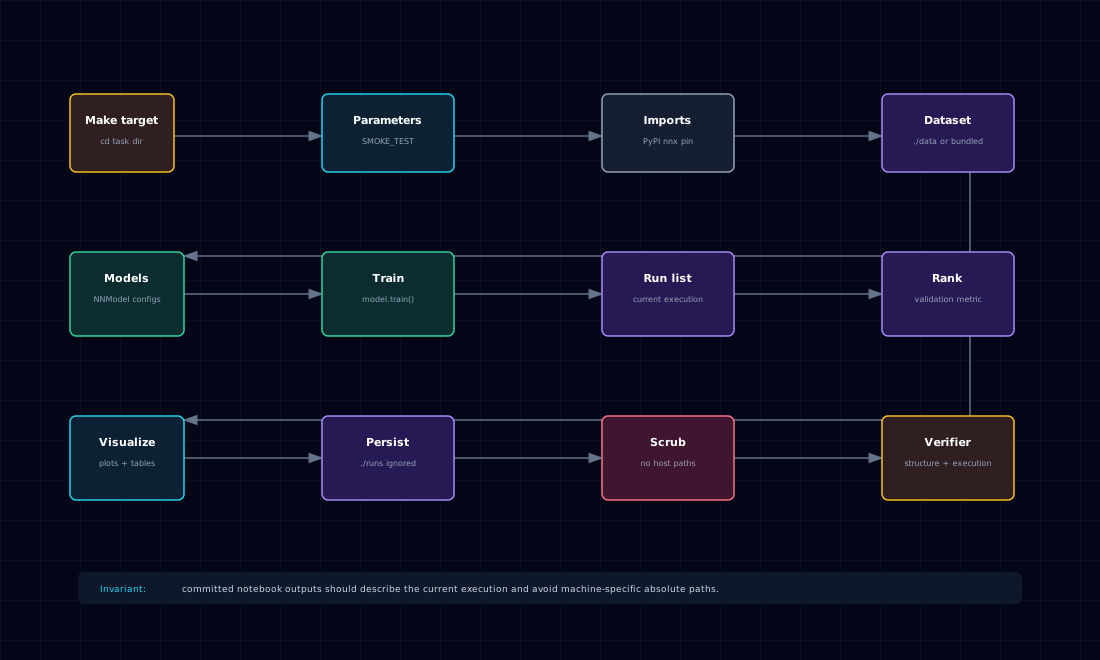
The sequence separates task-local execution from repository-wide validation. That boundary keeps ignored run artifacts near their task while allowing CI to verify source notebooks without mutating their committed outputs.
| Tier | Cost | Re-run policy | Local target |
|---|---|---|---|
| A | Cheap (<5 min) | make run-tier-a deliberately refreshes a committed snapshot; CI smoke-runs to /tmp/ml-tier-a without rewriting it. |
make run-tier-a / make smoke-tier-a |
| B | Moderate (model-selection sweeps) | Original outputs preserved. Smoke-run with SMOKE_TEST=1 to /tmp/. |
make smoke-tier-b |
| C | Expensive (main GPU training) | Historical Aug-2023 GPU outputs preserved as artifact. Smoke-run with SMOKE_TEST=1 to /tmp/. |
make smoke-tier-c |
5.2.1 The SMOKE_TEST papermill parameter¶
Tier-B and Tier-C notebooks are gated by an injected papermill parameters
cell that defines SMOKE_TEST = 0 (full run). The smoke targets pass
-p SMOKE_TEST 1, which each notebook reads to shrink its workload: the
parameterized image_classification-mnist-ffnn-pytorch notebook reduces its
sweep, the reddit phase2 notebooks run smoke-truncated epochs/subsets (notebook4
also reduces fanout via n_neighbors=[5,5]), and the phase3 notebooks take the
CPU path. scripts/inject_smoke_test_cell.py adds this cell when promoting a
notebook to Tier-B/C, and tests/test_inject_smoke_test_cell.py guards the
injected shape against papermill parser drift.
5.2.2 What CI runs¶
- Complete pytest, every PR and every push to
developormain: the unconditionalpytest-repositoryjob installs the runtime and documentation dependency sets, runs exactmake test, and has a 15-minute cap. It does not initialize Atlas and accepts only explicit, reason-bearing test skips. - Tier-A, every PR and every push to
developormain: thetier-a-papermilljob runsmake smoke-tier-a, writes fresh copies under/tmp/ml-tier-a, then runsmake check-tier-a-artifactsandmake check-tier-a-cleanto prove every output exists and execution did not rewrite tracked source notebooks. Those fresh copies are uploaded as a 7-day artifact; committed notebook outputs are refreshed only deliberately withmake run-tier-a. The job has a 90-minute cap: Linux GH runners are roughly 3–4× slower than a macOS M-series CPU for the hand-coded numpy training loop inimage_classification-mnist-ffnn-numpy. - Tier-B: runs on the weekly schedule, on
workflow_dispatch, and on PRs labeledtier-b-smoke. Writes to/tmp/ml-smoke; never touches committed outputs. - Tier-C: runs on the weekly schedule and on
workflow_dispatchonly. - All smoke targets execute each notebook from its own task directory
(papermill
cwd= the notebook's folder), so relative paths behave like an interactive run. Training/evaluation may therefore create ignored task-local./data/or./runs/artifacts even when source outputs are preserved.
5.2.3 Tier-C output preservation¶
Tier-C phase3 notebooks are locked to the immutable annotated
tier-c-deterministic-seeding-atlas-baseline-2026-08-22 git tag at commit
35e7903afe45f60e5e30bf8fbd49f7d6463caa6a for their code-cell source.
The execution check E5 fails closed if that fully qualified tag is missing,
lightweight, moved, or unreadable, and diffs each Tier-C notebook's code cells
against it; markdown cells and embedded outputs are deliberately not
compared, so wording fixes are safe. Edit phase3 markdown via
scripts/edit_notebook_markdown.py rather than by hand. The historical pre-cleanup-baseline
remains an unchanged rollback anchor; never move either published baseline tag.
5.2.4 Notebook output freshness¶
For every output-bearing code cell in a notebook enumerated by the authoritative
active_task_dirs inventory, cell.metadata.source_hash is a bare lowercase 64-character
SHA-256 digest of the exact UTF-8 logical code-cell source. A JSON source string is used as-is;
a JSON source array concatenates its string elements with no separator. Whitespace, comments,
magics, line endings, and syntax are not normalized.
Output bytes are never hashed. The marker says retained outputs correspond to the source now in
the cell; it does not say that nondeterministic output rendering is byte-reproducible. E8 reports
error severity for missing, malformed, stale, or orphan markers across all active notebooks.
Any metadata.source_hash on an outputless code, markdown or raw cell is
E8.source_hash_orphan; normal stamping removes all such markers.
The exception boundary is deliberately narrow: notebooks/archive/ is immutable historical
material outside the active inventory, and outputless code cells are structurally inapplicable and
must not carry a marker. There is no tag, path, wildcard, or general exemption for an
output-bearing active cell.
make run-tier-a, make smoke-tier-a, make smoke-tier-b, and make smoke-tier-c invoke
scripts/stamp_notebook_source_hashes.py only after successful Papermill execution. Papermill
inputs may inherit prior source hashes, so merely skipping that success stamper is not sufficient
when execution fails. On a nonzero exit, each Make target checks whether its in-place or temporary
artifact exists and invokes --clear to validate the failed/partial notebook and atomically remove
every cell's metadata.source_hash; the success stamper is never invoked. The target preserves
the execution failure even when cleanup also fails. This caught-failure boundary cannot run after
an uncatchable host or process kill, so it does not claim crash durability beyond the atomic file
replacement itself.
Clear mode requires one or more explicit notebook paths and rejects --all-active. For intentional
maintenance repair, use python scripts/stamp_notebook_source_hashes.py --all-active; it is not a
replacement for executing changed source. A success-stamper failure still fails the Make target.
Both modes validate the raw nbformat-4 schema on the parsed JSON without normalization or coercion
before mutation. Rollback is separable: reverting verifier/execution enforcement does not rewrite
outputs, while reverting the metadata migration alone makes E8 fail.
5.3 Validation gates¶
A change is not ready until the repository verifier, complete pytest contract, Ruff, and documentation gate pass. CI keeps complete pytest separate from faster focused and publication signals so failures remain attributable.
5.3.1 Repo verifier — make verify¶
scripts/verify_repo.py --check all --fast runs five checks (the --fast
flag only affects the execution check):
- Structure (
S) — task-folder naming, the absence of atasks/subdir and of a re-introducedcommon/(S7.forbidden_toplevel), no tracked bloat (S7.tracked_bloat), expected top-level layout. - Assets (
D11) — the exact VADER manifest and the install/verify ordering shared by Make, Docker, CI, Codespaces, the sentiment notebook, and Atlas. - Docs (
D) —check_docsvalidates the generated documentation tree for self-containment, completeness againstdocs/manifest.yaml, and the absence of placeholder text. - Comments (
C) — comment/code invariants the repo relies on. - Execution (
E) — in--fastmode this is skipped; in full mode it runs the Tier-A/B/C papermill smoke.E5is the Tier-Ctier-c-deterministic-seeding-atlas-baseline-2026-08-22code-cell equality gate described above.
Exit code 0 means zero error-severity findings; warnings are
informational. The verifier is the source of truth for "is the repo
internally consistent" and runs in CI as the verify-repo job.
5.3.2 Pytest — make test¶
Runs pytest tests/ -v. The test tree covers the docs pipeline
(test_manifest, test_links, test_transforms, test_render_diagrams,
test_build_docs, test_wiki, test_check_docs, test_push_wiki), the
verifier and helper scripts (test_verify_repo,
test_inject_smoke_test_cell, test_edit_notebook_markdown,
test_rewrite_imports), the Makefile contract (test_makefile_contract),
and NNx surface guards (tests/nnx_surface/). The pytest configuration's
testpaths = ["tests"] plus its infra, notebooks/archive, and .venv
exclusions define collection; no fixed test count is contractual.
Both NNx-consuming pytest jobs install the exact hash-required Linux lock selected by
requirements/lock-policy.toml; the NNx wheel is binary-only within that lock. After dependency
installation and immediately before their test workload, both run make verify-nnx-install: the
unconditional pytest-repository job then runs make test, while pytest-nnx-surface runs
make test-nnx-surface. No package installation may intervene between verification and either
workload.
pytest-repository is the required merge-blocking complete-suite contract. Its setup installs
libcairo2, the selected runtime lock, and the hash-required documentation lock; cache identity
includes the lock policy, source inputs, and committed locks. pytest-nnx-surface is the focused
diagnostic NNx/PyPI compatibility and Ruff signal. Both jobs validate the canonical released wheel
with make verify-nnx-install; editable results are development-surface evidence only (see
dependency-contracts.md §6).
5.3.3 Atlas consumer policy — make test-atlas-consumer¶
The atlas-consumer-policy job runs unconditionally on every pull request and is intended to be a
required gate. It recursively checks out the exact infra/ gitlink so projection tests inspect the
real pinned Atlas files, sets up exact Python 3.11.15, installs the bootstrap lock and hash-required
Atlas contract lock, runs ShellCheck, and executes the focused Make target.
atlas-contract-requirements.txt remains the human-authored input and includes exact
nltk==3.10.3 for the VADER runtime-probe tests; routine execution consumes
requirements/locks/atlas-contract.txt.
The fourth step runs
shellcheck scripts/atlas-up.sh scripts/atlas-down.sh scripts/atlas-connect.sh scripts/lib/atlas-dotenv.sh.
The fifth runs exact make test-atlas-consumer, which selects the consumer contract, lifecycle,
runtime-probe, and Makefile-contract test modules. The job does not start, stop, or contact Atlas,
JupyterHub, Ollama, ComfyUI, Docker Compose, or unrelated containers. It is a focused parent-policy
signal inside complete make test, not a replacement for the required pytest-repository job.
The separate atlas-contract workflow is path-scoped and non-required. It recursively checks out
infra/ and directly validates the Atlas consumer manifest against that pinned submodule when an
Atlas input changes; it is not the unconditional parent-policy gate.
5.3.4 Dependency advisory policy — make audit-advisories¶
make audit-advisories runs the unsuppressed comparison of the combined-runtime, Torch,
documentation, and parent-owned Atlas-contract surfaces against
security/accepted-advisories.json. New primary IDs and accepted-version drift fail; a disappeared
accepted ID is a reconciliation notice, not proof of remediation. Update the JSON policy and the
current Markdown ledger rows together through review. The focused audit does not initialize Atlas
or start any service.
All four audit surfaces use exact lock-derived, no-resolve projections. The combined-runtime and Torch surfaces also carry explicit non-PyPI PyG-extension evidence instead of asking PyPI to re-resolve those platform wheels. The gate validates each projection against the selected locks before network access.
The unconditional dependency-audit job is isolated from pytest-repository and
atlas-consumer-policy for attribution and timeout isolation. The controller makes it the third
required GitHub context alongside those two existing contexts; the job itself does not make a
ruleset change. Issue #63 supplies and verifies the complete lock family consumed by this job.
5.3.5 Lint — make lint¶
ruff check . using the [tool.ruff] config in pyproject.toml: line length
120, target py311, rules E/F/W selected, E501 (line too long) ignored
because much of the code is notebook-derived and under gradual cleanup.
Tier-C phase3 notebooks carry per-file ignores because their source is locked
to the baseline tag.
5.3.6 Docs gate — make docs-check¶
Render diagrams (scripts/docs.render_diagrams) → run check_docs →
mkdocs build --strict. The dedicated .github/workflows/docs.yml workflow
runs this plus ruff check scripts/docs/ and the docs-script unit tests on
any PR touching docs/, notebook READMEs, mkdocs.yml, scripts/docs/,
docs-requirements.txt, or the Makefile. This is the gate that catches
broken manifest entries, leaked placeholders, and non-self-contained generated
pages before they reach the published site.
5.4 Commit & PR workflow¶
- Branch off
develop. Open a feature branch from the currentdevelopHEAD and merge it there through a pull request. Promote the resultingdevelopstate tomainthrough a separate pull request; do not merge a feature branch directly tomain. - PRs are required on
main. Branch protection (set 2026-05-29) requires a pull request, allows zero approvals, and forbids force-push and deletion. This lets the solo maintainer self-merge while keeping every change on the reviewable PR queue. - Conventional commit messages. Use the
type(scope): subjectform (feat,fix,docs,ci,chore,test,refactor). The recent history is consistent with this —feat(docs): 20 notebook deep-dives,fix(docs): push_wiki defaults a commit identity, `ci(docs): install ruff - pytest in the docs gate`. Scope the message to the change.
- One concern per PR. Don't bundle unrelated cleanup with a feature. Tier-C notebook re-execution, if ever needed, belongs in its own PR — preserved outputs are intentional and rare to touch.
- CHANGELOG is the durable record. A PR description goes stale after
merge;
CHANGELOG.md(Keep-a-Changelog format) is the long-term history. Wrap one workstream per branch and keep going on the same branch; record the outcome in the CHANGELOG rather than editing old PR bodies.
5.4.1 Pre-PR checklist¶
make verify(fast, <30 s) — must exit 0.make testlocally; CI reruns that complete contract aspytest-repositoryand also retains the focusedpytest-nnx-surfacesignal.- If you changed the Atlas consumer policy, run
make test-atlas-consumerbefore opening the PR. - If you changed an audited manifest or accepted advisory, run
make audit-advisories. make lint.- If you touched a notebook: re-run it at the right tier (
make run-tier-afor an intentional Tier-A snapshot refresh,make smoke-tier-afor a non-mutating Tier-A execution,make smoke-tier-b,make smoke-tier-c). Aftermake smoke-tier-a, runmake check-tier-a-artifactsandmake check-tier-a-cleanto confirm the generated copies exist and sources remained unchanged. - If you touched docs:
make docs-check.
5.5 Documentation convention¶
ml-eng-lab projects a canonical documentation source set into two additional, derived surfaces. Canonical sources are the only documentation files a human edits.
- Canonical sources — the root
README.md, manifest-declared root governance pages such asSECURITY.md, the hand-authored files underdocs/, and the per-task notebook READMEs.docs/manifest.yamlindexes every page projected into the site and wiki, including root governance pages. This is where content is written and reviewed. This page, architecture.md, env-setup.md, dependency-contracts.md, and the otherdocs/*.mdfiles all live in the canonical source set. - Generated MkDocs site —
python -m scripts.docs.build_docs --siterenders the manifest into a site input undergenerated/, thenmkdocs build --strictproducessite/. Published to GitHub Pages by the Pages workflow. Built locally withmake docs-buildor previewed withmake docs-serve. - Generated GitHub wiki —
python -m scripts.docs.build_docs --wikirenders the same manifest into wiki Markdown, andscripts/docs/push_wiki.pypushes it to the repo's wiki (which renders frommaster, not the repo defaultmain). Previewed locally withmake docs-wiki(a--checkdry run).
The three rules that follow from this:
- Never hand-edit the generated trees.
generated/, the rootmkdocs.yml, andsite/are gitignored and rebuilt on every change. If a page looks wrong in the site or wiki, fix the canonical source (or the generator inscripts/docs/), not the rendered output. - The manifest drives both derived surfaces. Adding a new
docs/*.mdpage or root governance page means adding an entry todocs/manifest.yaml; thecheck_docscompleteness check fails if a canonicaldocs/*.mdpage is undeclared or if a declared source is missing. - Root entry and governance pages link only to in-repo files. The three surfaces are deliberately independent: a reader of the raw repo (GitHub source view, clone) never depends on the generated site or wiki to follow a link. The generated surfaces link among themselves; canonical root pages do not link into them.
The documentation gate (§5.3) enforces self-containment (every generated page must resolve its assets without leaving the site), completeness (manifest ↔ source agreement), and the absence of placeholder text — so the three-surface pipeline stays in sync without manual reconciliation.