8.19 Preference alignment — toy DPO¶
A comprehensive walk-through of notebooks/preference_alignment-toy-dpo-pytorch/ — the in-repo
canonical demo of Direct Preference Optimization (Rafailov et al., 2023) on a tiny
TransformerNN. This page is the deep-dive companion to the task notebook: it states the problem,
builds the DPO loss math from first principles, dissects the reference-policy + contrastive-step
architecture, reads the code top to bottom, reports the measured chosen−rejected log-prob gap, and
lands the central contract — DPO training must strictly increase the policy's chosen−rejected
log-prob gap relative to the reference.
The notebook is Tier-A — CPU re-runs in about seven seconds and it is re-executed end-to-end
in CI on every pull request. The model is deliberately tiny (4 976 parameters, 16-dim residual
stream) and the preference corpus is 16 hand-written (prompt, chosen, rejected) triplets
(cheerful chosen, gloomy rejected) so the whole DPO recipe — BPE tokenizer, NNPreferenceDataset,
auto-freezing reference, dpo_train_step_factory, before/after gap measurement — runs on a laptop.
The recorded gap is large because the corpus is tiny and the policy overfits; the contract (gap
must increase) holds, which is the pedagogical point.
8.19.1 Problem & motivation¶
Aligning a language model to human preferences is the post-pretraining step that turns a
next-token predictor into a helpful assistant. The dominant historical recipe is RLHF (reward
model + PPO); Direct Preference Optimization (DPO) replaces that two-stage pipeline with a single
contrastive loss over (prompt, chosen, rejected) triplets, with no reward model and no RL.
This notebook exists for three reasons:
- First in-repo exercise of the
nnxDPO stack. The megamerge ships the full recipe:NNPreferenceDatasetpackages the triplets (prompt/chosen/rejected tokenization, padding, batching),dpo_train_step_factory(ref_model, beta=, pad_token_id=)produces thetrain_step_fnconsumed bypolicy.train(...), and the reference model is automatically frozen inside the factory (every parameterrequires_grad=False,.eval()mode). This notebook walks every piece end-to-end on a single self-contained corpus, on CPU. - Make the DPO contract concrete on real numbers. The notebook measures the
chosen−rejected log-prob gap before training, runs DPO, re-measures after, and asserts the gap
strictly increased. On the recorded run the gap moves from
+2.1434(before) to+59.6521(after) — a delta of+57.5087. The absolute magnitude reflects overfitting on 16 triplets; the sign and direction are the contract. - Reusable seam for the §8.16 generative stack. DPO rides on the same
GenerativeNNModel+TransformerNN+train_step_fn=hook as the §8.16 language-modeling notebook. The only difference is the step function: §8.16 injectslm_train_stepfor next-token cross-entropy; this notebook injects the DPO factory's step for contrastive preference loss. A reader who understands both notebooks has the full generative-and-alignment skeleton.
The falsifiable hypothesis tested by the notebook is that even at toy scale — 16 triplets, 12 epochs, a 4 976-parameter transformer — DPO training strictly increases the policy's chosen−rejected log-prob gap relative to the frozen reference. The notebook asserts this and fails loudly if it ever inverts.
8.19.2 Concepts¶
| Concept | Where it shows up |
|---|---|
| Preference alignment | (prompt, chosen, rejected) triplets; learn to prefer chosen over rejected |
| Direct Preference Optimization (DPO) | Contrastive loss replacing reward-model + PPO |
| Reference vs policy model | ref_model frozen; policy trained; both start bit-identical |
| Chosen−rejected log-prob gap | The metric DPO optimizes; must strictly increase |
| Temperature β | beta=0.1 trades off "stay close to ref" (low β) vs "move toward preference" (high β) |
| Auto-freezing | dpo_train_step_factory sets requires_grad=False + .eval() on the reference |
NNPreferenceDataset |
Packages triplets with prompt/response length bounds + padding |
| BPE tokenizer (tiny) | train_bpe on a 10-line corpus; effective vocab 52 (target 80 unreachable) |
| Decoder-only transformer (tiny) | TransformerNN, d_model=16, n_layers=2, n_heads=2 |
| Implicit reward | DPO is the optimal policy under a Bradley-Terry reward derived from the data |
The nnx surface consumed: GenerativeNNModel, NNTransformerParams, NNTokenizerParams,
NNModelParams, NNTrainParams, NNOptimParams, NNPreferenceDataset,
dpo_train_step_factory, train_bpe, plus the enums Devices, Losses, Nets, Optims and
nnx.set_seed. The factory + dataset pair is the DPO-specific half; everything else is shared
with §8.16.
8.19.3 Mathematical formulation¶
DPO derives a maximum-likelihood objective for preference data from the RLHF setup, eliminating the reward model. Let \(\pi_{\mathrm{ref}}\) be the frozen reference policy (the starting point) and \(\pi_\theta\) the trainable policy. For a triplet \((x, y_w, y_l)\) — prompt \(x\), chosen (winning) response \(y_w\), rejected (losing) response \(y_l\) — define the implicit reward as the log-ratio of policy to reference, summed over response tokens:
Under a Bradley-Terry preference model, the probability that \(y_w\) is preferred over \(y_l\) is the sigmoid of the reward difference:
Maximizing the log-likelihood of the observed preferences gives the DPO loss:
Two observations from the form:
- At initialization \(\pi_\theta = \pi_{\mathrm{ref}}\) (the policy starts as a bit-identical
copy), so both log-ratios are zero, the sigmoid argument is zero, and
\(\mathcal{L}_{\mathrm{DPO}} = -\log \sigma(0) = \log 2 \approx 0.6931\). The recorded
first-iteration loss is exactly
0.6931, confirming the reference and policy start identical — a built-in sanity check. - The loss pushes the policy to raise \(\log \pi_\theta(y_w \mid x)\) and lower \(\log \pi_\theta(y_l \mid x)\), both relative to the reference. This is why the chosen−rejected log-prob gap,
is the metric the notebook measures before and after training. The DPO contract is that \(\mathrm{gap}\) strictly increases from its pre-training value — equivalently, the policy becomes more confident in chosen over rejected than the reference was.
The β knob trades off "stay close to the reference" (low β → small KL move, slow preference
update) vs "move aggressively toward the preference" (high β → large move, risk of degenerating).
beta=0.1 is the recipe-paper default; production sweeps β ∈ {0.01, 0.1, 0.5} and picks by
held-out win-rate.
8.19.4 Architecture¶
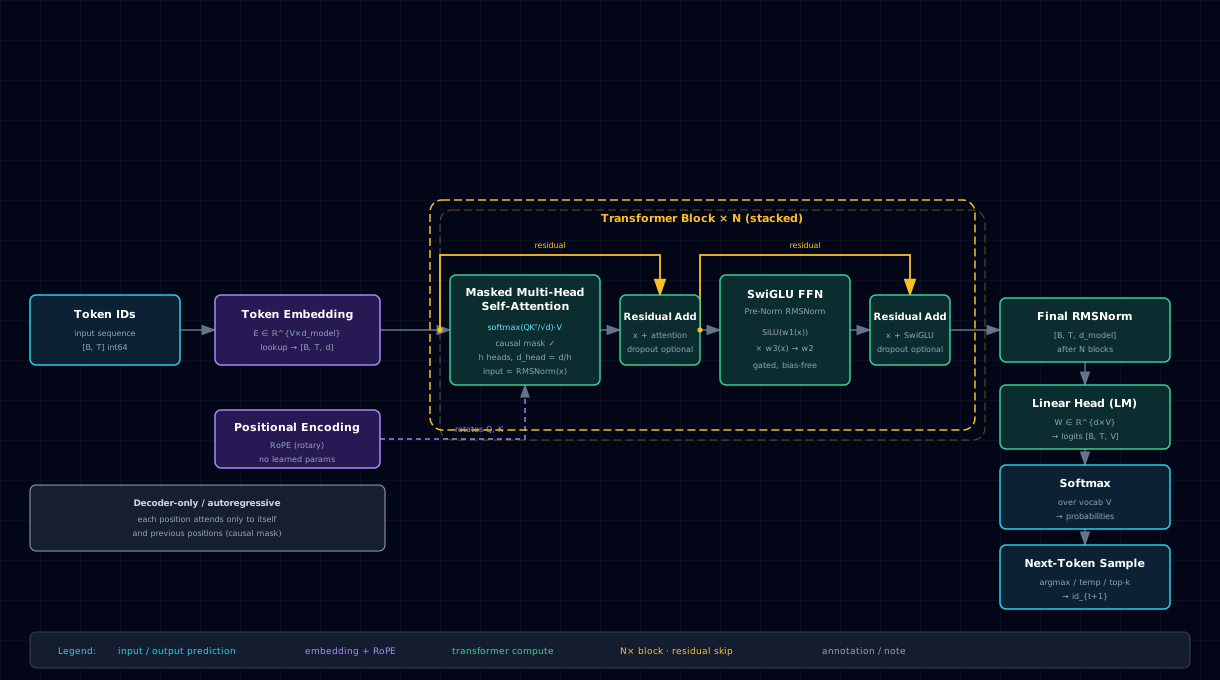
Two identical transformer models — a frozen reference and a trainable policy — sharing the same architecture and the same starting weights.
Model (Nets.TRANSFORMER): the same decoder-only transformer as §8.16, one notch smaller:
| Knob | Value | Role |
|---|---|---|
n_layers |
2 |
Two transformer blocks |
d_model |
16 |
Residual-stream width |
n_heads |
2 |
Two attention heads, \(d_k = 8\) |
max_seq_len |
64 |
Covers prompt + response (8 + 8 padded) |
ffn_mult |
2 |
FFN hidden width \(= 2 \times 16 = 32\) |
dropout_prob |
0.0 |
Disabled |
vocab_size |
52 |
Effective BPE vocab (target 80 unreachable on a 10-line corpus) |
Recorded parameter count: 4 976.
The DPO-specific contract:
- Reference:
make_lm()built afternnx.set_seed(0); frozen insidedpo_train_step_factory(requires_grad=False,.eval()). - Policy:
make_lm()built after a secondnnx.set_seed(0)so the init RNG matches the reference, thenpolicy.net.load_state_dict(ref_model.net.state_dict())as a belt-and-suspenders guard so any init drift cannot violate the DPO assumption that policy starts == reference. - Loss: the DPO contrastive loss above, applied via the factory's
train_step_fn. - Optimizer:
Optims.ADAM,max_lr=5e-3,momentum=(0.9, 0.999),weight_decay=0.0. - β:
0.1;pad_token_id=1(the<pad>id in the special-token list). - Device:
Devices.CPU; Epochs:12; Batch size:4; Seed:0.
The data: 16 (prompt, chosen, rejected) triplets (5 distinct tuples cycled, "cheerful chosen,
gloomy rejected" — e.g. "the cat" → chosen "is happy and warm", rejected "sat on the mat").
A 10-line tokenizer corpus trains the BPE tokenizer. NNPreferenceDataset tokenizes and pads each
triplet to max_prompt_len=8 / max_response_len=8, batches 4-at-a-time → 4 batches/epoch × 12
epochs = 48 iterations.
8.19.5 Code walkthrough¶
8.19.5.1 Reference and policy construction¶
def make_lm():
    net_params = NNTransformerParams(
        input_dim=tokenizer.vocab_size, output_dim=tokenizer.vocab_size,
        dropout_prob=0.0, vocab_size=tokenizer.vocab_size,
        n_layers=N_LAYERS, n_heads=N_HEADS,
        d_model=D_MODEL, ffn_mult=2, max_seq_len=MAX_SEQ_LEN,
    )
    model_params = NNModelParams(net=Nets.TRANSFORMER, device=DEVICE, loss=Losses.CROSS_ENTROPY)
    return GenerativeNNModel(net_params=net_params, params=model_params, tokenizer=tokenizer)

nnx.set_seed(0)
ref_model = make_lm()
nnx.set_seed(0)                                  # same init RNG for policy
policy = make_lm()
policy.net.load_state_dict(ref_model.net.state_dict())   # belt-and-suspenders: policy == ref
The seed reset + load_state_dict pair is the explicit guarantee that policy starts
bit-identical to ref_model. This matters because DPO's initialization-sanity check (loss = log 2
at step 0) only holds when the two models are identical; any drift would surface as a wrong
first-iteration loss and invalidate the §8.19.3 reasoning.
8.19.5.2 Preference dataset¶
ds = NNPreferenceDataset(
    prompts=PROMPTS, chosen=CHOSEN, rejected=REJECTED,
    tokenizer=tokenizer,
    max_prompt_len=MAX_PROMPT_LEN, max_response_len=MAX_RESPONSE_LEN,
    pad_token_id=PAD_TOKEN_ID,
    batch_sizes=(BATCH_SIZE, BATCH_SIZE, BATCH_SIZE),
    val_proportion=0.0, test_proportion=0.0,
    seed=0,
)
NNPreferenceDataset packages the three parallel lists into padded (prompt, response) tensor
pairs per triplet, with prompt and response truncated/padded to their respective length
bounds. The batch_sizes triple sets train/val/test batch sizes; with val_proportion=0 and
test_proportion=0, all 16 triplets go to the train loader → 4 batches of 4.
8.19.5.3 The DPO train step (factory)¶
step_fn = dpo_train_step_factory(ref_model, beta=BETA, pad_token_id=PAD_TOKEN_ID)
This is the load-bearing line. The factory captures ref_model, freezes it
(requires_grad=False on every parameter, .eval() mode so dropout/batchnorm are inert), and
returns a train_step_fn that computes the DPO loss above for each batch. The freezing is
verified by the nnx test suite (bit-for-bit reference invariance after training); the notebook
never calls requires_grad_ or .eval() itself — that is the factory's contract.
8.19.5.4 Training¶
run = policy.train(
    params=NNTrainParams(
        n_epochs=N_EPOCHS, train_loader=ds.train_loader,
        optim=NNOptimParams(name=Optims.ADAM, max_lr=LR,
                            momentum=(0.9, 0.999), weight_decay=0.0),
    ),
    train_step_fn=step_fn,
)
The train_step_fn=step_fn seam swaps the default classification step for the DPO contrastive
step — the same hook §8.16 uses for lm_train_step. Training runs 4 batches × 12 epochs = 48
iterations; the resulting NNRun is checkpointed to ./runs/<run-id>.
8.19.5.5 The before/after gap measurement¶
def _lp(seq):
    logits = net(seq)
    log_probs = torch.log_softmax(logits, dim=-1)
    resp_logits = log_probs[:, prompt_len - 1 : -1, :]
    resp_targets = seq[:, prompt_len:]
    return resp_logits.gather(dim=-1, index=resp_targets.unsqueeze(-1)).squeeze(-1).sum(dim=-1)

# Before: policy == ref, so gap reflects the random init's incidental bias.
# After:  policy trained on the triplets.
# Assert: gap_after - gap_before > 0  (the DPO contract).
The _lp helper computes the token-summed response log-prob under a model — the raw ingredient
of both the DPO loss and the gap metric. The [:, prompt_len - 1 : -1, :] slice aligns the
log-prob of predicting response token \(t_i\) with the position that generates it (one step
before), and the .gather(...) picks out exactly the ground-truth response token's log-prob. The
gap is the mean of (chosen_lp - rejected_lp) across triplets; the notebook measures it on the
policy before and after training and asserts the delta is positive.
8.19.6 Results & analysis¶
On the recorded Tier-A run (SMOKE_TEST=0, 12 epochs, 48 iterations):
| Stage | Mean chosen−rejected log-prob gap |
|---|---|
| BEFORE DPO (policy == ref) | +2.1434 |
| AFTER DPO (policy trained) | +59.6521 |
| delta (DPO contract) | +57.5087 (> 0 ✓) |
DPO loss trajectory: 0.6931 → 0.0039. The first-iteration loss 0.6931 equals \log 2, exactly
the theoretical DPO loss at init when policy == ref — a built-in sanity check that the two models
start identical. The final loss 0.0039 is essentially zero, meaning the policy has fully
separated chosen from rejected on the train triplets.
Three observations:
- The DPO contract holds. The gap strictly increased (
+2.14 → +59.65, delta+57.51 > 0). This is the load-bearing claim: DPO training moved the policy to prefer chosen over rejected more than the reference did. The notebook asserts this and would fail loudly if it ever inverted. - The recorded gap is large because the corpus is tiny. With 16 triplets and 12 epochs the
policy overfits — chosen tokens get very high log-prob, rejected get very low. The
+59.65after-gap reflects overfitting more than generalization; a real DPO run on thousands of triplets with held-out evaluation would show a much smaller, more honest gap. The contract (gap must increase) is the right invariant to test; the magnitude is not the right number to boast about. - The before-gap is
+2.14, not zero. A random-init transformer does not produce a uniform distribution over tokens — its incidental biases already favor chosen tokens slightly on average. This is why DPO measures the change in gap relative to the reference, not the absolute gap. A before-gap of zero would be a coincidence; the+2.14baseline is the honest starting point the after-gap must beat.
The §6.3 prose owns the overfitting caveat and points at the scaling levers (real preference data, β-sweep, held-out win-rate evaluation, DPO variants like IPO and KTO).
8.19.7 Pitfalls & edge cases¶
- The recorded
+59.65is the post-training gap, not the improvement. The improvement is+57.51. The README's framing risks conflating the two; the gap itself moved from+2.14to+59.65, a delta of+57.51. Either reading confirms the DPO contract, but the magnitude to cite as "what DPO bought" is the delta. - The gap is large because of overfitting, not generalization. With 16 train triplets and no
held-out evaluation, the policy can memorize the specific chosen/rejected token sequences. Real
DPO runs measure win-rate of the trained policy vs the reference on a held-out preference set;
with 16 triplets there is no spare data to carve off, so the notebook measures only the train
gap. Read the
+57.51delta as "DPO works on the train signal," not "the policy generalized." - No held-out evaluation. Real DPO measures win-rate on a held-out preference set. With 16 train triplets the notebook does not bother carving off a val/test split; this is the right call at toy scale but the wrong call the moment the corpus grows.
β=0.1is the recipe-paper default, not a tuned value. Production DPO sweepsβ ∈ {0.01, 0.1, 0.5}and picks by held-out win-rate. Low β moves the policy slowly (safer); high β moves it aggressively (risk of degenerating). The notebook keeps the default for reproducibility.- The reference is frozen inside the factory, not in notebook code.
dpo_train_step_factorysetsrequires_grad=Falseand.eval()onref_model— but you will not see those calls in the notebook. If you want to train another model afterwards, build a freshNNModel; do not try to "un-freeze" the reference (its.eval()state and zeroed grad flags will leak). - The BPE target vocab (80) is unreachable on a 10-line corpus.
train_bpe(vocab_size=80)on 10 lines produces an effective vocab of 52 — there are not enough merge candidates. The transformer inheritsvocab_size=52viatokenizer.vocab_size. Real LM tokenizers have vocab 30 k–100 k; the tiny vocab here is a correctness smoke, not a quality claim. - No generation demo. The notebook measures the log-prob gap, not actual generations from the
trained policy.
policy.generate(prompt)would give Shakespeare-style gibberish at this scale; the gap is the cleaner metric and the one that directly tests the DPO contract.
8.19.8 Extensions & references¶
- Add a held-out win-rate evaluation. Split the 16 triplets (or scale to 100+) into train/held-out; measure the trained policy's win-rate vs the reference on the held-out set via a judge (the reference itself, or an external reward model). This is the production-grade DPO metric and the one that exposes the overfitting caveat in §8.19.7.
- Sweep β. Run DPO at
β ∈ {0.01, 0.1, 0.5}on the same triplets and report the gap trajectory + held-out win-rate for each. The β that maximizes held-out win-rate is the one to ship; the recipe default is a starting point, not a tuned value. - Try DPO variants: IPO, KTO. Identity Preference Optimization (IPO) adds a regularization
term to prevent the loss from collapsing to zero on small datasets; KTO (Kahneman-Tversky
Optimization) drops the paired-triplet requirement and trains on unpaired preferred/non-preferred
examples. Both are one-line swaps in the
train_step_fnand exercise the sametrain_step_fn=seam. - Scale the model + corpus. A real DPO run uses a 7B-parameter policy and thousands of triplets from a real preference dataset (Anthropic HH-RLHF, OpenAssistant, UltraFeedback). The gap shrinks to a few points but generalizes; the contract (gap > 0) still holds.
- Reference reading. Rafailov et al., "Direct Preference Optimization: Your Language Model is
Secretly a Reward Model" (2023) for the derivation of the DPO loss from the RLHF objective;
Ethayarajh et al., "IPO" (2023) for the regularization-on-small-data variant; the nnx examples
directory for the reference
dpo_train_step_factoryimplementation this notebook consumes.