8.17 Text classification — AG-News spaCy + MLP¶
A comprehensive walk-through of notebooks/text_classification-agnews-spacy-mlp-pytorch/ — the
first in-repo NLP classification task and the canonical exemplar of the
tokenize → vectorize → classify recipe that predates Transformers and still underpins most
production text classifiers. This page is the deep-dive companion to the task notebook: it states
the problem, builds the math, dissects the pipeline, reads the code top to bottom, reports the
measured accuracy, and catalogues the pitfalls — chief among them the train-only vocabulary
footgun that silently inflates evaluation accuracy when handled wrong.
The notebook is Tier-A — CPU re-runs in about thirteen seconds and it is re-executed end-to-end
in CI on every pull request. The corpus is embedded inline (80 hand-written headlines, 20 per
topic, tiled 4×) so the notebook is fully self-contained: no torchtext.datasets.AG_NEWS download,
no HuggingFace auth, no network hang in CI. It pairs naturally with the future
text_classification-imdb-distilbert-hf roadmap entry — same task family, transformer vectorizer
instead of BoW.
8.17.1 Problem & motivation¶
AG-News is the canonical four-topic news-headline classification benchmark (World / Sports / Business / Sci-Tech). This notebook solves an AG-News-style version of it on an embedded hand-written corpus, deliberately small so the entire pipeline — tokenization, vocabulary construction, featurization, training, evaluation — fits in one screen and runs in seconds on a laptop CPU.
The notebook exists for three reasons:
- Land the pre-transformer NLP recipe. The dominant text-classification pipeline shape — tokenize → vectorize → classify — predates Transformers and is still the right baseline for many production text classifiers (high-throughput routing, spam, topic tagging). This notebook lands that recipe with the simplest vectorizer (bag-of-words) and the smallest plausible model (one-hidden-layer MLP) so the recipe shape is unambiguous.
- First NLP classification task in the lab. The existing text task
(
text_generation-tinyshakespeare-transformer-pytorch, §8.16) is autoregressive generation, not classification. This notebook is the classification counterpart and exercises theFeedFwdNN+NNModelcore on text features the same way §8.1 exercised it on tabular features. - Make the train-only-vocabulary footgun explicit. The standard silent error in text-classification pipelines is building the vocabulary over the entire corpus (train + test), leaking test-only tokens into the featurizer and inflating accuracy. The notebook builds the vocabulary from the train split only and flags the choice in a code comment so a reader copying the recipe cannot miss it.
The falsifiable hypothesis tested by the notebook is that a single hidden layer over a 200-dim L2- normalized BoW featurization clears ~80% test accuracy on this four-topic corpus — i.e. that the top-200 lemma vocabulary is discriminative enough to separate the topics even with one-hot order destroyed.
8.17.2 Concepts¶
| Concept | Where it shows up |
|---|---|
| Multi-class text classification | Four AG-News topics; one correct label per headline |
| spaCy lemmatization + stopword/punct removal | nlp = spacy.load("en_core_web_sm", disable=["parser","ner"]) then lemma filter |
| Bag-of-words (BoW) featurization | Counts of vocab-token lemmas per document — order discarded |
| L2-normalized counts | Each BoW vector divided by its L2 norm so doc length doesn't dominate the dot product |
| Train-only vocabulary | Counter built from train docs only; most_common(200) keeps the top-K |
| MLP classifier | nnx.FeedFwdNN with hidden_dims=[64], ReLU, dropout 0 |
| Softmax + cross-entropy | The training objective over the four logits |
| Macro-averaged precision/recall/f1 | Per-class metrics averaged equally — right under the balanced 16-per-class test split |
| Stratified train/test split | train_test_split(..., stratify=labels_np) keeps all four topics balanced |
The nnx surface consumed: NNModel, NNParams, NNModelParams, NNTrainParams,
NNOptimParams, plus the enums Activations, Devices, Losses, Nets, Optims, VisUtils,
and nnx.set_seed. The text-specific half of the pipeline (spaCy, sklearn, numpy) sits outside
nnx and is glued together by hand — this is the pre-transformer recipe, before any of it was
absorbed into a unified API.
8.17.3 Mathematical formulation¶
The classifier maps a document to one of four topic logits. The pipeline has three stages, each with its own math.
Tokenization. Each headline string is mapped to a sequence of lowercased lemmas with stopwords and punctuation removed. This is a deterministic filter, not a continuous transform; it reduces the vocabulary to its discriminative content words.
Bag-of-words featurization. Let \(V\) be the train-only vocabulary (the \(K = 200\) most frequent train lemmas). For a document with token-multiset \(T\), the raw BoW vector is
Tokens not in the vocabulary (out-of-vocabulary at test time, or below the frequency cutoff) are silently dropped — they contribute zero. The vector is then L2-normalized:
L2 normalization removes the effect of document length so that a 12-token headline and a 6-token headline with the same relative lemma distribution map to the same feature vector. (TF-IDF would further down-weight corpus-frequent tokens; this notebook stays at the simplest baseline.)
Classifier. The MLP produces a four-vector of logits \(z = (z_0, z_1, z_2, z_3)\) via a single hidden layer with ReLU:
with shapes \(W_1 \in \mathbb{R}^{64 \times 200}\), \(W_2 \in \mathbb{R}^{4 \times 64}\). The softmax + cross-entropy objective is identical to the Iris tabular case (§8.1.3):
where \(c\) is the index of the correct topic. The optimizer is Adam with \(\eta = 5 \times 10^{-3}\), weight decay \(10^{-3}\), and momentum \((0.9, 0.999)\).
8.17.4 Architecture¶
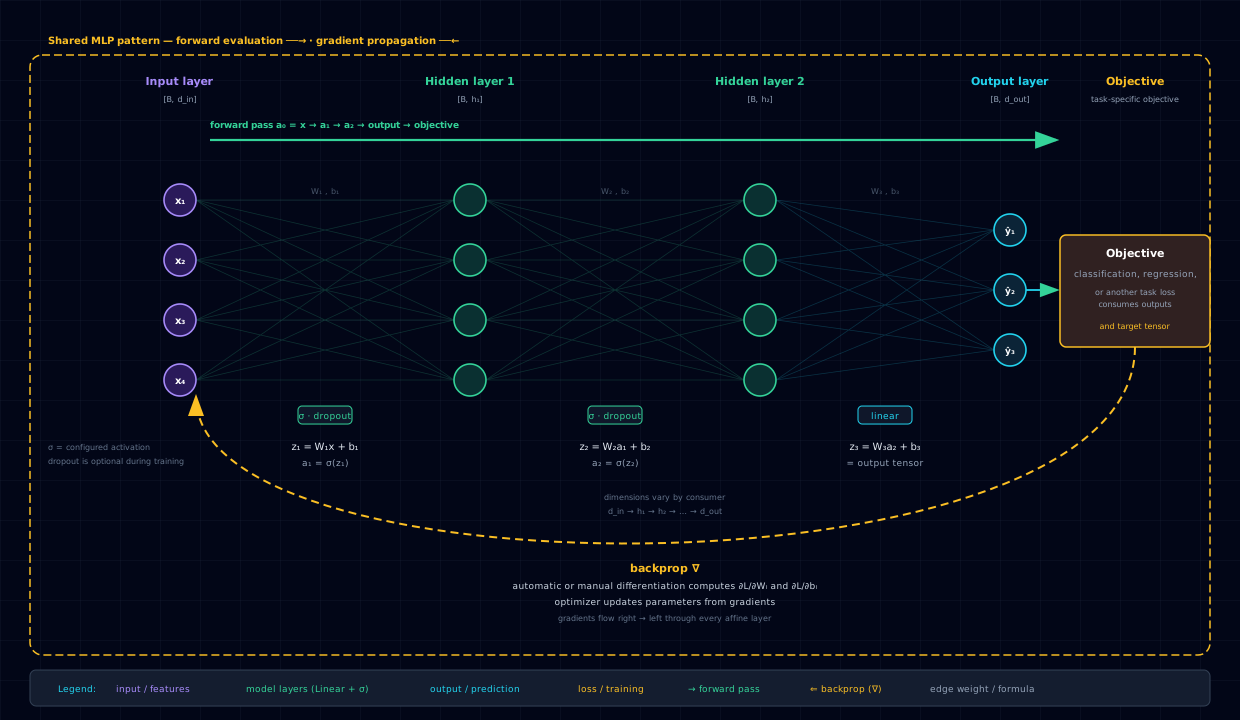
The pipeline has two stages — a frozen hand-written featurizer and a learned MLP head.
Featurizer (frozen): spaCy lemmatizer + 200-dim train-only BoW + L2 normalization. No learned parameters; the entire "representation learning" is the choice of vocabulary and the L2 norm.
Classifier (Nets.FEED_FWD): a single-hidden-layer MLP, identical in shape to the Iris
Candidate B:
| Layer | Width | Activation |
|---|---|---|
| Input | 200 (vocab size) | — |
| Hidden | 64 | ReLU |
| Output | 4 (topics) | softmax (via cross-entropy) |
dropout_prob=0.0 — with 256 train docs and a 64-unit hidden layer, heavier dropout starves the
head of signal; the L2 normalization and weight decay already regularize.
The shared contract — everything held constant:
- Net:
Nets.FEED_FWD - Loss:
Losses.CROSS_ENTROPY - Optimizer:
Optims.ADAM,max_lr=5e-3,momentum=(0.9, 0.999),weight_decay=1e-3 - Device:
Devices.CPU - Epochs:
80(full run) or5(SMOKE_TEST=1for CI) - Batch size:
16 - Seed:
0
The data: 80 unique headlines (20 per topic) tiled CORPUS_REPEAT=4 → 320 documents, split 80/20
stratified → 256 train / 64 test (16 per topic in test). The train docs surface 410 unique lemmas;
the top 200 by train frequency are kept as the vocabulary. The test loader is wired as the
val_loader for visibility into per-epoch test loss — a deliberate choice on a tiny corpus, flagged
in the pitfalls.
8.17.5 Code walkthrough¶
8.17.5.1 spaCy lemmatization¶
nlp = spacy.load("en_core_web_sm", disable=["parser", "ner"])

def tokenize(text):
    doc = nlp(text)
    return [t.lemma_.lower() for t in doc
            if not t.is_stop and not t.is_punct and t.lemma_.strip()]
The parser and NER pipes are disabled for speed — only the tokenizer + tagger (needed for
lemmatization) run. The filter keeps content-word lemmas: lowercased, non-stopword, non-punct,
non-empty-after-strip. The t.lemma_.strip() guard also drops whitespace/SPACE tokens (whose
lemma is the whitespace itself).
8.17.5.2 The train-only vocabulary (the footgun)¶
counter = Counter()
for i in train_idx:                          # <- train split ONLY
    counter.update(tokens_per_doc[i])
vocab = {tok: idx for idx, (tok, _) in enumerate(counter.most_common(VOCAB_SIZE))}
# Vocab from TRAIN ONLY — leaking test tokens into the vocab is a real evaluation
# footgun in text-classification pipelines.
This is the single most important line in the notebook. for i in train_idx (not range(len(texts)))
guarantees that test-only tokens never enter the vocabulary. If the loop ran over all docs, the
featurizer would "see" the test distribution at vocabulary-construction time — a subtle form of
data leakage that inflates test accuracy by a few points and is invisible unless you audit the
vocab-construction loop. Recorded: 410 unique lemmas in train, top 200 kept. The vocab maps
token → dense index ordered by descending train frequency (so index 0 is the most frequent lemma).
8.17.5.3 L2-normalized BoW featurizer¶
def featurize(toks):
    v = np.zeros(VOCAB_SIZE, dtype=np.float32)
    for tok in toks:
        if tok in vocab:                      # OOV tokens silently dropped
            v[vocab[tok]] += 1.0
    n = np.linalg.norm(v)
    if n > 0:
        v /= n                                # L2-normalize so doc length doesn't dominate
    return v
Out-of-vocabulary tokens (test-only lemmas, or below-top-200 lemmas) hit the if tok in vocab
guard and contribute zero — this is the correct behavior and the flip side of the train-only
vocab choice: at test time the model must work with the vocabulary it learned, exactly as it would
in production. The L2 normalization projects every BoW vector onto the unit sphere so that the
downstream dot-product logits measure direction, not magnitude.
8.17.5.4 MLP head and training¶
def make_model():
    return NNModel(
        net_params=NNParams(input_dim=VOCAB_SIZE, output_dim=len(TOPIC_NAMES),
                            hidden_dims=HIDDEN_DIMS, dropout_prob=0.0,
                            activation=Activations.RELU),
        params=NNModelParams(net=Nets.FEED_FWD, device=DEVICE, loss=Losses.CROSS_ENTROPY),
    )

run = model.train(
    params=NNTrainParams(
        n_epochs=N_EPOCHS, train_loader=train_loader,
        val_loader=test_loader,               # tiny corpus — visibility, not early-stopping
        optim=NNOptimParams(name=Optims.ADAM, max_lr=LR,
                            momentum=(0.9, 0.999), weight_decay=1e-3),
    ),
)
The val_loader=test_loader wiring is a deliberate small-corpus choice: with only 64 test docs
there is no separate val split to carve off, so the test loss is surfaced per-epoch for visibility
into convergence — but it is not used for early-stopping or model selection. Training runs 16
batches/epoch × 80 epochs = 1280 iterations.
8.17.5.5 Evaluation¶
y_pred = np.argmax(model.predict_proba(X_test), axis=1)
print(classification_report(y_test, y_pred, target_names=TOPIC_NAMES))
VisUtils.confusion_matrix(Y_true=y_test, Y_pred=y_pred, class_names=TOPIC_NAMES, ...)
classification_report surfaces per-class precision/recall/f1; the confusion-matrix heatmap (via
VisUtils) is the directly-interpretable artifact showing which topic pairs get confused.
8.17.6 Results & analysis¶
On the recorded Tier-A run (SMOKE_TEST=0, 80 epochs, 1280 iterations) the loss trajectory is
train loss 1.3738 → 0.1120, val loss 1.3172 → 0.2770 across the 80 epoch-end probes. Test
accuracy 85.94% (55/64 correct). Per-class metrics, recorded verbatim:
| Topic | Precision | Recall | F1 | Support |
|---|---|---|---|---|
| world | 1.00 | 0.81 | 0.90 | 16 |
| sports | 0.87 | 0.81 | 0.84 | 16 |
| business | 0.70 | 1.00 | 0.82 | 16 |
| sci-tech | 1.00 | 0.81 | 0.90 | 16 |
| macro avg | 0.89 | 0.86 | 0.86 | 64 |
Three observations:
- Business is over-predicted. It has recall 1.00 (every business test doc is caught) but precision 0.70 — meaning several non-business docs get routed into business. The confusion matrix shows business absorbing overflow from sci-tech and world. This is the typical failure mode when one topic's vocabulary overlaps another's (business ↔ sci-tech is the classic AG-News overlap; world ↔ sports is the other).
- World and sci-tech have precision 1.00. When the model predicts them it is always right — the business over-prediction is what costs the remaining points. A TF-IDF featurizer or a bigram vocabulary would likely tighten the business boundary.
- The 86% headline is on a 64-doc test split. Each misclassification costs ~1.5 percentage
points. The notebook pins
random_state=0so the result is reproducible, but a different seed would move the boundary by a point or two. Read the headline as "on this split," not "on AG-News" — real AG-News at 120 k docs lands near 90–91% with this exact recipe.
8.17.7 Pitfalls & edge cases¶
- Train-only vocabulary is the load-bearing choice. The single most common silent error in
text-classification pipelines is building the vocabulary over the entire corpus. The
featurizer then "knows" about test-only tokens at vocabulary-construction time — a subtle leak
that inflates accuracy by a few points. The notebook loops
for i in train_idxand flags the choice in a code comment. If you copy this recipe, audit this loop first. en_core_web_smis part of the immutable root lock.requirements/lock-policy.tomladmits only the exacten-core-web-sm==3.8.0direct URL and SHA-256, somake install-torch-stackinstalls the model without an unreviewed secondary solve. The notebook has no in-notebook download fallback and fails loudly if a noncanonical environment omits the model.val_loader=test_loaderis visibility, not model selection. On a 64-doc test split there is no val set to carve off, so the test loss is surfaced per-epoch for convergence visibility but is not used for early-stopping. This is defensible at this scale; it is not the pattern to copy for a real 120 k-doc run, where you would hold out a proper val split for hyperparameter selection.- No baseline. A standard pipeline compares the MLP against
sklearn.naive_bayes.MultinomialNBorsklearn.linear_model.LogisticRegressionon the same BoW features. At this corpus scale the MLP does not necessarily win; the notebook ships without that comparison (queued) and the §8.17.6 numbers should be read as "this MLP's score," not "BoW-MLP's ceiling." - BoW destroys word order. "Stock market closes at record high" and "high record at closes market stock" featurize identically. Negation, scope, and phrase-level meaning are all lost. For topic classification this is mostly fine (topics are keyword-driven); for sentiment it is a much bigger loss — see §8.18.
- The embedded corpus is tiny. 80 unique headlines × 4 tiling = 320 documents. Real AG-News is 120 k. Absolute accuracy is not directly comparable; the recipe shape and the pitfalls are the transferable lessons.
8.17.8 Extensions & references¶
- Add sklearn baselines on the same BoW features.
MultinomialNBandLogisticRegressionare the standard BoW baselines; running both on the same featurizer isolates what the MLP's hidden layer actually buys (likely nothing at this scale). This is the queued comparison the notebook ships without. - Upgrade the featurizer to TF-IDF + bigrams. Term-frequency–inverse-document-frequency
down-weights corpus-frequent tokens (the/and/of) that the stopword filter misses; bigrams
(
ngram_range=(1,2)) recover minimal phrase structure ("stock market", "interest rate"). Both typically add 2–5 accuracy points on AG-News. - Swap BoW for pretrained embeddings. Average GloVe or fastText vectors per document as the feature vector instead of BoW counts. This captures word similarity (market ≈ economy) that one-hot BoW cannot, and is the natural stepping stone toward a transformer fine-tune.
- Scale to real AG-News via
torchtext.datasets.AG_NEWSor HuggingFace. 120 k training docs land this recipe near 90–91% accuracy; the bottleneck moves from featurization to train-time throughput. Requires solving the issue #3 network-download-in-CI problem first (cache the dataset, or fetch in a setup step outside the papermill run). - Reference reading. Manning, Raghavan & Schütze, Introduction to Information Retrieval
(2008), ch. 13–14 for BoW + TF-IDF + Naive Bayes; Jurafsky & Martin, SLP (3rd ed.), ch. 4–5
for logistic regression on text. The spaCy lemmatizer docs (
spacy.io/api/lemmatizer) cover thelemma_.lower()filter pattern this notebook uses.