8.8 Quantization — MNIST FFN (PTQ + QAT via torchao)¶
A comprehensive walk-through of notebooks/quantization-mnist-ffnn-pytorch/ — the canonical
in-repo demo of post-training quantization (nnx.quantize_int8) and quantization-aware training
(nnx.qat_train_step_factory + nnx.QATLifecycleCallback), both backed by torchao. This page is
the deep-dive companion to the task notebook: it states the problem, builds the quantization math,
dissects the PTQ vs QAT contracts, reads the code top to bottom, reports the measured
accuracy / size / latency comparison, and catalogues the pitfalls and extensions.
The notebook is Tier B under Issue #66 on Torch 2.11.0 (torch==2.11.0),
torchvision==0.26.0, torchao 0.18.0 (torchao==0.18.0), and
thekaveh-nnx[lm]==0.2.0. Its one-epoch
smoke executes complete PTQ and QAT, proves final conversion, reconstructs the saved QAT shadow
checkpoint exactly, and emits a fail-closed semantic marker. The retained NNx 0.2.0 8da4w
model.train call has one exact test-local UserWarning debt at
torchao/quantization/quant_primitives.py; zero warnings or tuple drift retires the assertion, and
all other warnings remain fatal under -W error. The full three-epoch path is qualified locally and
through the retained Atlas JupyterHub runtime. The older committed Torch 2.8.0 outputs remain
historical evidence and are not rewritten.
This notebook belongs to the "efficient/compressed MLP" family: where §8.5 edits the architecture and §8.7 drives the weights sparse, quantization keeps the architecture and sparsity fixed and instead reduces the bitwidth of the weights (and, in QAT, the activations).
8.8.1 Problem & motivation¶
Once a model trains, you would often like to deploy it smaller and faster. Quantization maps the trained FP32 weights (and, in some recipes, activations) to lower-bitwidth integers — int8, int4, or mixed — so the deployed model needs less memory and, on hardware with low-bitwidth kernel support, runs faster. The catch is accuracy: lower bitwidths approximate the FP32 weight distribution less faithfully, and at aggressive bitwidths (4-bit) the approximation error can cost real accuracy.
Two canonical recipes trade off differently:
- PTQ (post-training quantization) — quantize an already-trained model in one shot. Cheap (no extra training), but accuracy can drop if the weight distribution does not quantize cleanly.
- QAT (quantization-aware training) — insert fake-quant ops during training so the optimizer sees the quantization noise and adapts to it. Slower (a full extra training run), but typically recovers more accuracy than PTQ at the same bitwidth.
This notebook exists for two reasons:
- First in-repo exercise of
nnx.quantize_int8and the QAT lifecycle. Thennxrelease ships both recipes via thetorchaobackend; this notebook is the canonical side-by-side demo on the same baseline architecture, with size + latency + accuracy measured for direct comparison. - The PTQ-vs-QAT trade-off is the deployment decision. Measuring all three (FP32 baseline, PTQ int8, QAT 8da4w) on one figure makes the Pareto frontier — accuracy vs size vs latency — directly visible, and the right operating point depends on which constraint binds at deployment.
The falsifiable hypothesis tested by the notebook is that PTQ int8 weight-only quantization recovers near-FP32 accuracy at a \(\sim 4\times\) size reduction, while 8da4w QAT reaches the smallest size at a measurable accuracy cost that a longer training budget would mostly close.
8.8.2 Concepts¶
| Concept | Where it shows up |
|---|---|
| Post-training quantization (PTQ) | nnx.quantize_int8(fp32_model) — one-shot, no extra training |
| Quantization-aware training (QAT) | qat_train_step_factory + QATLifecycleCallback — fake-quant during training |
| INT8 weight-only | PTQ packs Linear weights as int8 with per-channel scales; activations stay FP |
| 8da4w (8-bit dynamic act, 4-bit weight) | The QAT config; dominant edge-LLM deployment recipe |
| Fake-quant (straight-through estimator) | Forward quantizes; backward uses the FP gradient (STE) |
| Per-channel scales | One scale per output channel; finer than per-tensor quantization |
| int4 groupsize 32 | 4-bit weights grouped in blocks of 32; hidden widths must divide 32 |
QATLifecycleCallback |
on_train_begin inserts fake-quant; on_train_end converts to truly-quantized |
| QAT checkpoint reconstruction | torch.load(qat_checkpoint_path, weights_only=False) + NNModel.from_checkpoint explicitly load deterministic last.pt, then prove exact saved-state/metadata parity and finite evaluation |
| Tier B semantic output | One-epoch deterministic smoke plus a machine-readable PTQ/QAT/checkpoint contract |
The nnx surface consumed is: NNModel, NNParams, NNModelParams, NNTrainParams,
NNOptimParams, NNDataset, Activations, Devices, Losses, Nets, Optims, set_seed, and
the quantization primitives nnx.quantize_int8, nnx.qat_train_step_factory,
nnx.QATLifecycleCallback. The torchao backend is opt-in via the nnx[quantize] extra.
8.8.3 Mathematical formulation¶
Uniform affine quantization. A real weight \(w\) is mapped to an integer \(\bar{w}\) in \(\{0, \dots, 2^b - 1\}\) via a scale \(s\) and (optionally) a zero-point \(z\):
For a weight matrix \(W\), per-channel quantization chooses one scale \(s_c\) per output channel (column of \(W\)), set to \(s_c = \max_i |W_{ic}| / (2^{b-1}-1)\) for symmetric int8. Per-channel scales track the per-column dynamic range and are markedly more accurate than a single per-tensor scale for typical weight distributions.
PTQ (int8 weight-only). The trained FP32 weights are quantized once to int8 with per-channel
scales; activations stay FP at runtime. The forward pass dequantizes the int8 weights back to FP
for the matmul. This is cheap (no training) and works well when the weight distribution is
quantization-friendly. nnx.quantize_int8 returns a new NNModel whose Linear layers are the
torchao int8-weight-only variants.
QAT (8da4w). Training inserts fake-quant nodes that simulate the quantization rounding in the forward pass while the backward pass uses the straight-through estimator (STE) — gradients pass through the rounding unchanged:
This lets the optimizer "see" the quantization noise and adapt the FP weights to minimize its
effect. The QATLifecycleCallback(qat_config="8da4w") swaps the Linear layers for fake-quant
variants at on_train_begin and converts them to truly-quantized variants (real int4 weights, real
int8 dynamic activations) at on_train_end. The 8da4w recipe uses 8-bit dynamic activations
(quantized per-batch at runtime) and 4-bit weights in groups of 32.
Groupsize constraint. The int4 weights are quantized in blocks of groupsize=32 contiguous
entries, each block with its own scale. A Linear weight column whose width does not divide 32
either needs padding_allowed=True or fails the QAT preparation step. The notebook picks
HIDDEN_DIMS=[128, 64] (both multiples of 32) to avoid this entirely.
The training objective is cross-entropy on the MNIST logits,
and the baseline optimizer is Adam with \(\eta = 10^{-3}\), \(\beta = (0.9, 0.999)\), weight decay \(0\).
8.8.4 Architecture¶
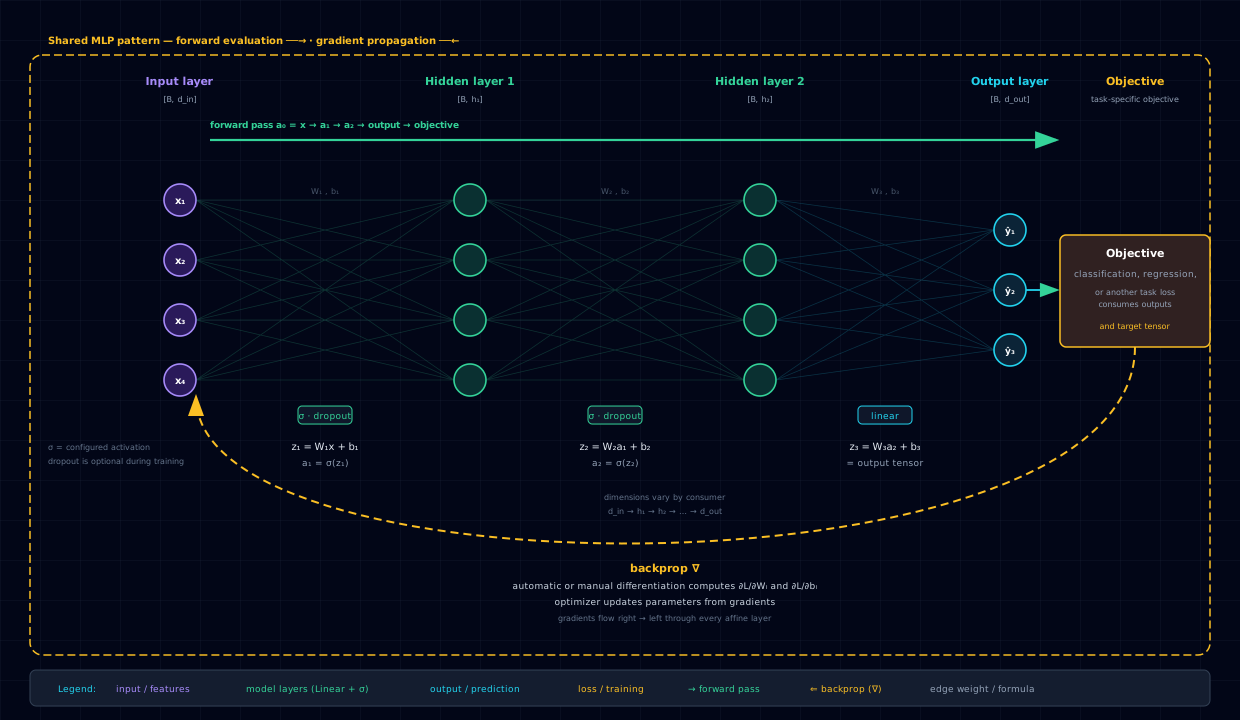
The architecture is Nets.FEED_FWD (nnx.FeedFwdNN): a 784-unit input layer (flattened MNIST),
two hidden layers [128, 64] with ReLU, and a 10-unit output layer consumed by softmax +
cross-entropy. The widths are chosen as multiples of 32 so the 8da4w int4 groupsize divides
cleanly.
| Object | hidden_dims |
Role |
|---|---|---|
| FP32 baseline | [128, 64] |
Trained 3 epochs from scratch; the accuracy ceiling and size floor |
| PTQ int8 (weight-only) | [128, 64] |
quantize_int8(fp32_model) — one-shot on the baseline |
| QAT 8da4w | [128, 64] |
Fresh model trained end-to-end with the QAT callback |
The shared contract:
- Net:
Nets.FEED_FWD, activation:Activations.RELU - Loss:
Losses.CROSS_ENTROPY - Optimizer: Adam,
max_lr=1e-3,weight_decay=0.0,momentum=(0.9, 0.999) - Device:
Devices.CPU - Budget:
N_EPOCHS=3for both the FP32 baseline and the QAT model (orSMOKE_TEST_EPOCHS=1underSMOKE_TEST=1) - Batching:
batch_sizes=(128, None, None)— 128-sample train minibatches; val as one batch - Seed:
0 - QAT config:
qat_config="8da4w"(8-bit dynamic activations, 4-bit weights, groupsize 32)
The a priori expectation at MNIST scale + a short budget: PTQ int8 shrinks the state-dict at a small accuracy hit (possibly slower on CPU because torchao dispatch overhead dominates the math savings at this tiny scale); QAT 8da4w has the smallest converted state-dict but the highest accuracy cost since 4-bit is aggressive, with recovery partial at 3 epochs.
8.8.5 Code walkthrough¶
8.8.5.1 PTQ — one-shot quantize_int8¶
fp32_model = make_model()
fp32_run = fp32_model.train(params=train_params())   # 3 epochs

ptq_model = nnx.quantize_int8(fp32_model)
print(f"PTQ model type: {type(ptq_model).__name__}")  # NNModel
nnx.quantize_int8 takes the trained NNModel and returns a new NNModel whose Linear weights
are packed int8 with per-channel scales; activations stay FP. The contract is "same forward shape,
possibly different output values within a quantization tolerance." No extra training is involved —
this is the cheap, one-shot path.
8.8.5.2 QAT — lifecycle callback + step factory¶
qat_model = make_model()
qat_cb = nnx.QATLifecycleCallback(qat_config="8da4w")
qat_step = nnx.qat_train_step_factory(qat_config="8da4w")

qat_run = qat_model.train(
    params=train_params(),
    callbacks=[qat_cb],
    train_step_fn=qat_step,
)
print(f"QAT callback: is_prepared={qat_cb.is_prepared}, is_converted={qat_cb.is_converted}")
Three moving parts. The QATLifecycleCallback hooks the train loop: at on_train_begin it swaps
the model's Linear layers for fake-quant variants (the forward quantizes, the backward uses STE);
at on_train_end it converts those fake-quant variants to truly-quantized variants (real int4
weights, real int8 dynamic activations). The qat_train_step_factory returns a custom train step
that knows how to step the fake-quant parameters. Both are passed to model.train(...). The
post-call assertions — is_prepared=True, is_converted=True, and the presence of
Int8DynActInt4WeightLinear modules in qat_model.net.modules() — verify the lifecycle ran to
completion.
8.8.5.3 The size + latency measurement¶
def state_size_bytes(model):
    return len(pickle.dumps(model.net.state_dict()))

def avg_latency_us(model, n_batches=10):
    """Mean per-batch forward latency in microseconds (CPU, eval mode)."""
    # warm up, then time n_batches forward passes on the val loader
    ...
state_size_bytes pickles the state_dict() to a bytes blob and takes its length — a direct proxy
for deployed model size. avg_latency_us warms up one batch then times ten forward passes on the
validation loader in eval() mode, returning the mean per-batch latency in microseconds. Both are
CPU measurements; the latency number is honest about the CPU context (see pitfalls — torchao
dispatch overhead can dominate at this scale).
8.8.5.4 The comparison table¶
rows = [
    ("FP32 baseline",        fp32_edp.loss, fp32_edp.accuracy, state_size_bytes(fp32_model), avg_latency_us(fp32_model)),
    ("PTQ int8 (weight-only)", ptq_edp.loss, ptq_edp.accuracy, state_size_bytes(ptq_model),  avg_latency_us(ptq_model)),
    ("QAT 8da4w (converted)",  qat_edp.loss,  qat_edp.accuracy,  state_size_bytes(qat_model),  avg_latency_us(qat_model)),
]
model.evaluate(ds.val_loader) returns an evaluation data point carrying loss and accuracy; the
size and latency helpers complete the three-axis comparison. The verdict sorts the three recipes by
the deployment constraint that matters (memory? latency? accuracy floor?).
8.8.6 Results & analysis¶
On the recorded historical run (committed outputs produced under torch 2.8.0), the three
recipes land as:
| Model | Val loss | Val acc | State size (KB) | Fwd latency (µs/batch) |
|---|---|---|---|---|
| FP32 baseline | 2.0587 | 53.48% | 429.3 | 1382 |
| PTQ int8 (weight-only) | 2.0587 | 53.38% | 112.6 | 1721 |
| QAT 8da4w (converted) | 2.0729 | 44.53% | 406.7 | 3512 |
Three observations:
- PTQ int8 recovers near-FP32 accuracy at \(\sim 4\times\) size reduction. Val accuracy drops only 0.10 pp (53.48% → 53.38%) while the state-dict shrinks from 429.3 KB to 112.6 KB. This is the cheap default working as advertised: int8 weight-only quantization on a friendly distribution is essentially free at MNIST scale.
- QAT 8da4w is the smallest at the highest accuracy cost. The converted state-dict is 406.7 KB — larger than PTQ int8 here, because the 8da4w module wraps the int4 weights with per-group scales/zero-points that, at this tiny model width, outweigh the 4-bit savings; on a real LLM the 4-bit weight compression dominates and 8da4w is much smaller than int8. Accuracy drops to 44.53% (a 9-point cost) because 4-bit is aggressive and the 3-epoch budget leaves QAT recovery partial — longer schedules typically close most of the gap.
- On CPU at MNIST scale, quantization is slower, not faster. PTQ int8 latency is 1721 µs (vs FP32's 1382 µs) and QAT 8da4w is 3512 µs. The torchao dispatch overhead dominates the math savings at this tiny model size on CPU; the latency win shows up on bigger models, GPUs, and mobile NPUs with native low-bitwidth kernels. Read the latency numbers as "CPU-bound, tiny model," not as a general statement about quantization speedup.
The right reading: quantization is a real Pareto trade-off, and the right operating point depends on which constraint binds at deployment. PTQ is the cheap default; QAT is the recourse when PTQ accuracy is not acceptable and a training budget is available. At MNIST scale the size win is real (PTQ) and the latency win is absent (CPU-bound); both generalize differently to larger models and accelerator hardware.
8.8.7 Pitfalls & edge cases¶
- Tier B is a correctness smoke, not an accuracy benchmark. It bounds both FP32 and QAT to one epoch, then proves PTQ/QAT conversion, exact checkpoint reconstruction, and semantic output. The full three-epoch path remains the release/Atlas qualification path, while committed older outputs remain immutable historical evidence.
- 8da4w is aggressive (4-bit weights). At the short training budget used here for CPU feasibility (3 epochs), QAT recovery is partial (44.53% vs FP32's 53.48%). Longer schedules typically close most of the gap; do not read the recorded QAT accuracy as the achievable 8da4w ceiling.
- CPU latency is misleading at MNIST scale. The torchao dispatch overhead can make int8 and 8da4w slower than FP32 on CPU at this model size (1721 µs and 3512 µs vs 1382 µs). The latency win shows up on bigger models, GPUs, and mobile NPUs with native low-bitwidth kernels. Do not report the CPU latency as a quantization speedup.
- Hidden widths must divide the int4 groupsize (32). The 8da4w default int4 groupsize is 32.
Hidden widths that do not divide 32 either trigger
padding_allowed=True(thennxtest suite uses this) or fail the QAT preparation step. The notebook picks[128, 64](both multiples of 32) to dodge this completely; an arbitrary width will surprise you. - The QAT val-loss is measured on the FP-shadow, not the converted net. During training the
fake-quant layers keep an FP "shadow" copy for the loss computation, so
qat_run.idps[-1].val_edp.lossreflects the FP-shadow forward, not the truly-quantized forward. The post-conversion accuracy comes fromqat_model.evaluate(...)aftermodel.train(...)returns (i.e. afteron_train_endconverted the layers). The notebook prints both and they differ slightly — do not conflate them. - Random-init baseline. The FP32 baseline is trained from scratch in this notebook (3 epochs). The PTQ + QAT delta is measured against this very-short FP32 ceiling; in production you would PTQ a more-converged model and the absolute accuracy numbers would be much higher across the board. The shape of the trade-off is what generalizes; the absolute numbers are a budget artifact.
- Deprecation noise.
torchaoemits aTorchAODType is deprecated, please use torch.intNUserWarningat import time under newer torch versions; this is harmless and does not affect correctness. Do not treat it as a failure.
8.8.8 Extensions & references¶
- Lengthen the budget to close the QAT recovery gap. Train the FP32 baseline to convergence (10–20 epochs), then PTQ it; separately train the QAT model for the same total budget. The PTQ accuracy hit should shrink (friendlier weight distribution) and the QAT recovery should close most of the gap to FP32 — the canonical production outcome the short Tier-A-style budget cannot show.
- Add an int4 PTQ point.
torchaosupports int4 weight-only PTQ as well; adding it to the comparison table gives a fourth operating point (cheaper than QAT, lower-accuracy than QAT in expectation) and completes the bitwidth Pareto curve. - Measure latency on a GPU / mobile NPU. The CPU latency numbers here are dispatch-bound and misleading. Re-running the latency measurement on a CUDA GPU or a mobile NPU with native int8 / int4 kernels exposes the real speedup that motivates quantization in deployment.
- Pair with pruning (§8.7). Prune to \(s = 0.7\), then PTQ or QAT the pruned model. Sparse + int8 / int4 is the dominant edge-deployment recipe; the joint Pareto curve over the \(s \times\) bitwidth grid is the full deployment study.
- Try
padding_allowed=Trueon non-32-multiple widths. If a wider architecture (e.g.[200, 100]) is desired, enable padding in the QAT config rather than redesigning widths around the groupsize. This trades a small accuracy noise for architectural freedom. - References. Jacob et al., 2018, Quantization and Training of Neural Networks for Efficient
Integer-Arithmetic-Only Inference (arXiv:1712.05877) — the canonical QAT formulation with the
straight-through estimator. The
torchaolibrary documentation covers the8da4wrecipe (Int8DynActInt4WeightLinear) and theInt8WeightOnlyConfigPTQ path. See also the taskREADME.md§4 anddocs/env-setup.md§4.1.6 for the Tier B execution path and the torch/torchao pin rationale, issue #10 for the historical reclassification, and Issue #66 for the restored automated contract.