8.18 Sentiment classification — VADER vs MLP¶
A comprehensive walk-through of notebooks/sentiment_classification-vader-mlp-pytorch/ — the
in-repo head-to-head between a hand-tuned rule-based lexicon (VADER) and a learned neural
classifier (spaCy BoW → MLP) on the same embedded sentiment corpus. This page is the deep-dive
companion to the task notebook: it states the problem, builds the math for both recipes, dissects
each pipeline, reads the code top to bottom, reports the measured head-to-head accuracy, and lands
the production-relevant lesson — hand-tuned lexicons are much harder to beat than the supervised-
ML literature acknowledges, so always include VADER as a baseline.
The notebook is Tier-A — CPU re-runs in about ten seconds and it is re-executed end-to-end in
CI on every pull request. The corpus is embedded inline (60 hand-written reviews, 20 per class,
tiled 4×) so the notebook is fully self-contained. It pairs naturally with the sibling AG-News
notebook (§8.17) — same BoW + MLP recipe, different task — and previews the future
text_classification-imdb-distilbert-hf transformer counterpart.
8.18.1 Problem & motivation¶
Three-class sentiment classification (negative / neutral / positive) is the canonical text-classification teaching task. Sentiment has two famously-good recipes, and this notebook runs both on the same corpus:
- VADER (Hutto & Gilbert, 2014) — a hand-tuned lexicon plus grammar rules. No training. The separately installed lexicon is integrity-locked by the repository. A strong, domain-robust baseline; in many production settings it beats supervised neural models on out-of-distribution text.
- Supervised neural — spaCy lemmatize → 100-token BoW → 32-hidden MLP, trained on labeled examples. Wins on in-distribution text; loses on domain shift.
The notebook exists for three reasons:
- Make the "lexicons are competitive" lesson concrete. Sentiment is the task where the gap between a zero-training lexicon and a learned neural model is smallest and most production-relevant. The recorded head-to-head on the embedded corpus (VADER 81.25% vs neural MLP 79.17%) makes the point on real numbers, not hand-waving.
- Land the VADER contract end-to-end. The
SentimentIntensityAnalyzerAPI, compound-score threshold mapping (±0.05per the original paper), and fail-closed preflight for the repository-installed lexicon are first-class and reproducible. A reader who copies this half of the notebook has a production-ready sentiment baseline without hidden network mutation. - Reuse the §8.17 recipe on a different task. The spaCy BoW +
FeedFwdNNMLP half is identical in shape to the AG-News notebook (same train-only vocab, same L2-normalized BoW, sameNNModelfactory). The contrast — same learned recipe, different baseline — isolates what the baseline choice buys.
The falsifiable hypothesis tested by the notebook is that on a 240-review embedded corpus the neural MLP does not meaningfully outperform VADER — i.e. that the "always include the lexicon baseline" advice is load-bearing at this scale, not a courtesy.
8.18.2 Concepts¶
| Concept | Where it shows up |
|---|---|
| 3-class sentiment classification | negative / neutral / positive; one correct label per review |
| VADER lexicon + polarity rules | SentimentIntensityAnalyzer().polarity_scores(text)['compound'] |
| Compound-score threshold mapping | > +0.05 → positive, < -0.05 → negative, else neutral (paper defaults) |
| Rule-based vs learned classifier | The notebook's central contrast — zero-training lexicon vs trained MLP |
| spaCy BoW featurizer | Same recipe as §8.17: lemmatize + train-only vocab + L2-normalized counts |
| MLP classifier | nnx.FeedFwdNN, hidden_dims=[32], ReLU, dropout 0 |
| Softmax + cross-entropy | The neural training objective over the three logits |
| Stratified train/test split | train_test_split(..., stratify=labels_np) keeps classes balanced |
| Verified NLTK resource preflight | nltk.data.find('sentiment/vader_lexicon.zip') after make verify-nlp-assets |
The nnx surface consumed is the same tabular/text-classification surface as §8.17 (NNModel,
NNParams, NNModelParams, NNTrainParams, NNOptimParams, the enums). The VADER half sits
entirely in NLTK (nltk.sentiment.vader.SentimentIntensityAnalyzer); the glue is a thin
vader_predict(text) function. prettytable.PrettyTable renders the head-to-head comparison.
8.18.3 Mathematical formulation¶
The two recipes produce the same output (a label in {neg, neu, pos}) by very different math.
VADER (rule-based). VADER maintains a hand-curated lexicon mapping word/emoji stems to a
valence in \([-4, +4]\). For an input text it sums the valences, applies grammar-rule
adjustments (intensifiers like very, negators like not, punctuation boost like !!!), and
normalizes to a compound score in \([-1, +1]\):
The normalize step is a fixed algebraic squash (sum divided by the square root of sum-of-squares
plus an alpha constant, then a tanh-like transform) — details in the VADER paper. The notebook
then thresholds:
The thresholds ±0.05 are the original-paper defaults; strict inequalities mean exactly ±0.05
falls into neutral. Domain-specific tuning (e.g. > 0.2 for more conservative positive
classification) helps on noisy text; the notebook keeps the defaults for reproducibility.
Neural MLP (learned). Identical math to §8.17.3 — L2-normalized BoW vector \(x\), single hidden layer with ReLU, three-class softmax + cross-entropy:
with \(W_1 \in \mathbb{R}^{32 \times 100}\), \(W_2 \in \mathbb{R}^{3 \times 32}\). Adam with \(\eta = 5 \times 10^{-3}\), weight decay \(10^{-3}\), momentum \((0.9, 0.999)\).
The key contrast is not the math but the training cost: VADER pays zero (the lexicon ships with NLTK); the neural MLP pays 192 samples × 60 epochs of gradient descent. On a 240-review corpus the lexicon's prior knowledge is worth roughly the learned model's capacity to overfit the train distribution — which is exactly the lesson.
8.18.4 Architecture¶
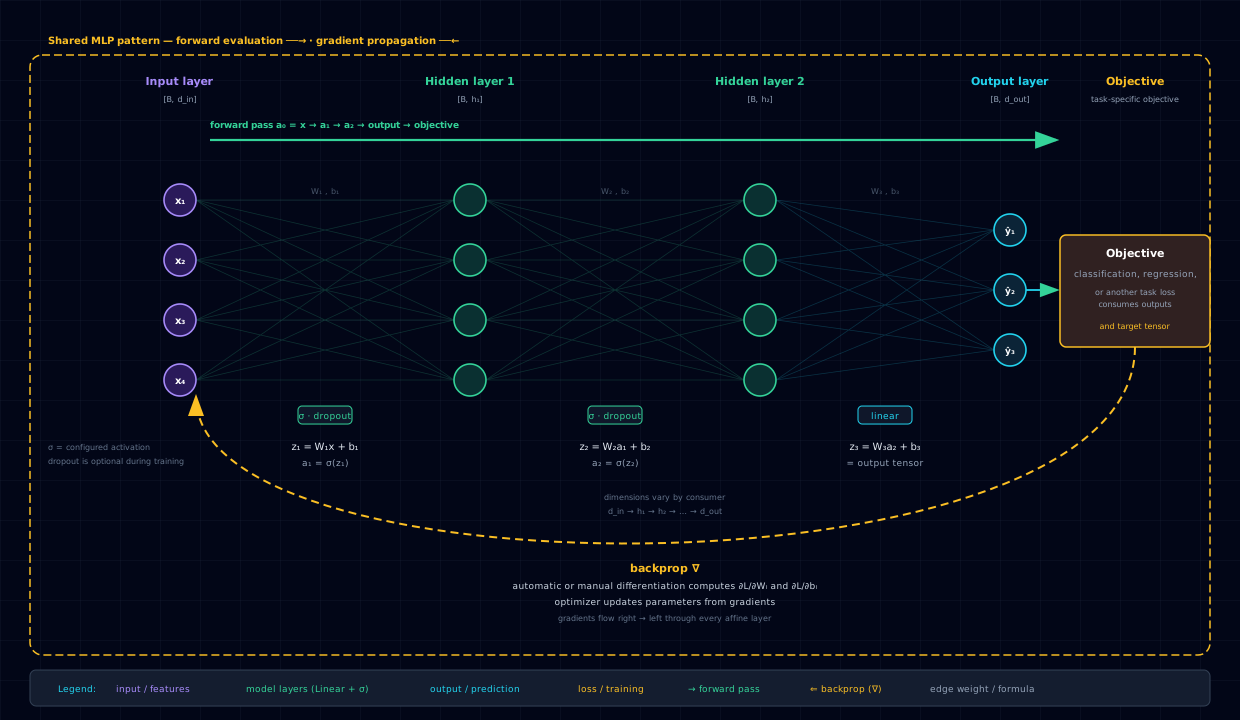
Two independent pipelines, evaluated on the same test split.
VADER pipeline (frozen): SentimentIntensityAnalyzer → compound score → ±0.05 threshold
mapping → label. No learned parameters, no training step, deterministic given the lexicon.
Neural pipeline (Nets.FEED_FWD): identical shape to the AG-News MLP, one notch smaller:
| Layer | Width | Activation |
|---|---|---|
| Input | 100 (vocab size) | — |
| Hidden | 32 | ReLU |
| Output | 3 (sentiment classes) | softmax (via cross-entropy) |
The shared neural contract:
- Net:
Nets.FEED_FWD - Loss:
Losses.CROSS_ENTROPY - Optimizer:
Optims.ADAM,max_lr=5e-3,momentum=(0.9, 0.999),weight_decay=1e-3 - Device:
Devices.CPU - Epochs:
60(full run) or5(SMOKE_TEST=1) - Batch size:
16 - Seed:
0
The data: 60 unique reviews (20 per class) tiled CORPUS_REPEAT=4 → 240 documents, split 80/20
stratified → 192 train / 48 test (16 per class in test). Each class is a mix of movie, product,
restaurant, and miscellaneous factual reviews — the factual reviews (release dates, weights,
opening hours) are the neutral class and the weak spot for both recipes.
8.18.5 Code walkthrough¶
8.18.5.1 VADER setup with verified lexicon preflight¶
from nltk.sentiment.vader import SentimentIntensityAnalyzer

try:
    nltk.data.find("sentiment/vader_lexicon.zip")
except LookupError as exc:
    raise RuntimeError(
        "VADER lexicon is missing; run `make nlp-assets` before this notebook"
    ) from exc
The notebook never downloads data. make nlp-assets installs the official 90,486-byte ZIP after
checking its SHA-256 and member identity; make verify-nlp-assets repeats the contract offline.
The preflight turns a missing asset into an actionable error before model work begins.
8.18.5.2 VADER prediction¶
sia = SentimentIntensityAnalyzer()

def vader_predict(text):
    score = sia.polarity_scores(text)['compound']
    if score > COMPOUND_POS_THRESHOLD:   return 2    # positive
    if score < COMPOUND_NEG_THRESHOLD:   return 0    # negative
    return 1                                          # neutral
One call per document, no batching, no training. The compound score is the normalized summary
valence; the two thresholds map it to the three labels. This is the entire VADER pipeline.
8.18.5.3 Neural half (spaCy BoW + MLP)¶
def tokenize(text):
    doc = nlp(text)
    return [t.lemma_.lower() for t in doc
            if not t.is_stop and not t.is_punct and t.lemma_.strip()]

counter = Counter()
for i in train_idx:                                  # train-only vocab (cf. §8.17)
    counter.update(tokens_per_doc[i])
vocab = {tok: idx for idx, (tok, _) in enumerate(counter.most_common(VOCAB_SIZE))}

def featurize(toks):
    v = np.zeros(VOCAB_SIZE, dtype=np.float32)
    for tok in toks:
        if tok in vocab: v[vocab[tok]] += 1.0
    n = np.linalg.norm(v)
    return v / n if n > 0 else v

clf = NNModel(net_params=NNParams(input_dim=VOCAB_SIZE, output_dim=len(LABEL_NAMES),
                                  hidden_dims=HIDDEN_DIMS, dropout_prob=0.0,
                                  activation=Activations.RELU),
              params=NNModelParams(net=Nets.FEED_FWD, device=DEVICE, loss=Losses.CROSS_ENTROPY))
run = clf.train(params=NNTrainParams(n_epochs=N_EPOCHS, train_loader=train_loader,
                optim=NNOptimParams(name=Optims.ADAM, max_lr=LR,
                                    momentum=(0.9, 0.999), weight_decay=1e-3)))
This is line-for-line the §8.17 recipe with VOCAB_SIZE=100, HIDDEN_DIMS=[32], three output
classes. The train-only vocabulary and L2-normalized BoW carry over verbatim — the pitfalls
discussed in §8.17.7 (train-only vocab, en_core_web_sm install) apply here unchanged.
8.18.5.4 Head-to-head comparison¶
vader_acc  = accuracy_score(y_test, [vader_predict(t) for t in X_test_text])
neural_acc = accuracy_score(y_test, np.argmax(clf.predict_proba(X_test), axis=1))
# PrettyTable renders the side-by-side accuracy + training-cost row.
Both recipes are evaluated on the same 48-doc stratified test split; the PrettyTable surfaces not just the accuracy but the training cost — the load-bearing asymmetry the lesson turns on.
8.18.6 Results & analysis¶
On the recorded Tier-A run (SMOKE_TEST=0, 60 epochs, 720 iterations) the head-to-head on the
48-doc stratified test split, recorded verbatim:
| Recipe | Accuracy | Training cost |
|---|---|---|
| VADER (rule-based) | 81.25% | none (lexicon ships with nltk) |
| neural MLP [32] | 79.17% | 192 samples × 60 epochs |
VADER wins by ~2 percentage points — on zero training. The neural MLP's final train loss was
0.1313, i.e. it fit the train split well; the gap to test is the generalization gap, not an
optimization failure. Per-class metrics, recorded verbatim:
| Recipe | Class | Precision | Recall | F1 |
|---|---|---|---|---|
| VADER | negative | 1.00 | 0.69 | 0.81 |
| VADER | neutral | 0.76 | 0.81 | 0.79 |
| VADER | positive | 0.75 | 0.94 | 0.83 |
| neural | negative | 0.80 | 0.75 | 0.77 |
| neural | neutral | 0.73 | 1.00 | 0.84 |
| neural | positive | 0.91 | 0.62 | 0.74 |
Three observations:
- The two recipes fail in complementary ways. VADER has high positive recall (0.94 — it catches every clearly-positive review) but low negative recall (0.69 — it misses reviews whose negativity is subtle or context-dependent). The neural MLP is the mirror: perfect neutral recall (1.00 — it over-predicts neutral) but low positive recall (0.62). Neither dominates.
- Neutral is the weak spot for both, in different senses. VADER's neutral precision is 0.76 (it falsely routes negative reviews to neutral); the neural MLP's neutral precision is 0.73 with recall 1.00 (it absorbs everything into neutral). This is the canonical sentiment failure mode: factual "neutral" text (release dates, weights, hours) has no polarity words for VADER and weak learned signal for the MLP — both guess neutral by default.
- The lesson is the relative ordering, not the absolute numbers. At 48 test docs each misclassification costs ~2 points and the seed moves the boundary; do not read 81.25% vs 79.17% as a precise gap. Read it as "the lexicon is competitive — within striking distance of the learned model on zero training, and ahead of it on this split." That is the production-relevant claim: a zero-cost baseline that ties the learned model is a baseline you must ship before claiming the neural model earns its training cost.
8.18.7 Pitfalls & edge cases¶
vader_lexiconis a separate integrity-locked asset.pip install nltkdoes not include it. Runmake nlp-assetsonce for a clean environment andmake verify-nlp-assetsfor offline validation. The notebook deliberately fails if the verified asset is absent instead of downloading during execution.- The
±0.05thresholds are paper defaults, not optimal. Domain-specific tuning helps on noisy real-world text. Social-media sentiment typically wants> 0.2 / < -0.2to avoid over-predicting polarity; product reviews sometimes want the opposite. The notebook keeps the defaults for reproducibility and flags this in the README. - Neutral detection is the weak spot for both recipes. Embedded "neutral" reviews are factual statements (release dates, store hours, package weights). VADER calls these neutral by default (no polarity words) — good — but the neural MLP, with only ~16 neutral train samples, sometimes overfits to specific neutral keywords and over-predicts neutral (recall 1.00, precision 0.73). A bigger neutral-train-set or class-balanced loss would help; neither is in this notebook.
- Train-only vocabulary applies here too. The neural half inherits the §8.17.7 footgun verbatim: build the vocab from train_idx only, or silently inflate test accuracy.
- The corpus is tiny and embedded. 60 unique reviews × 4 tiling = 240 documents. Real sentiment benchmarks (IMDB 50k, Amazon Reviews) are 200–1000× larger. Absolute accuracy is not directly comparable; the relative ordering (VADER ≈ neural at this scale) is the pedagogical point and the load-bearing lesson.
- BoW destroys negation scope. "Not good" and "good" share the lemma good; BoW cannot tell
them apart. VADER handles negation via its grammar rules (
notflips the valence). This is one structural reason VADER stays competitive — its rule layer captures minimal syntax the BoW featurizer flattens away.
8.18.8 Extensions & references¶
- Add a transformer baseline. Fine-tune a DistilBERT (or the future
text_classification-imdb-distilbert-hftask) on the same split. The point of the comparison is to show where the learned model finally pulls ahead of the lexicon — and at what training cost. On IMDB-50k, DistilBERT reaches ~93% vs VADER's ~75%; on a 240-review embedded corpus the gap may not open. - Sweep the VADER thresholds. Grid-search
compound ∈ {0.0, 0.05, 0.1, 0.2, 0.3}on a held-out val split and report the accuracy surface. This is the cheapest win available — the defaults are not optimal for most domains. - Ensemble VADER + neural. Average the two probability vectors (VADER's via a softmax over the compound-score bins, the neural's directly) and report the blended accuracy. Lexicon + learned ensembles are a standard production pattern and often beat either alone by 1–3 points.
- Scale to a real benchmark. IMDB 50k or Amazon Reviews via HuggingFace
datasets. At scale the neural model finally overtakes VADER — but the lexicon stays within ~15 points at zero training cost, which is the production-relevant headline. - Reference reading. Hutto & Gilbert, "VADER: A Parsimonious Rule-based Model for Sentiment
Analysis" (2014) for the compound-score normalization and the
±0.05thresholds; Bird, Klein & Loper, Natural Language Processing with Python (NLTK book) for theSentimentIntensityAnalyzerAPI. The §8.17 references cover the BoW + MLP half.