5.2.1. Apache Airflow (DAG orchestrator)¶
1. Overview¶
Airflow schedules and runs Python-defined DAGs against the stack's data services: Spark, MinIO, Iceberg, Supabase Postgres and LiteLLM. It is disabled by default. The data-eng track prompts for it, or pass --airflow-source container.
Airflow runs as four containers in the agents band:
airflow-webserver: Web UI and REST API (airflow api-server).airflow-scheduler: LocalExecutor task runner. It starts afterairflow-webserveris healthy, because tasks call the api-server's Execution API.airflow-dag-processor: parses DAG files into the metadata DB. Airflow 3 requires it as a separate service.airflow-init: runs on every start. It checks the database login, runsairflow db migrate, syncs the admin user and seeds Connections.
Image: apache/airflow:3.3.2 (Apache 2.0), extended by services/airflow/build/Dockerfile with:
- nine providers: apache-spark, amazon, postgres, redis, common-sql, weaviate, neo4j, openai, fab;
pyspark[connect]==4.1.2for the sample DAG's Spark Connect step (the[connect]extra pulls grpcio);- Java 17, PySpark's
spark-submitonPATH, and the S3A and Iceberg jars; /opt/airflow/atlas-jars/atlas-lakehouse-smoke.jar, built from source for the lakehouse smoke DAG.
LocalExecutor is the only supported executor; tasks run in the scheduler's process pool. The metadata DB is the airflow database on Supabase Postgres. supabase-db-init creates it (services/supabase/db/scripts/05-scoped-roles.sh); airflow-init checks the login and runs airflow db migrate.
2. Access¶
| Surface | URL | Auth |
|---|---|---|
| Web UI (direct) | http://localhost:${AIRFLOW_PORT} |
admin / ${AIRFLOW_ADMIN_PASSWORD} (FAB session cookie) |
| Web UI (Kong) | http://airflow.localhost:${KONG_HTTP_PORT} |
Same |
| REST API | http://airflow.localhost:${KONG_HTTP_PORT}/api/v2/ |
JWT bearer: POST to /auth/token first (§6). AIRFLOW__FAB__AUTH_BACKENDS (basic auth) applies only to legacy FAB endpoints, not /api/v2/. |
AIRFLOW_ADMIN_PASSWORD is auto-generated on first run and persisted to .env. Treat it like any other secret.
3. Configuration¶
AIRFLOW_SOURCE=disabled              # container | disabled
AIRFLOW_IMAGE=apache/airflow:3.3.2
AIRFLOW_PORT=                        # auto-assigned (agents band)
AIRFLOW_DB_USER=airflow              # role on Supabase Postgres
AIRFLOW_DB_PASSWORD=                 # auto-generated
AIRFLOW_FERNET_KEY=                  # auto-generated (Connection-password encryption)
AIRFLOW_SECRET_KEY=                  # auto-generated (AIRFLOW__API__SECRET_KEY — signs inter-process payloads in Airflow 3.x)
AIRFLOW_JWT_SECRET=                  # auto-generated (AIRFLOW__API_AUTH__JWT_SECRET — signs Execution API JWTs; shared across webserver/scheduler/dag-processor)
AIRFLOW_ADMIN_PASSWORD=              # auto-generated (admin login)
Auto-managed (resolved by the bootstrapper from AIRFLOW_SOURCE; do not hand-edit): AIRFLOW_WEBSERVER_SCALE, AIRFLOW_SCHEDULER_SCALE, AIRFLOW_DAG_PROCESSOR_SCALE, AIRFLOW_INIT_SCALE.
Execution API routing. airflow-scheduler and airflow-dag-processor set AIRFLOW__CORE__EXECUTION_API_SERVER_URL=http://airflow-webserver:8080/execution/ in compose.yml. Only airflow-webserver runs airflow api-server, so the upstream default (http://localhost:8080/execution/) is unreachable from the other containers. Without the override, every task fails at Pre-Execute with httpcore.ConnectError. The URL uses the Compose service name, so it works under any PROJECT_NAME. All three processes also share AIRFLOW_JWT_SECRET. Without it, the Execution API rejects task tokens with 403 InvalidSignatureError.
4. Seeded Connections¶
airflow-init runs on every ./start.sh. It seeds an Airflow Connection for each enabled sibling service, gated on that sibling's _SOURCE variable:
| Connection ID | Type | Target | Gated on |
|---|---|---|---|
postgres_supabase |
postgres | supabase-db:5432/${SUPABASE_DB_NAME} as the scoped reader ${AIRFLOW_ATLAS_DB_USER} |
always (required dep) |
litellm_default |
openai | http://litellm:4000/v1 with LITELLM_MASTER_KEY (the /v1 lives in conn.host because OpenAIHook ignores api_base extras) |
always (LiteLLM is locked always-on) |
redis_default |
redis | redis:6379 with REDIS_PASSWORD |
always (Redis ships container-only always-on, auth-on by default) |
spark_default |
spark | spark://spark-master:7077 with deploy-mode=cluster, spark-binary=spark-submit |
SPARK_SOURCE=container |
minio_default |
aws (S3-compat) | http://minio:9000 with root creds, path-style addressing, region us-east-1 |
MINIO_SOURCE=container |
weaviate_default |
weaviate | host weaviate, port 8080, gRPC weaviate:50051 (via extra) |
WEAVIATE_SOURCE=container (NOT localhost — the in-Compose DNS does not resolve in host-mode) |
neo4j_default |
neo4j | host neo4j-graph-db, port 7687, login ${GRAPH_DB_USER}, password ${GRAPH_DB_PASSWORD} (Hook prepends bolt://) |
NEO4J_GRAPH_DB_SOURCE=container (same caveat) |
Seeding is idempotent: airflow-init deletes and re-adds each Connection on every start, so credential changes apply on the next ./start.sh. For a localhost source, create the Connection yourself (for example weaviate_default pointing at host.docker.internal); airflow-init leaves it alone. It removes a source-gated Connection only in these cases:
- the source is
container(the Connection is re-seeded) ordisabled; - a
localhostsource still has the in-Compose Connection Atlas seeded earlier (hostweaviate/neo4j-graph-db).
Trusted DAG boundary. LocalExecutor does not sandbox DAG code. DAGs run in the scheduler's process pool and can read every seeded Connection. These hold MinIO root, LiteLLM master, Neo4j administrator, the scoped Supabase reader role (AIRFLOW_ATLAS_DB_USER) and Redis credentials. Only trusted authors may supply DAGs. Atlas does not provide tenant isolation for untrusted DAG code.
Reading a seeded Connection outside a task. DAG tasks use hooks and operators, for example S3Hook(aws_conn_id="minio_default") and SparkSubmitOperator(conn_id="spark_default"). Scripts run with docker exec … python are outside a task execution context. There, BaseHook.get_connection() or hook construction can raise AirflowNotFoundException, even though airflow connections get minio_default shows the row. In preflight scripts, read the metadata DB directly:
from airflow.models import Connection
from airflow.settings import Session

with Session() as session:
    conn = session.query(Connection).filter(Connection.conn_id == "minio_default").one()
The same pattern works for spark_default. Use direct airflow.settings.Session + airflow.models.Connection access only in standalone health or preflight scripts. DAG tasks should keep using hooks/operators so masking, provider behaviour and task-context rules stay intact.
5. Sample DAG¶
services/airflow/dags/example_etl_with_llm.py ships pre-loaded. It is scheduled @daily with catchup=False, and runs three PythonOperator steps that smoke-test the stack:
spark_smokechecks that the Spark cluster answers through Spark Connect atsc://spark-connect:15002(pyspark[connect]). It does not use the seededspark_defaultConnection, which points atspark://spark-master:7077forSparkSubmitOperatorDAGs.summarize_via_litellmcalls LiteLLM's chat-completions endpoint throughOpenAIHook.get_conn(). It defaults toollama/qwen3.8:latest. With--llm-provider-source noneandCLOUD_OPENAI_SOURCE=enabled, switch to a cloud model such asgpt-4o-mini.list_minio_bucketscallsS3Hook.list_buckets()againstminio_default.
A commented LangChain block at the end of the file shows chain-based LLM steps in a PythonOperator. Apache publishes no LangChain provider, so wrap chains in a Python callable.
Use it as a template. Put your own DAGs in services/airflow/dags/. The folder is bind-mounted into the scheduler, DAG processor and API server.
5.1. Lakehouse SparkSubmit smoke¶
services/airflow/dags/lakehouse_spark_submit_smoke.py is a manual DAG (schedule=None) for the data-engineering track. It prepares a tiny landing object, uploads the image-built validation JAR to s3a://jars/atlas/lakehouse-smoke/latest/atlas-lakehouse-smoke.jar, and runs the Atlas SparkSubmitOperator subclass with deploy_mode="cluster" against spark://spark-master:7077.
Cluster deploy mode is the default: the driver runs on a Spark worker, which already has the S3A and Iceberg jars. The Airflow image carries the same jars, so the submit client resolves S3A paths and client-mode runs do not fail on missing classes.
Driver status through :6066. The provider polls post-submit driver status over the spark_default RPC port (:7077). The standalone master reports status only over REST on spark-master:6066 (backend network only; no host port or Kong route). AtlasSparkSubmitOperator therefore wraps the provider hook in RestConfirmingSparkHook (dags/atlas_spark_utils.py). The wrapper:
- turns off the
:7077poll; - streams spark-submit output into the task log and reads the driver ID (
driver-YYYYMMDDHHMMSS-NNNN); - fails the task if spark-submit exits non-zero or no driver ID is found;
- fails the task unless
:6066reportsFINISHEDwith success; - kills the cluster driver through
:6066when the task is killed, marked failed or times out (the smoke DAG sets a 30-minuteexecution_timeout).
The wrapper uses internals of apache-airflow-providers-apache-spark==5.6.0, so the image pins that exact version. To reuse it, copy the AtlasSparkSubmitOperator class from lakehouse_spark_submit_smoke.py. This partial configuration excerpt shows endpoint and event-log settings. Use the complete services/airflow/dags/lakehouse_spark_submit_smoke.py file in your checkout for catalog settings, credentials and application arguments:
AtlasSparkSubmitOperator(
    task_id="submit_lakehouse_s3a_jar",
    conn_id="spark_default",
    application="s3a://jars/atlas/lakehouse-smoke/latest/atlas-lakehouse-smoke.jar",
    java_class="com.atlas.spark.LakehouseSmoke",
    deploy_mode="cluster",
    rest_host="spark-master",
    conf={
        "spark.hadoop.fs.s3a.endpoint": "http://minio:9000",
        "spark.sql.catalog.lakehouse.uri": "http://iceberg-rest:8181",
        "spark.eventLog.enabled": "true",
        "spark.eventLog.dir": "s3a://spark-history/",
    },
)
Validation flow:
./start.sh --track data-eng \
  --airflow-source container \
  --spark-source container \
  --iceberg-rest-source container \
  --minio-source container
New DAGs start paused, so unpause lakehouse_spark_submit_smoke first. Trigger it in the UI at http://airflow.localhost:${KONG_HTTP_PORT}, or use the REST flow in §6. A successful run writes lakehouse.bronze.airflow_spark_submit_smoke and leaves an event log in Spark History (http://spark-history.localhost:${KONG_HTTP_PORT}). If it fails:
- before submission: check that
airflow-initseededminio_defaultandspark_default; - after Spark ran, with a status failure in Airflow: check that the scheduler can reach
http://spark-master:6066; - during Spark execution: inspect the driver in the master UI and the app in Spark History.
6. Triggering DAGs over the REST API (Hermes and other clients)¶
Hermes has no built-in Airflow client. A Hermes skill, or any other client, triggers a DAG over the REST API. Airflow 3's /api/v2/ uses JWT bearer tokens, not HTTP basic auth, so this takes two steps:
# 1. Exchange admin password for a short-lived JWT.
TOKEN=$(curl -fsS -X POST \
  -H 'Content-Type: application/json' \
  -d "{\"username\":\"admin\",\"password\":\"${AIRFLOW_ADMIN_PASSWORD}\"}" \
  http://airflow.localhost:${KONG_HTTP_PORT}/auth/token | jq -r .access_token)

# 2. Trigger the DAG. `logical_date` is REQUIRED-but-nullable in
# Airflow 3.x's TriggerDAGRunPostBody schema — omit it and the API
# returns 422. Set to null to let the scheduler assign one.
curl -fsS -X POST \
  -H "Authorization: Bearer $TOKEN" \
  -H 'Content-Type: application/json' \
  -d '{"logical_date": null, "conf": {}}' \
  http://airflow.localhost:${KONG_HTTP_PORT}/api/v2/dags/example_etl_with_llm/dagRuns
New DAGs start paused. Unpause the DAG in the UI before you trigger it.
7. Dependencies & Integrations¶
7.1. Current — Upstream (this service calls)¶
| Service | Category | Status |
|---|---|---|
| iceberg-rest | data | current |
| minio | data | current |
| neo4j | data | optional: an operator-authored DAG; airflow-init only seeds the Connection |
| redis | data | optional: an operator-authored DAG; airflow-init only seeds the Connection |
| redpanda | data | optional: an operator-authored DAG; Atlas passes only SPARK_KAFKA_BOOTSTRAP_SERVERS |
| spark | data | current |
| supabase | data | current |
| weaviate | data | optional: an operator-authored DAG; airflow-init only seeds the Connection |
| litellm | llm | current |
7.2. Current — Downstream (services that call this)¶
Rows marked planned are documented or intended, not wired yet.
| Service | Category | Status |
|---|---|---|
| kong | infra | current |
| hermes | agents | planned |
7.3. Architecture diagram¶
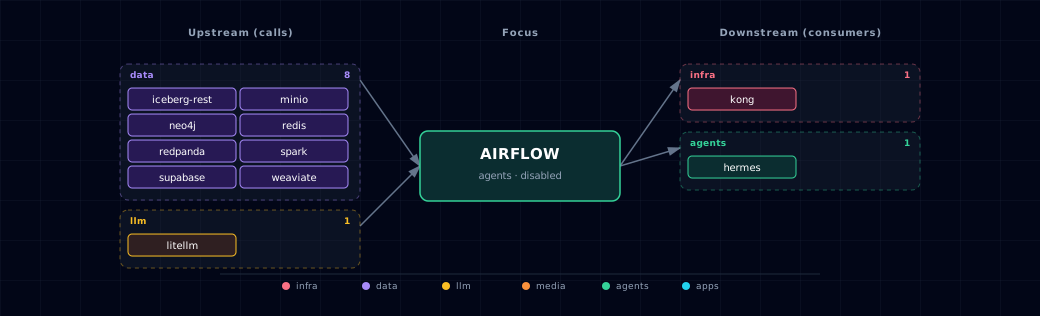
Open the full-size diagram for a full-screen view.
7.4. Future — Missing pair integrations¶
No high-confidence opportunities identified.
7.5. Future — Candidate new services¶
No high-confidence opportunities identified.
7.6. Future — Unused features in this service¶
No high-confidence opportunities identified.
8. Troubleshooting¶
airflow-initfails with "database does not exist" — the Airflow database is created bysupabase-db-init.airflow-initdepends_onsupabase-db-init: service_completed_successfully, so this points at a failed or skipped db-init: checkdocker logs ${PROJECT_NAME}-supabase-db-init, thendocker logs ${PROJECT_NAME}-airflow-initfor the psql error.- Web UI login rejected —
AIRFLOW_ADMIN_PASSWORDin.envmay have rotated. Check the value; if rotated,airflow-initre-runs and re-syncs the admin user on next./start.sh. - Deferrable operators never resume — Atlas runs no
airflow-triggererservice, so a task usingdeferrable=Trueor an async sensor defers and stays deferred. Use the non-deferrable form of the operator. - Spark submit stays SUBMITTED / waiting for cores — the standalone pool is 2 workers × 2 cores by default.
SPARK_WORKER_CORESis unset, so each worker offers the 2 CPUs ofSPARK_WORKER_CPU_LIMIT. Spark Connect holdsSPARK_CONNECT_CORES_MAX(1) and Zeppelin's interpreterZEPPELIN_SPARK_CORES_MAX(1). A cluster-mode submit needs one core for its driver plus one for an executor, so withSPARK_WORKER_COUNT=1it cannot start until another app releases cores. - DAG appears in the UI but does not run — New DAGs start paused (Airflow default
dags_are_paused_at_creation=True); unpause the DAG in the UI. If the DAG shows an import error, readdocker logs ${PROJECT_NAME}-airflow-dag-processor. The DAG processor finds new files every 300 s ([dag_processor] refresh_interval) and re-parses known files every 30 s. summarize_via_litellm(OpenAIHook) fails withauth required—litellm_defaultConnection has the wrongLITELLM_MASTER_KEY. Re-run./start.shto re-sync the Connection; alternatively edit it in the Web UI under Admin → Connections.spark_smokecannot reachsc://spark-connect:15002(or a user DAG cannot reachspark://spark-master:7077):- Spark is disabled (
SPARK_SOURCE=disabled). Start with--spark-source container, or remove the Spark steps from the DAG. - It is the first run after start-up, and spark-connect is still binding port 15002 (20-60 s). The DAG's
retries: 1withretry_delay: 2musually covers this. If not, trigger the DAG again.
- Spark is disabled (
ModuleNotFoundError: No module named 'pyspark'— the running container predates the current image. Run./start.sh; it rebuilds stale local images.
9. Capabilities & limitations¶
Support tier: experimental — Capability contract declared; no cited cold-start, workflow, or upgrade qualification run yet (evidence at v0.1.0).
| Capability | Status | Verification | Notes |
|---|---|---|---|
| Code-defined DAG orchestration | supported | tested | Atlas runs Airflow 3 with a separate API server, scheduler, DAG processor, and init path, using LocalExecutor for operator-authored DAGs. |
| Untrusted DAG code isolation | not-supported | tested | LocalExecutor operator-authored DAGs execute unsandboxed. Their Airflow Connections hold MinIO root, LiteLLM master, Neo4j administrator, scoped Supabase reader, and Redis password credentials. Admit only trusted DAG authors. |
| Seeded stack service connections | partial | tested | Init seeds LiteLLM, Redis, Supabase, and enabled container-only lakehouse or graph connections; localhost variants are deliberately not mapped to unusable Compose DNS names. |
| Spark lakehouse job execution | partial | tested | Bundled DAGs and jars exercise SparkSubmit and lakehouse configuration, but live Spark, MinIO, Iceberg, and Redpanda execution remains an operator-run smoke path. |
| Airflow UI and API authentication | supported | tested | Direct and CORS-only Kong surfaces rely on Airflow FAB login for the UI and JWT exchange for /api/v2. Kong adds routing but no second authentication gate. |
| Distributed executor and control-plane HA | not-supported | documented | Atlas fixes one scheduler, API server, and DAG processor around LocalExecutor; it configures neither Celery/KubernetesExecutor nor a multi-replica Airflow control plane. |