5.2.43. Ray¶
Distributed-compute substrate for the stack. Ray runs as a head + worker cluster. The Backend reaches it through the dashboard REST API. Ray Client (ray.init("ray://…")) works only from Python 3.10 with ray 2.56.x (§6).
1. Overview¶
Ray (rayproject/ray:2.56.0, Apache 2.0) is a generic parallel-compute framework. This stack ships it as a 2-container family (head + workers) wired so every tier can dispatch parallel work without rolling its own asyncio.gather glue. Use Ray when you have N independent units of work to fan out across CPUs (and eventually GPUs on multi-host Linux).
Active when RAY_SOURCE ∈ {ray-container-cpu, ray-container-gpu}. Authenticated remote Ray endpoints (Anyscale, self-hosted clusters) are deferred to the stack-wide authenticated-remote design.
2. Access¶
| Surface | URL | Auth |
|---|---|---|
| Dashboard (UI + REST job-submission API) | http://localhost:${RAY_DASHBOARD_PORT} direct or http://ray.localhost:${KONG_HTTP_PORT} via Kong |
Direct: unauthenticated and bound to loopback only. Kong: basic-auth with DASHBOARD_USERNAME / DASHBOARD_PASSWORD. |
| Client server (trusted host Python) | ray://localhost:${RAY_CLIENT_PORT} |
Unauthenticated; bound to loopback only. Never forward or publicly expose this port. |
| GCS (internal cluster controller) | localhost:${RAY_GCS_PORT} host-side; ray-head:6379 inside the network |
Unauthenticated; host mapping is loopback only. |
| Backend REST jobs API | http://localhost:${BACKEND_PORT}/api/ray/jobs/submit etc. |
Bearer token from RAY_JOB_API_TOKEN |
The backend reaches Ray through the dashboard's HTTP job API, never Ray Client. It sets RAY_API_SERVER_ADDRESS to the dashboard URL. Otherwise the Ray SDK resolves RAY_ADDRESS=ray://… through ray.init, which fails on the backend's newer Python. Every SDK call, including the client's construction-time version probe, has a transport timeout. When the dashboard does not answer the probe or /api/cluster_status, the routes return 503; no job request was sent.
POST /api/ray/jobs/submit requires a stable submission_id using the
Ray-compatible raysubmit_ prefix and letters, digits, or underscores. Reuse
that ID after an ambiguous response: Atlas returns 409 when it already exists,
and the existing GET/DELETE .../{job_id} routes reconcile or stop it.
3. Configuration¶
| Env var | Default | When | Description |
|---|---|---|---|
RAY_SOURCE |
disabled |
always | One of ray-container-cpu, ray-container-gpu, disabled. ray-container-gpu only swaps in the CUDA image: the compose fragment requests no GPU device yet, so Ray reports GPU: 0 and num_gpus tasks stay pending. |
RAY_WORKER_COUNT |
2 |
when source ∈ | Number of ray-worker containers. Use 0 for head-only single-node mode. The wizard and --ray-worker-count accept 0-64. |
RAY_DASHBOARD_PORT, RAY_GCS_PORT, RAY_CLIENT_PORT |
auto-assigned | always | Topology-allocated in the infra block and published only on 127.0.0.1. |
RAY_JOB_API_TOKEN |
auto-generated | always | Required as Authorization: Bearer <token> on every Backend /api/ray route. Stored in .env and injected only into Backend. |
RAY_DASHBOARD_URL |
empty | optional | Dashboard URL for the Backend job client. Empty derives http://ray-head:8265 from RAY_ADDRESS. |
RAY_HEAD_MEMORY_LIMIT, RAY_WORKER_MEMORY_LIMIT |
4g |
when source ∈ | Memory limit per head or worker container. The /dev/shm object store counts against this limit. |
RAY_HEAD_CPU_LIMIT, RAY_WORKER_CPU_LIMIT |
2.0 |
when source ∈ | CPU limit per head or worker container. |
RAY_IMAGE, RAY_GPU_IMAGE |
rayproject/ray:2.56.0, rayproject/ray:2.56.0-gpu |
always | Image pins. For ray-container-gpu, _generate_ray_config() writes the RAY_GPU_IMAGE value into RAY_IMAGE. |
RAY_HEAD_SCALE, RAY_WORKER_SCALE, RAY_ADDRESS |
auto-managed | always | Resolved by _generate_ray_config() from RAY_SOURCE and RAY_WORKER_COUNT. RAY_ADDRESS is ray://ray-head:10001 for container sources and empty for disabled. Do not edit by hand. |
Wizard: after you pick a Ray container source, the wizard asks for RAY_WORKER_COUNT (default 2) on the same step. CLI: --ray-worker-count.
4. Architecture & wiring¶
Containers in the family:
- ray-head — the cluster controller. Runs ray start --head. Exposes ports 8265 (dashboard + REST), 6379 (GCS) and 10001 (client server). The GCS speaks the Redis protocol but is not the project's Redis cache. Healthcheck on :8265/api/version.
- ray-worker — one or more replicas. Runs ray start --address=ray-head:6379 --block. No host ports.
No /tmp/ray volume. Ray keeps per-node session state under /tmp/ray. The image runs as the non-root ray user, and Docker would create a named volume there as root:root, which stops Ray from starting. Session state therefore lives in the container's writable layer and is lost when the container is replaced. shm_size gives the object store enough /dev/shm to avoid spilling.
Shared memory. Both containers set shm_size: 8gb. Docker's default 64MB crashes Ray at once, because the Plasma object store uses shared memory. If port 8265 refuses connections within 60 seconds of start, check the shm size.
No runtime dependencies. Ray includes its own GCS (Redis-protocol cluster controller) and Plasma object store. The supabase and redis entries in depends_on.required only fix display order, so Kong wins the alphabetical tie in the infra port-slot block. Ray does not call them.
Consumers in the stack:
- Backend — exposes POST /api/ray/jobs/submit, GET/DELETE /api/ray/jobs/{job_id}, and GET /api/ray/cluster/status. It adapts via RAY_ADDRESS set by _generate_ray_config() and requires RAY_JOB_API_TOKEN as a bearer token on every route.
- JupyterHub — receives RAY_ADDRESS, and services/jupyterhub/build/notebooks/07_ray_cluster.ipynb calls ray.init(). That call fails because the kernel runs Python 3.13 and the Ray image runs Python 3.10 (open issue #1374). Until that issue is resolved, submit notebook work through the Ray Jobs REST API at http://ray-head:8265/api/jobs/. §6 has an example.
- Hermes — no Ray submission integration is wired today. A future integration must receive RAY_JOB_API_TOKEN through a scoped client contract before it can call Backend's protected Ray routes.
5. Dependencies & Integrations¶
5.1. Current — Upstream (this service calls)¶
No upstream calls.
5.2. Current — Downstream (services that call this)¶
| Service | Category | Status |
|---|---|---|
| kong | infra | optional: RAY_SOURCE=ray-container-cpu or ray-container-gpu |
| backend | apps | current |
| jupyterhub | apps | current |
5.3. Architecture diagram¶
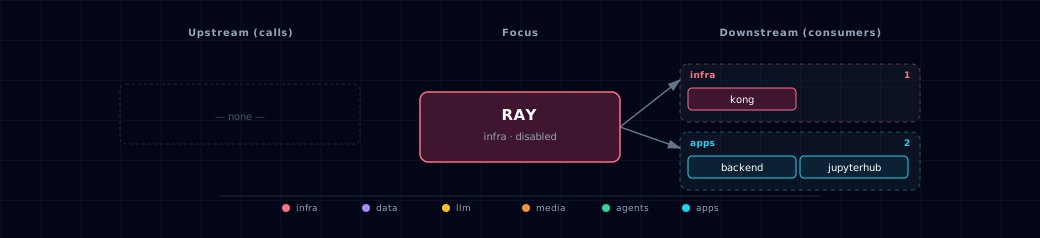
Open the full-size diagram for a full-screen view.
5.4. Future — Missing pair integrations¶
No high-confidence opportunities identified.
5.5. Future — Candidate new services¶
No high-confidence opportunities identified.
5.6. Future — Unused features in this service¶
No high-confidence opportunities identified.
6. Troubleshooting¶
- Head container exits immediately with "Bus error" or "/dev/shm too small" — Docker's default shared-memory size (64MB) is too small. Compose sets
shm_size: 8gb, but some installs (rootless Podman, older Docker) ignore it. Verify withdocker inspect ${PROJECT_NAME}-ray-head | grep ShmSize. - Workers stuck "starting" — they
depends_on: ray-head: service_healthy. The head'sstart_period: 60sallows up to 60s before health checks count. If still stuck after 2 minutes, check the head's healthcheck output:docker exec ${PROJECT_NAME}-ray-head wget -qO- http://localhost:8265/api/version(the image ships wget, not curl). ray.init("ray://…")fails with a version mismatch — Ray Client needs the samerayversion and the same Python minor version on both sides.rayproject/ray:2.56.0runs Python 3.10. From the host, use Python 3.10 withray>=2.56.0,<2.57. The JupyterHub kernel runs Python 3.13, so07_ray_cluster.ipynbfails atray.init()(open issue #1374). From a notebook, use the Ray Jobs REST API instead:
import time, requests
api = "http://ray-head:8265/api/jobs/"
entry = "python -c 'import ray; ray.init(); print(ray.cluster_resources())'"
job_id = requests.post(api, json={"entrypoint": entry}).json()["submission_id"]
while requests.get(api + job_id).json()["status"] not in ("SUCCEEDED", "FAILED", "STOPPED"):
    time.sleep(2)
print(requests.get(api + job_id + "/logs").json()["logs"])
ray.localhost route requires --setup-hosts to have run AND basic-auth credentials match DASHBOARD_USERNAME / DASHBOARD_PASSWORD in .env. The unauthenticated direct port works only from the Docker host because Compose binds it to 127.0.0.1.
7. Capabilities & limitations¶
Support tier: experimental — Capability contract declared; no cited cold-start, workflow, or upgrade qualification run yet (evidence at v0.1.0).
| Capability | Status | Verification | Notes |
|---|---|---|---|
| Containerized CPU distributed compute | supported | tested | Atlas configures a Ray head plus an operator-selected worker count and supplies the backend with the resulting cluster address. |
| NVIDIA GPU worker execution | partial | tested | The GPU source selects the CUDA images only. The compose fragment requests no NVIDIA device, so GPU tasks stay pending until GPU reservations are wired (#1373). |
| Remote Ray surface security | partial | tested | Kong protects the dashboard and the backend API uses bearer authentication, while native client and GCS ports remain unauthenticated loopback bindings. |
| Persistent Ray session state | not-supported | documented | The stock Ray cluster has no named volume for session state, so jobs and cluster metadata do not survive container replacement. |