5.2.16. FAL Cloud Media¶
1. Overview¶
FAL Cloud Media is a virtual media provider for fal.ai's hosted generation APIs. It gives Atlas a cloud path for creative generation without local ComfyUI CPU/GPU containers or a host ComfyUI process.
Atlas does not run a FAL container. The backend reads FAL_SOURCE, FAL_API_KEY and model defaults from the environment. When FAL_SOURCE=enabled, it routes hosted image-generation operations to the fal.ai Python client.
2. Access¶
| Surface | URL or command | Notes |
|---|---|---|
| Atlas SOURCE | FAL_SOURCE=disabled |
Default. No FAL calls are made and no API key is required. |
| FAL provider | FAL_SOURCE=enabled |
Enables FAL-backed hosted media generation through the backend. |
| Media gateway (image) | POST /media/generate with {"provider":"fal","modality":"image"} |
Submits a FAL image operation (text→image with fal-ai/flux/dev, or image-to-image with an init image) and returns an operation id. Custom endpoints take input.provider_arguments. provider=comfyui uses the same route for the managed or local ComfyUI host. Schema: backend /docs (OpenAPI). |
| Media gateway (image→3D) | POST /media/generate with {"modality":"image_to_3d"} |
Submits a hosted image→3D operation through a verified Hunyuan3D, TRELLIS, Tripo, or Rodin endpoint and returns an operation id. |
| Operation polling | GET /media/operations/{operation_id} |
Polls provider status and returns normalized artifacts (the GLB is the primary artifact_url), cost, license, and provenance. |
| Operation cancel | POST /media/operations/{operation_id}/cancel |
Requests cancellation from FAL. Budget stays reserved until polling confirms a terminal provider outcome. Idempotent. Status codes: backend /docs. |
| Ambiguous submission reconciliation | POST /media/operations/{operation_id}/reconcile |
An operator with BACKEND_INTERNAL_API_TOKEN records outcome=commit or outcome=release after checking FAL billing. A missing provider id counts as ambiguous. Intents and recovery rows do not expire before settlement; same-outcome retries are safe. recovery_ledger_ids names cleanup candidates if operation persistence fails. The default Postgres store survives restarts; memory is ephemeral. |
| Spend read | GET /media/spend?consumer=<c> |
Scoped spend read (committed/reserved totals + rows for one consumer). Empty unless MEDIA_BUDGET_ENABLED=true. |
| Compatibility route | POST /comfyui/generate |
Uses FAL for simple image generation when FAL_SOURCE=enabled; otherwise preserves the existing ComfyUI path. |
| Kong | No direct route | FAL is a server-side provider only. The API key stays in the backend environment. |
Enable from the CLI with:
./start.sh --fal-source enabled --fal-api-key <your-fal-key>
Interactive wizard. FAL is a paid cloud provider. Like the OpenAI, Anthropic and OpenRouter keys, it has a masked API-key step, placed after the ComfyUI step (both are media). There is no plain enabled/disabled tile. Enter a key to enable FAL, or leave it blank to keep it disabled. A key sets FAL_SOURCE=enabled and FAL_API_KEY. When a key is already saved, the step takes the same words as the cloud key steps:
- Enter changes nothing.
enableturns FAL on with the saved key. Without a saved key, FAL stays disabled, because the backend rejectsFAL_SOURCE=enabledwithoutFAL_API_KEY.disableturns FAL off and keeps the key.remove(or its older synonymclear) setsFAL_SOURCE=disabledand blanks the key.
FAL still appears in the services grid as a media service. Its row shows the resulting source as soon as the key step is answered.
3. Configuration¶
| Variable | Default | Purpose |
|---|---|---|
FAL_SOURCE |
disabled |
Enables or disables the FAL provider. |
FAL_API_KEY |
empty | Required when FAL_SOURCE=enabled; not required when disabled. |
FAL_MODEL |
fal-ai/flux/dev |
Default FAL model endpoint used by the media gateway for text-to-image generation. |
FAL_IMAGE_TO_3D_MODEL |
fal-ai/trellis |
Default endpoint id for the image_to_3d modality. Must resolve to a curated registry entry (see below); TRELLIS is the MIT-licensed default. |
FAL_MODEL_LICENSE |
fal/provider-terms |
License or terms marker returned in normalized media operation responses when provider-specific model licensing is not more specific. For image_to_3d, the per-model registry license overrides this. |
BACKEND_MEDIA_INPUT_BUCKET |
default |
Supabase Storage bucket the gateway hosts image_to_3d inputs in (under the media-inputs/ prefix) when a provider rejects data-URI inputs. Declared on the backend service. |
BACKEND_MEDIA_INPUT_PUBLIC_BASE_URL |
empty | Optional public base URL for hosted inputs (<base>/<bucket>/<key>), so the provider's cloud can fetch them through a reachable ingress. Empty uses the storage client's public URL. Declared on the backend service. |
FAL_TIMEOUT_SECONDS |
120 |
Backend timeout for FAL media submit/poll operations and the compatibility route. Greater than zero, at most 3,600 seconds. |
FAL_OUTPUT_FORMAT |
jpeg |
Requested image format for compatible models. |
FAL_ENABLE_SAFETY_CHECKER |
true |
Requests the provider-side safety checker for compatible models. |
4. Architecture & Wiring¶
Atlas models FAL as a virtual media service:
- Track membership:
gen-ai-creativeandall. - Service category:
media. - Source values:
disabledandenabled. - Runtime ownership: no compose service, no container, no volume, and no Kong route.
- Backend integration:
POST /media/generatevalidates the selected model's full schema before any state, budget, storage or provider work, then submits hosted image operations to FAL.GET /media/operations/{operation_id}polls provider status.POST /media/operations/{operation_id}/cancelrecords a cancellation request and keeps spend reserved until polling confirms FAL's terminal outcome. - Compatibility route:
POST /comfyui/generateuses FAL first whenFAL_SOURCE=enabled, for the defaultfal-ai/flux/devcontract. It reserves no budget, so it returns409whileMEDIA_BUDGET_ENABLED=true, and504on a FAL timeout. For custom endpoint schemas, usePOST /media/generatewithinput.provider_arguments. - Deadlines: a budget-tracked
/media/generateFAL job past its deadline becomescancellation_requestedand keeps its reservation until a poll sees FAL's terminal state. If FAL never reports one, settle it withPOST /media/operations/{id}/reconcile. - ComfyUI-specific routes: workflow execution, queue inspection, history lookup, cancellation, and image file proxying remain ComfyUI-specific.
- Secret handling:
FAL_API_KEYis server-side only. The backend maps it toFAL_KEYfor the fal.ai Python client and never exposes it to browser clients. - Operation state: submitted and terminal metadata is shared in Redis with a bounded TTL. Polling and cancellation therefore survive Backend restarts and stay consistent across replicas. An unresolved
submission_unknownintent and a budget-tracked terminal transition do not expire until ledger settlement; then the normal TTL applies. Owner scope is recorded at submission and enforced on reads and cancellation. §4.2 describes the Postgres recovery/spend ledger and budget enforcement.
4.1. Image→3D modality¶
{"modality":"image_to_3d","provider":"fal","model":<id>,"input":{"image":<url-or-data-uri>}} submits a hosted image→3D job. model must match a verified registry endpoint id (aliases and case are tolerated). An unknown or unverified id returns HTTP 400 that lists the supported ids. If model is omitted, the gateway uses FAL_IMAGE_TO_3D_MODEL.
The backend handles provider differences, so consumers do not need to:
- It maps each provider's request field names and seed ranges onto one
inputshape. - The GLB is always the primary
artifact_url, withlicenseand estimatedcost_usdfrom the registry entry. - It composites transparent inputs onto a neutral background before submission, to avoid a known fal Hunyuan3D v2 crop bug.
- For providers that reject data URIs, it uploads inputs to
BACKEND_MEDIA_INPUT_BUCKET. An uploaded data URI must be PNG, JPEG or WebP and match its declared type, else HTTP 400.image/jpgis accepted as JPEG.
The per-provider field names, seed ranges and response-key mappings are in the backend /docs OpenAPI.
Limits:
- Hosted inputs. FAL can fetch uploaded inputs only if
BACKEND_MEDIA_INPUT_PUBLIC_BASE_URLreaches a public bucket. The defaultdefaultbucket is private, and the fallback URL uses the internal Kong host. So with the defaults, a data-URI input to Tripo fails at FAL. - Timeouts. With media budgets off,
FAL_TIMEOUT_SECONDS(120 s) is also the whole-operation deadline. A slower image→3D job (Rodin, Hunyuan, queued work) is markedtimeoutand its result is not fetched, although FAL may finish and bill it. RaiseFAL_TIMEOUT_SECONDSfor 3D work. - Per-request timeout. A larger
timeout_seconds(1–3600) extends Atlas's deadline and FAL's server-side queue-start limit together, so a long-queued job is not dropped. The queue-start limit is never belowFAL_TIMEOUT_SECONDS, which still bounds each submit and poll HTTP call. - No GLB. A completed job with no GLB in its result stays
succeeded, withartifact_url: nullandprovenance.glb_missing: true. FAL billed it, so its spend settles as spent. - An unrecognised FAL queue status returns HTTP 502, not 400.
- Baking. A successful GLB (
artifact_url+license/provenance) stays on FAL's CDN. To bake it, download it and upload it to theraw-assetsMinIO bucket. The asset-baker/assets/bake/refendpoint accepts only{bucket, key}in an allowlisted bucket, and the gateway never calls it.
| Endpoint id | Family | License | Commercial use | Input hosting |
|---|---|---|---|---|
fal-ai/trellis |
TRELLIS | MIT | yes | data URI ok |
fal-ai/hunyuan3d/v2 |
Hunyuan3D | tencent-hunyuan-community | yes via fal (self-host Tencent-gated, EU/UK/KR excluded) | data URI ok |
tripo3d/tripo/v2.5/image-to-3d |
Tripo | tripo-commercial-gated | gated to Pro/Enterprise | requires hosted URL |
fal-ai/hyper3d/rodin |
Rodin (Hyper3D) | hyper3d-provider-terms | conditional | data URI ok |
Pixal3D is in the internal research registry as an unverified candidate. It is not advertised or routable until its current endpoint id and request contract are validated.
4.2. Spend ledger & budgets¶
Hosted media generation has no LiteLLM-style spend accounting, so the media gateway has its own cost ledger and budget engine:
- Enforcement is off by default (
MEDIA_BUDGET_ENABLED=false). - Even with enforcement off, an ambiguous FAL submission writes a minimal recovery row to
MEDIA_BUDGET_STORE. Keep the defaultpostgresfor cross-process and restart durability;memoryis ephemeral. - A lost or unusable submit reply returns
504with alocal_submission_id. Malformed JSON, incomplete replies and invalid request ids follow this recovery path. Atlas keeps the reservation andsubmission_unknownoperation. Check FAL's dashboard and billing before reconciliation; do not resubmit blindly. - With enforcement on, each generation reserves its estimated cost before the provider call and reconciles to the final cost on completion, per operation, in
public.media_spend_ledger. - A submission over the cap (
MEDIA_BUDGET_DEFAULT_USD, and per-scopeMEDIA_BUDGET_CONSUMER_CAPS) is rejected before any provider call or storage write. MEDIA_DISABLED_PROVIDERS(CSV) turns off a specific provider, with or without enforcement.GET /media/spend?consumer=<c>[&project=<p>]returns that consumer's totals and rows only.- An accepted cancellation is not a settlement: spend stays reserved until a provider poll proves a terminal outcome.
The full status-code, concurrency-safety and unknown-cost contract is in the backend /docs OpenAPI.
Attribution comes from the authenticated Backend principal plus optional request consumer/project fields or X-Atlas-Consumer/X-Atlas-Project headers (default default). A consumer, project or model value is rejected with 400 if it is longer than 255 characters or contains a control character (such as NUL). Operation polling and cancellation are owner-scoped. Spend reads require the same Backend application-auth boundary. MEDIA_BUDGET_* and MEDIA_DISABLED_PROVIDERS are declared on the backend service.
4.3. LiteLLM text→image route¶
When FAL_SOURCE=enabled and FAL_API_KEY is set, litellm-init also registers a fal-image model on the LiteLLM gateway. It uses LiteLLM's native fal_ai image provider (model: fal_ai/${FAL_MODEL}), gated and disabled-tolerant like the hermes/vllm-metal rows. OpenAI-shaped clients (Open WebUI image generation, n8n, notebooks) then reach FAL text→image through http://litellm:4000/v1/images/generations. They get LiteLLM's unified auth, spend logging and retries, with no bespoke backend call.
- Scope is text→image only. FAL image→3D (§4.1), video and audio stay on the Backend media gateway. LiteLLM has no 3D or video modality. The gateway owns the curated registry, normalized provenance, and hosting of image inputs in Supabase Storage (results stay on FAL's CDN).
- Provenance boundary. The LiteLLM route returns raw image data (b64/URL) and does not perform Atlas provenance or storage. The Backend media gateway (
POST /media/generate) is authoritative for provenance and spend accounting. It does not copy artifacts:artifact_urlis FAL's own CDN URL, which expires, so download results you need to keep. The two paths complement each other. - Key wiring. The
fal-imagerow referencesos.environ/FAL_AI_API_KEY, which the LiteLLM server resolves at request time. The compose fragment setsFAL_AI_API_KEY=${FAL_API_KEY}on the litellm container. The key is never written intoconfig.yaml.
5. Dependencies & Integrations¶
5.1. Current — Upstream (this service calls)¶
No upstream calls.
5.2. Current — Downstream (services that call this)¶
| Service | Category |
|---|---|
| litellm | llm |
| backend | apps |
5.3. Architecture diagram¶
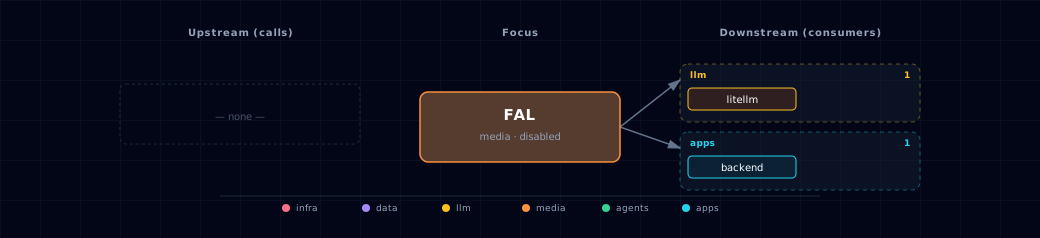
Open the full-size diagram for a full-screen view.
5.4. Future — Missing pair integrations¶
- Optional FAL model catalog prompts if Atlas adopts a curated cloud-media model list.
5.5. Future — Candidate new services¶
- Additional cloud media providers such as Replicate, RunPod Serverless, or provider-specific video generation APIs behind the same backend provider seam.
5.6. Future — Unused features in this service¶
- FAL queue webhooks are not wired; the backend uses submit/poll operations.
6. Capabilities & limitations¶
Support tier: experimental — Capability contract declared; no cited cold-start, workflow, or upgrade qualification run yet (evidence at v0.1.0).
| Capability | Status | Verification | Notes |
|---|---|---|---|
| Virtual hosted media generation | supported | tested | The backend uses the server-side FAL key for hosted image and curated image-to-3D operations; Atlas runs no FAL container or direct provider ingress. |
| LiteLLM text-to-image passthrough | partial | tested | An enabled keyed provider registers fal-image through LiteLLM, but that route covers text-to-image only. It returns LiteLLM's OpenAI-shaped b64/URL image result without Atlas storage or provenance normalization. |
| Durable media-operation accounting | partial | tested | Redis operation state and the Postgres recovery ledger handle polling and ambiguous submissions, while spend-budget enforcement remains disabled unless explicitly configured. |
| Automatic 3D post-processing | not-supported | documented | Image-to-3D returns a normalized GLB reference but never invokes Asset Baker or Asset Worker; callers must submit the artifact to those services explicitly. |
| Provider webhook completion | not-supported | documented | Atlas uses bounded submit-and-poll operations rather than FAL queue webhooks, so no webhook ingress or signature-validation path is configured. |