5.2.54. Apache Tika
1. Overview
Apache Tika is Atlas' disabled-by-default fallback extractor for long-tail document formats that Docling does not target well. It is a degraded plain-text path, not a replacement for Docling's structure-aware PDF, Office, image, table, OCR, and chunking pipeline.
Atlas pins Apache Tika 3.3.1 through apache/tika:3.3.1.0. Tika 4.x is not used because its server has breaking endpoint and configuration changes.
2. Access
- Direct URL:
http://localhost:${TIKA_PORT} - Kong URL:
http://tika.localhost:${KONG_HTTP_PORT} - Internal URL:
http://tika:9998 - Localhost source URL:
http://host.docker.internal:${TIKA_LOCALHOST_PORT}
Kong creates the tika.localhost route when TIKA_SOURCE=container or TIKA_SOURCE=tika-localhost. The route is removed when TIKA_SOURCE=disabled.
3. Configuration
TIKA_SOURCE=disabled|container|tika-localhostcontrols the source. The default isdisabled.TIKA_IMAGE=apache/tika:3.3.1.0pins the stable Tika 3.x image.TIKA_PORTis assigned by Atlas' media-category port slot allocator.TIKA_LOCALHOST_PORT=9998points Kong and in-container consumers at a host-running Tika server.TIKA_ENDPOINTis auto-managed for backend, Celery and n8n consumers.TIKA_MAX_FILE_SIZE=52428800is a required positive integer. It limits every backend extraction payload, Docling or Tika, to 50 MiB by default. Malformed, zero and negative values fail Backend startup.TIKA_TIMEOUT_SECONDS=30bounds backend fallback calls; it must be finite, greater than 0, and no greater than 3,600 seconds or Backend startup fails.TIKA_JAVA_TOOL_OPTIONS=-Xmx768mcaps the container JVM heap.
4. Docling-first fallback policy
Backend and Celery extraction choose the extractor per file. They send a file straight to Tika, without calling Docling, when:
- its extension is
.doc,.xls,.ppt,.epub,.eml,.msg,.rtf,.odt,.ods,.odp,.zip,.tar,.gz,.gzipor.bz2; or - its content type is a mail, RTF, OpenDocument or archive type.
Every other file goes to Docling. Tika is also tried when Docling answers 415 or reports an unsupported format. Atlas's own Docling providers answer such files with 500, so in practice only the list above reaches Tika. If Docling is disabled, other formats fail: Tika does not replace Docling. Tika output is plain text and is marked degraded.
5. Guardrails
- Keep Tika disabled unless long-tail extraction is needed.
- Do not expose Tika directly to untrusted networks; it accepts document bytes and has no built-in Atlas auth.
- Use
TIKA_MAX_FILE_SIZEandTIKA_TIMEOUT_SECONDSto bound backend fallback calls. - Treat ZIP and other archive formats carefully. Tika can inspect embedded content. Atlas adds no malware scanning, recursive archive policy or persistent quarantine storage.
- Preserve provenance in downstream indexing: filename, content type, byte size, selected extractor, and fallback reason.
6. Dependencies & Integrations
6.1. Current — Upstream (this service calls)
No upstream calls.
6.2. Current — Downstream (services that call this)
| Service | Category |
|---|---|
| kong | infra |
| celery | agents |
| n8n | agents |
| backend | apps |
6.3. Architecture diagram
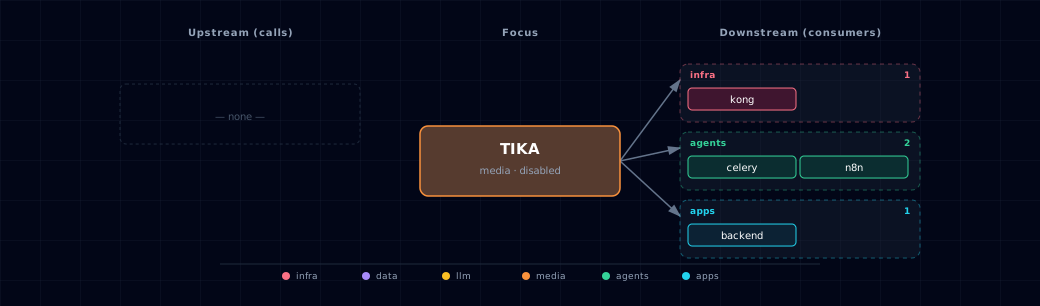
Open the full-size diagram for a full-screen view.
6.4. Future — Missing pair integrations
No high-confidence opportunities identified.
6.5. Future — Candidate new services
No high-confidence opportunities identified.
6.6. Future — Unused features in this service
No high-confidence opportunities identified.
7. Troubleshooting
- Kong route missing: confirm
TIKA_SOURCEiscontainerortika-localhost, then rerun./start.sh. - Backend returns
503"Tika fallback is disabled": setTIKA_SOURCEtocontainerortika-localhost, then rerun./start.shsoTIKA_ENDPOINTis generated. - Localhost mode cannot connect: ensure the host Tika server listens on
TIKA_LOCALHOST_PORTand thathost.docker.internalresolves from containers. - Empty or low-quality text: remember Tika is the degraded fallback path. Prefer Docling for formats it supports.
8. Capabilities & limitations
Support tier: experimental — Capability contract declared; no cited cold-start, workflow, or upgrade qualification run yet (evidence at v0.1.0).
| Capability | Status | Verification | Notes |
|---|---|---|---|
| Long-tail plain-text extraction | partial | tested | The backend falls back to Tika for explicit unsupported and archive-oriented formats, but results lack Docling's structure-aware tables, OCR, images, and chunks. |
| Container and existing-host Tika sources | supported | tested | Atlas resolves a pinned Tika container or an operator-run localhost server and clears downstream endpoints when the fallback is disabled. |
| Bounded backend fallback calls | partial | tested | Backend calls enforce configured file-size and finite timeout limits, while direct Tika and Kong requests bypass those application-layer bounds. |
| Authenticated Tika access | partial | documented | Kong protects tika.localhost with dashboard Basic authentication and ACL, but the host-published container port and operator-run localhost server bypass that gate. |
| Archive malware and recursion policy | not-supported | documented | Atlas provides no malware scanner, recursive archive policy, or quarantine store; keep Tika disabled or network-restricted unless long-tail extraction is required. |