5.2.40. OpenTelemetry Collector
1. Overview
OpenTelemetry Collector is Atlas' disabled by default, internal-only telemetry ingest point. It receives OTLP traces and logs, forwards traces to Tempo, and persists redacted logs in Loki. The stock backend, Celery, and LiteLLM wiring currently emits traces; any application that emits OTLP logs to the same endpoint uses the Loki path.
This is a local development service. It is not exposed through Kong, has no browser UI, and should not be treated as an internet-facing ingestion endpoint.
2. Access
- SOURCE:
OTEL_COLLECTOR_SOURCE=disabledby default. - Internal OTLP HTTP endpoint when enabled:
http://otel-collector:4318. - Internal OTLP gRPC endpoint when enabled:
http://otel-collector:4317. - Direct host URL: none.
- Kong URL: none; no Kong route is generated.
- Grafana surface: use the Tempo datasource for traces and Loki for logs.
3. Configuration
The service reads ./config/config.yaml, mounted at /etc/otelcol/config.yaml. Atlas computes OTEL_COLLECTOR_ENDPOINT, OTEL_COLLECTOR_OTLP_HTTP_ENDPOINT, OTEL_COLLECTOR_OTLP_GRPC_ENDPOINT and ATLAS_OTEL_ENABLED from the SOURCE values. Container mode requires TEMPO_SOURCE=container and LOKI_SOURCE=container. If either is missing, ./start.sh stops with an error before Compose starts.
Receiver limits. gRPC messages are capped at 4 MiB and HTTP request bodies at 4,194,304 bytes. The gRPC transport rejects larger messages. The HTTP receiver returns 400 Bad Request with request body too large before it parses OTLP.
Logs pipeline. The pipeline applies the memory limiter and redaction, then batches at most 1,024 records. It sends through a queue of 512 requests with two consumers and exponential retry. The queue is bounded and in memory. It rides out a Loki outage while the Collector runs, but queued records do not survive a Collector restart. Loki keeps accepted logs for LOKI_RETENTION_PERIOD.
Attribute redaction deletes top-level log and resource attributes whose keys case-insensitively end in one of the names below. The name is the whole key or follows a ., _ or -.
Names: authorization, proxy-authorization, x-api-key, api_key, api-key, apikey, token, access_token, refresh_token, client_secret, password, passwd, secret, cookie, set-cookie, master_key. For example, it removes db.password, OPENAI_API_KEY and http.request.header.cookie, and keeps max_tokens. It does not recursively inspect nested attribute maps.
String-body redaction uses the same key list, also with a prefix such as LITELLM_MASTER_KEY=, in key=value or key: value text:
authorizationandproxy-authorization: the whole value, including the scheme (Bearer,Basic,Tokenand others).cookieandset-cookie: the first value and every following; name=valuepair.- All other keys: the value up to the next whitespace,
,,;,&, quote,}or]. - Passwords in
scheme://user:password@strings, andsk-…API keys.
A body key must start the string or follow whitespace, {, [, ,, ?, & or ;. Quotes around keys and values are allowed, so JSON-like and logfmt text match. A transform error fails the batch instead of sending it unredacted. Body filtering is best-effort: it does not traverse structured nested or non-string bodies, encodings, or unknown keys. Do not log secrets.
Trace redaction blanks credential query values in the url.query, url.full and http.url span attributes. Parameters: apikey, api_key, token, access_token, key, password, secret, sig, X-Amz-Security-Token, X-Amz-Signature, X-Amz-Credential. This keeps the apikey that Kong's key-auth forwards to the backend out of Tempo. The transform uses error_mode: ignore, so a span that fails it is exported unchanged.
Health and startup. The image is distroless, so the health check runs the Collector's validate subcommand against the mounted config. The Collector starts after Tempo is healthy and Loki has started. Loki has no health check; the Loki export queue retries until Loki accepts writes. The backend stops at startup if tracing is enabled without an exporter endpoint or the OTel packages.
4. Architecture & Wiring
Backend, Celery, and LiteLLM export OTLP HTTP spans to the collector. The collector batches and forwards traces to Tempo. OTLP log producers use the same receiver; after redaction and bounded live retry, the collector sends logs to Loki's native /otlp endpoint. The collector stays stateless and uses no persistent volume.
Loki keeps OTLP trace_id and span_id as structured metadata. Grafana's Loki datasource reads the trace_id label to build the Tempo link; it does not scan the log line. To query a correlated record in LogQL:
{service_name="backend"} | trace_id = "0123456789abcdef0123456789abcdef"
Trace correlation uses W3C traceparent. Backend spans start or continue request traces. The backend's instrumented httpx client sends traceparent on outbound calls. When ATLAS_OTEL_ENABLED=true, LiteLLM's otel callback continues the trace and excludes prompt and completion content. Kong emits no spans, so Kong access logs and request IDs are correlation clues only. A Kong correlation-id plugin is a candidate in the Kong README.
5. Dependencies & Integrations
5.1. Current — Upstream (this service calls)
| Service | Category |
|---|---|
| loki | infra |
| tempo | infra |
5.2. Current — Downstream (services that call this)
| Service | Category |
|---|---|
| litellm | llm |
| celery | agents |
| backend | apps |
5.3. Architecture diagram
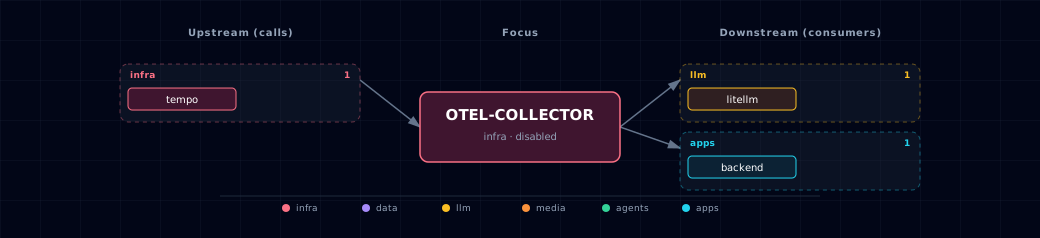
Open the full-size diagram for a full-screen view.
5.4. Future — Missing pair integrations
No high-confidence opportunities identified.
5.5. Future — Candidate new services
No high-confidence opportunities identified.
5.6. Future — Unused features in this service
No high-confidence opportunities identified.
6. Troubleshooting
- If backend, Celery or LiteLLM do not emit traces, confirm
OTEL_COLLECTOR_SOURCE=containerandTEMPO_SOURCE=container. - If logs do not appear, confirm
LOKI_SOURCE=container, query the normalizedservice_namelabel, and inspect Collector retry errors. A Collector restart discards records that Loki had not accepted. - If the collector is unhealthy, run
docker exec ${PROJECT_NAME}-otel-collector /otelcol-contrib validate --config=/etc/otelcol/config.yaml. The output names the failing receiver, processor or exporter. - If Grafana shows no traces, check the Tempo datasource and the collector logs.
- Roll back by setting
OTEL_COLLECTOR_SOURCE=disabled../start.shthen setsATLAS_OTEL_ENABLED=falseand empty endpoints, so backend, Celery and LiteLLM stop exporting.
7. Capabilities & limitations
Support tier: experimental — Capability contract declared; no cited cold-start, workflow, or upgrade qualification run yet (evidence at v0.1.0).
| Capability | Status | Verification | Notes |
|---|---|---|---|
| OTLP trace ingestion and Tempo export | supported | tested | Atlas accepts internal OTLP over gRPC and HTTP, batches traces, and exports them to the required Tempo service. |
| Log export to Loki | supported | tested | Atlas redacts a documented top-level credential-key allowlist and sends OTLP logs through a bounded live retry queue. Accepted logs persist in the required local Loki service. |
| Public telemetry ingestion | not-supported | tested | Collector receivers are backend-network only with no published host port or Kong route in the stock deployment. |