5.2.25. Langfuse (LLM traces + evals)¶
1. Overview¶
Langfuse is an optional, disabled-by-default store for LLM traces, prompt and eval history, latency and cost. LiteLLM sends a trace for every call through its success_callback and failure_callback, so failed, timed-out and rate-limited calls are traced too.
Prometheus and Grafana stay the infrastructure metrics layer; Langfuse covers LLM behavior. Section 4.2 lists what is traced.
2. Access¶
| Surface | URL | Notes |
|---|---|---|
| Kong | http://langfuse.localhost:${KONG_HTTP_PORT} |
Routed only when LANGFUSE_SOURCE=container; guarded by the Kong dashboard basic-auth (DASHBOARD_USERNAME / DASHBOARD_PASSWORD) before the Langfuse login. |
| Direct | http://localhost:${LANGFUSE_PORT} |
Bound through HOST_BIND_IP (default 127.0.0.1:, loopback only). Set 0.0.0.0: or a LAN address for deliberate remote access. An empty value also binds all interfaces. |
The first-run user is controlled by LANGFUSE_INIT_USER_EMAIL, LANGFUSE_INIT_USER_NAME, and LANGFUSE_INIT_USER_PASSWORD. The initial project keys are LANGFUSE_PUBLIC_KEY and LANGFUSE_SECRET_KEY; LiteLLM uses those for gateway tracing.
3. Configuration¶
LANGFUSE_SOURCE=disabled              # container | disabled
LANGFUSE_PORT=                        # topology-assigned
LANGFUSE_ENDPOINT=                    # auto-managed
LANGFUSE_PUBLIC_KEY=                  # auto-generated
LANGFUSE_SECRET_KEY=                  # auto-generated
LANGFUSE_SALT=                        # auto-generated
LANGFUSE_ENCRYPTION_KEY=              # auto-generated
LANGFUSE_NEXTAUTH_SECRET=             # auto-generated
LANGFUSE_CLICKHOUSE_PASSWORD=         # auto-generated
MINIO_BUCKET_LANGFUSE=langfuse
Langfuse self-hosting needs a web container, a worker container, Postgres, ClickHouse, Redis/Valkey and S3/blob storage. Atlas reuses Supabase Postgres, Redis and MinIO, and adds a Langfuse-owned ClickHouse container. This is a low-scale local Docker Compose deployment, not a high-availability production cluster.
4. Architecture & Wiring¶
When enabled, the family starts:
langfuse-init: afterminio-initprovisions the bucket and service account, checks the Langfuse Postgres database.supabase-db-initcreates that database (services/supabase/db/scripts/05-scoped-roles.sh).langfuse-clickhouse: stores traces, observations, and scores. A composeconfigs:entry mounted intoconfig.dkeeps ClickHouse's own system log tables (metric_log,text_log,trace_logand others) for 7 days. It also sets logging towarninglevel, 3 × 100 MB. Without it they grow about 126 MB a day while idle. On a volume that an Atlas release without this file created, ClickHouse renames each changed system table to<name>_0. Drop those tables once to reclaim the space.langfuse-web: serves the UI and ingestion APIs.langfuse-worker: processes queued ingestion work.
LiteLLM receives LANGFUSE_HOST, LANGFUSE_BASE_URL, LANGFUSE_PUBLIC_KEY, and LANGFUSE_SECRET_KEY. The generated LiteLLM config adds success_callback: ["langfuse"] and failure_callback: ["langfuse"] only while LANGFUSE_SOURCE=container. Disabling Langfuse removes both callbacks on the next config render. Existing Prometheus callbacks stay in place.
Media attachments are not browser-viewable. LANGFUSE_S3_MEDIA_UPLOAD_ENDPOINT is the in-network http://minio:9000, so presigned URLs given to the browser or to host-side SDK uploads point at a host they cannot resolve. Text traces (all LiteLLM traffic) are unaffected.
4.1. Why two host variables¶
Both LANGFUSE_HOST and LANGFUSE_BASE_URL hold the same endpoint. The variable name changed across SDK majors, and a wrong name fails silently:
| SDK | Reads | If unset |
|---|---|---|
| langfuse-python v2 (bundled in the pinned LiteLLM image) | LANGFUSE_HOST only |
defaults to https://cloud.langfuse.com |
| langfuse-python v4 | LANGFUSE_BASE_URL, with LANGFUSE_HOST as a deprecated alias |
defaults to https://cloud.langfuse.com |
With only LANGFUSE_BASE_URL set, the v2 SDK sends every trace to the public cloud, which rejects the local keys and drops the data. LiteLLM still logs Initialized Success Callbacks - ['langfuse'], and every call succeeds. Setting both keeps tracing correct on the current pin and after a later image bumps the SDK.
4.2. What is actually traced¶
Coverage is exactly what passes through the LiteLLM gateway. Open WebUI (OPENAI_API_BASE_URLS: http://litellm:4000/v1), the backend and LightRAG's default binding all route through it.
The exception is LightRAG's per-role binding overrides. LIGHTRAG_EXTRACT_LLM_BINDING_HOST, LIGHTRAG_KEYWORD_LLM_BINDING_HOST and LIGHTRAG_QUERY_LLM_BINDING_HOST can point a role straight at a native provider such as Ollama, bypassing LiteLLM. Those calls produce no Langfuse traces, and nothing warns about it.
Direct ComfyUI traces, Hermes custom spans, backend custom spans, n8n step spans, and OpenTelemetry fan-out are out of scope. LiteLLM's OTel export (its otel callback, enabled with ATLAS_OTEL_ENABLED) is independent of the Langfuse callback.
5. Dependencies & Integrations¶
5.1. Current — Upstream (this service calls)¶
| Service | Category |
|---|---|
| minio | data |
| redis | data |
| supabase | data |
5.2. Current — Downstream (services that call this)¶
| Service | Category |
|---|---|
| kong | infra |
| litellm | llm |
5.3. Architecture diagram¶
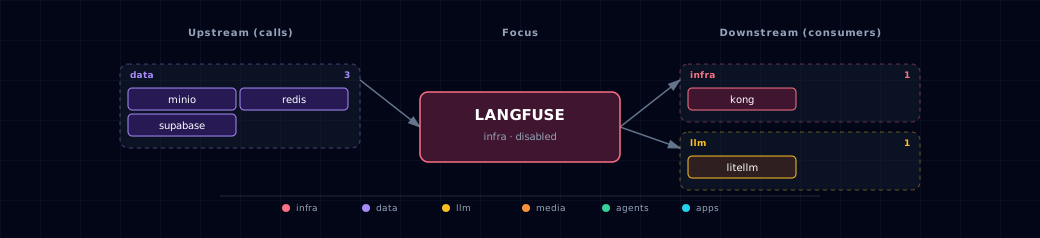
Open the full-size diagram for a full-screen view.
5.4. Future — Missing pair integrations¶
No high-confidence opportunities identified.
5.5. Future — Candidate new services¶
No high-confidence opportunities identified.
5.6. Future — Unused features in this service¶
No high-confidence opportunities identified.
6. Troubleshooting¶
- No traces appear and nothing errors. The SDK fails silently. Check in this order:
LANGFUSE_SOURCE=container, and the regenerated LiteLLM config has thelangfusecallback.docker exec <project>-litellm printenv LANGFUSE_HOSTprints your local endpoint (http://langfuse-web:3000). If the variable is missing, the SDK sends traces tohttps://cloud.langfuse.com. That host rejects your keys and drops the data without a log line. An empty value also keeps traces from local Langfuse.LANGFUSE_PUBLIC_KEYandLANGFUSE_SECRET_KEYmatch the initial project keys.- The call went through LiteLLM (§4.2). A LightRAG role bound to a native provider never reaches it.
To probe end to end, make one chat completion through LiteLLM. Then run curl -u "$LANGFUSE_PUBLIC_KEY:$LANGFUSE_SECRET_KEY" http://localhost:${LANGFUSE_PORT}/api/public/traces and check that meta.totalItems went up. Use the direct port: through Kong, the dashboard basic auth takes the Authorization header.
- langfuse-web is (unhealthy) but the UI works. Next.js binds $HOSTNAME, which Docker sets to the container ID, so loopback probes fail. Atlas sets HOSTNAME=0.0.0.0. If the problem returns, check docker exec <project>-langfuse-web printenv HOSTNAME.
- Langfuse is auto-disabled at start: Langfuse needs MinIO for S3-compatible event storage. With MINIO_SOURCE=disabled, ./start.sh reports a dependency violation and scales Langfuse to 0. Set MINIO_SOURCE=container.
- Rollback to direct LiteLLM behavior: for a rollback, set LANGFUSE_SOURCE=disabled and rerun ./start.sh. The Langfuse containers scale to zero, Kong stops routing langfuse.localhost, and LiteLLM no longer emits the Langfuse success_callback / failure_callback.
- ClickHouse timezone or empty queries: keep ClickHouse and Postgres on UTC. The compose fragment sets ClickHouse TZ=UTC.
7. Capabilities & limitations¶
Support tier: experimental — Capability contract declared; no cited cold-start, workflow, or upgrade qualification run yet (evidence at v0.1.0).
| Capability | Status | Verification | Notes |
|---|---|---|---|
| Self-hosted LLM observability stack | supported | tested | Atlas configures the Langfuse web, worker, ClickHouse, Postgres, Redis, and MinIO dependencies as one optional self-hosted deployment. |
| Automatic LiteLLM trace capture | partial | tested | LiteLLM success callbacks emit traces when Langfuse is enabled, but calls that bypass LiteLLM or use native provider bindings are not captured automatically. |
| Highly available Langfuse deployment | not-supported | documented | The stock topology is a local low-scale deployment without replicated Langfuse, ClickHouse, or supporting data-store services. |