5.2.32. MinIO¶
1. Overview¶
S3-compatible object storage for the artifact tier of the stack. It complements Supabase Storage and does not replace it.
- Supabase Storage is the app-tier surface: row-level-security uploads, signed URLs, files up to 50 MB.
- MinIO is the artifact-tier surface for high-throughput, large-blob workloads.
The container runs Silo (pgsty/silo and pgsty/mc), the Pigsty-maintained fork of the archived MinIO community server. MinIO no longer publishes community images, and quay.io/minio refuses anonymous pulls. Silo keeps MinIO's S3 API, MINIO_* environment, /minio/* routes and mc admin surface, so everything below applies. The long-term server choice is tracked in #1277.
2. Endpoints¶
| Surface | URL | Notes |
|---|---|---|
| Admin console (Kong alias) | http://minio.localhost:${KONG_HTTP_PORT} |
Use this from your browser. Requires ./start.sh --setup-hosts so minio.localhost resolves to 127.0.0.1. Login minioadmin / ${MINIO_ROOT_PASSWORD}. |
| Admin console (direct port) | http://localhost:${MINIO_CONSOLE_PORT} (default 63021) |
Equivalent; no hosts setup required. |
| S3 API (host port) | http://localhost:${MINIO_PORT} (default 63020) |
Recommended for s3 clients (no proxy hop). Stable per BASE_PORT. See §2.1. |
| S3 API (Kong alias) | http://s3.minio.localhost:${KONG_HTTP_PORT} |
BASE_PORT-independent host. Requires ./start.sh --setup-hosts. Proxies to minio:9000 with preserve_host so S3 SigV4 validates. Metrics paths answer 403 (§2.2). |
| S3 API (internal) | http://minio:9000 |
What sibling containers (backend, n8n, ComfyUI, JupyterHub, docling consumers) call via the per-bucket service-account credentials. |
| Admin console (internal) | http://minio:9001 |
What Kong proxies for the console alias. |
Both Kong routes are generated in bootstrapper/utils/kong_config_generator.py when MINIO_SOURCE != disabled. They use preserve_host, so the client keeps its real Host header. The console SPA then builds correct redirect URLs, and the S3 client's SigV4 signature validates.
2.1. Connecting an external S3-compatible client (CLI, SDK, TUI)¶
Any S3-compatible tool (aws CLI, boto3, mc, s3cmd, rclone, or a custom client) connects with these settings. Two endpoints reach the same S3 API and validate SigV4 signatures:
- The direct host port: no proxy hop, best for heavy upload traffic.
- The Kong alias: a
BASE_PORT-independent hostname that needs--setup-hosts.
| Setting | Value | Source |
|---|---|---|
| Endpoint URL | http://localhost:${MINIO_PORT} (default 63020) or http://s3.minio.localhost:${KONG_HTTP_PORT} |
MINIO_PORT / Kong alias |
| Region | us-east-1 |
MINIO_REGION |
| Access key | minioadmin (full access), or a per-bucket key (scoped) |
MINIO_ROOT_USER / MINIO_<BUCKET>_ACCESS_KEY |
| Secret key | grep ^MINIO_ROOT_PASSWORD= .env (full), or the per-bucket secret |
MINIO_ROOT_PASSWORD / MINIO_<BUCKET>_SECRET_KEY |
| Addressing style | path-style (required) | localhost/IP endpoints can't use virtual-host style |
| TLS | none (http://) |
the in-stack baseline serves plain HTTP |
The endpoint is stable across restarts for a given BASE_PORT, so you can hard-code it in a tool's profile. By default the port is BASE_PORT + 20. Use the root credentials to browse every bucket, or a per-bucket service-account key (§5) to scope a tool to one bucket.
2.2. Metrics endpoints¶
MINIO_PROMETHEUS_AUTH_TYPE=public lets Prometheus scrape MinIO on the internal network without credentials. Kong's s3.minio.localhost answers 403 on /minio/v2/metrics, /minio/metrics/v3 and /minio/prometheus/metrics. The direct MINIO_PORT serves them without credentials, and MinIO's default API CORS reflects any origin. Any web page can read them there, so keep MINIO_PORT loopback-bound.
3. Default credentials¶
- Root user:
MINIO_ROOT_USER(defaultminioadmin) - Root password:
MINIO_ROOT_PASSWORD— auto-generated to.envon first./start.sh. Retrieve withgrep ^MINIO_ROOT_PASSWORD= .env. Use these credentials to log into the admin console.
Consumers do not get the root credentials. They use the scoped service accounts in §5, including Spark's worker, connect and history containers. Two exceptions are deliberate:
- Airflow: its containers and seeded
minio_defaultconnection carry the root pair, so DAG authors must be trusted. The Airflow README states this trusted-DAG boundary. - Backup runner: it falls back to the root pair in local S3 mode (see the backup README).
minio-init applies a changed secret key to the existing account. A changed access key creates a new account, and minio-init never removes earlier ones. Remove a leaked key yourself with mc admin user svcacct rm local <old-access-key>.
4. Bucket layout¶
Sixteen buckets are pre-provisioned by minio-init across thirteen built-in consumers. Bucket names are the bare service identifier unless overridden:
| Bucket | Intended consumer |
|---|---|
comfyui |
ComfyUI generated outputs |
backend |
Backend (FastAPI) large blobs / embeddings / model checkpoints |
n8n |
n8n workflow file inputs and outputs |
jupyter |
JupyterHub datasets and model artifacts |
docling |
Doc Processor parsed-document persistence |
langfuse |
Langfuse trace and media object storage |
mlflow |
MLflow experiment and model artifacts |
label-studio |
Label Studio import/export and annotation assets |
spark-history |
Spark history-server event logs |
lakehouse, jars, checkpoints, landing |
Iceberg lakehouse storage, Spark artifacts, checkpoints, and landing data |
raw-assets |
Shared input objects written by the scoped asset-ingest identity and accepted by Asset Worker and Asset Baker reference routes |
asset-worker |
Asset Worker optimized GLB outputs |
asset-baker |
Asset Baker baked GLB and texture outputs |
Override bucket names with MINIO_BUCKET_<NAME> env vars. The asset processors' output buckets are set by ASSET_WORKER_MINIO_BUCKET and ASSET_BAKER_MINIO_BUCKET. Provisioning and runtime writes read the same values, so a renamed bucket stays aligned.
Parent-owned consumers can add their own bucket and scoped service account without forking Atlas:
- Pass
MINIO_EXTRA_CONSUMERSintominio-init: a space-separated list ofCONSUMER:BUCKET_VAR:ACCESS_VAR:SECRET_VARentries, optionally extended with extra read/write bucket lists. - Supply the referenced variables in the parent-owned
.env.userorATLAS_ENV_USER_FILE.
Reusing Atlas §6.1.2 has the full grammar and a worked example. §6.1 covers the declarative storage: alternative.
5. Service accounts¶
Each consumer has its own MinIO service account with an inline IAM policy. The policy allows get/put/delete/list on the consumer's own bucket, with these exceptions:
- The Iceberg account writes four buckets.
- The Spark account writes
spark-historyand the same four lakehouse buckets. - The Jupyter account can also read
lakehouse. - The shared
MINIO_ASSET_INGEST_*identity writesraw-assetswithout root access. Each asset processor can only read and listraw-assets, and writes its own bucket.
Extra consumers in MINIO_EXTRA_CONSUMERS get the same idempotent bucket, named policy and service-account provisioning. The minio-init provisioning script generates the policy JSON.
Built-in credentials are auto-generated to .env and exposed as MINIO_<NAME>_ACCESS_KEY and MINIO_<NAME>_SECRET_KEY where <NAME> is one of the built-in consumers. Parent-owned extra consumer credentials are supplied by the parent overlay. A cross-bucket access attempt with a consumer credential returns 403 AccessDenied.
6. Consumer integration recipe¶
A consumer connects with any standard S3 SDK or the mc CLI, using the endpoint and per-bucket credentials from §2.1 and §5. Examples: boto3 with Config(s3={"addressing_style": "path"}), or mc alias set against the host port.
6.1. Declarative consumer storage contract (storage:)¶
A downstream consumer can declare object stores in the storage: block of its atlas.consumer.yml, with no compose override. Atlas compiles each store to the MINIO_EXTRA_CONSUMERS grammar, provisions a scoped service-account credential, and generates the minio-init overlay. Each store exports stable ATLAS_STORE_<KEY>_* fields: bucket, internal and public endpoints, region, and credential variable names. Consumer Manifest Reference §7 has the full schema.
6.2. Browser-safe presigned URLs (sign against the public host)¶
A presigned-URL signature covers the request host. A URL signed against minio:9000 and then rewritten to the public host has an invalid signature. Never rewrite a signed URL. Sign against the browser-visible public endpoint, for example by setting boto3's endpoint_url to the public base before generate_presigned_url. bootstrapper/utils/s3_presign.py is a dependency-free reference presigner.
7. Source variants¶
MINIO_SOURCE may be:
container(default) — run MinIO in a Docker Compose containerdisabled— turn MinIO off (MINIO_SCALE=0); the service is not scheduled
localhost and external variants are not provided in this release.
8. Data persistence¶
MinIO data lives in the ${PROJECT_NAME}-minio-data named Docker volume mounted at /data. ./stop.sh --cold removes this volume.
9. Operations¶
- Add a bucket manually:
mc mb local/<bucket>from a host withmcand the root alias configured. - Add a parent-owned consumer bucket: set
MINIO_EXTRA_CONSUMERSand its bucket, access and secret variables in a_usercompose overlay and env overlay. Then run./start.shagain. A baredocker composecommand does not load the_useroverlay. - Rotate a service-account key: edit
MINIO_<NAME>_ACCESS_KEYandMINIO_<NAME>_SECRET_KEYin.env, then rundocker compose -p <PROJECT_NAME> up --force-recreate minio-initto re-provision. If the stack uses overlays or a consumer manifest, run./start.shagain instead. - Logs:
docker logs ${PROJECT_NAME}-minioanddocker logs ${PROJECT_NAME}-minio-init.
10. Dependencies & Integrations¶
10.1. Current — Upstream (this service calls)¶
No upstream calls.
10.2. Current — Downstream (services that call this)¶
| Service | Category | Status |
|---|---|---|
| backup | infra | current |
| kong | infra | current |
| langfuse | infra | current |
| prometheus | infra | current |
| iceberg-rest | data | current |
| spark | data | current |
| trino | data | current |
| asset-baker | media | current |
| asset-worker | media | current |
| airflow | agents | current |
| celery | agents | current |
| backend | apps | current |
| jenkins | apps | optional: an operator-authored Jenkins job; none ships with Atlas |
| jupyterhub | apps | current |
| label-studio | apps | current |
| mlflow | apps | current |
| zeppelin | apps | current |
10.3. Architecture diagram¶
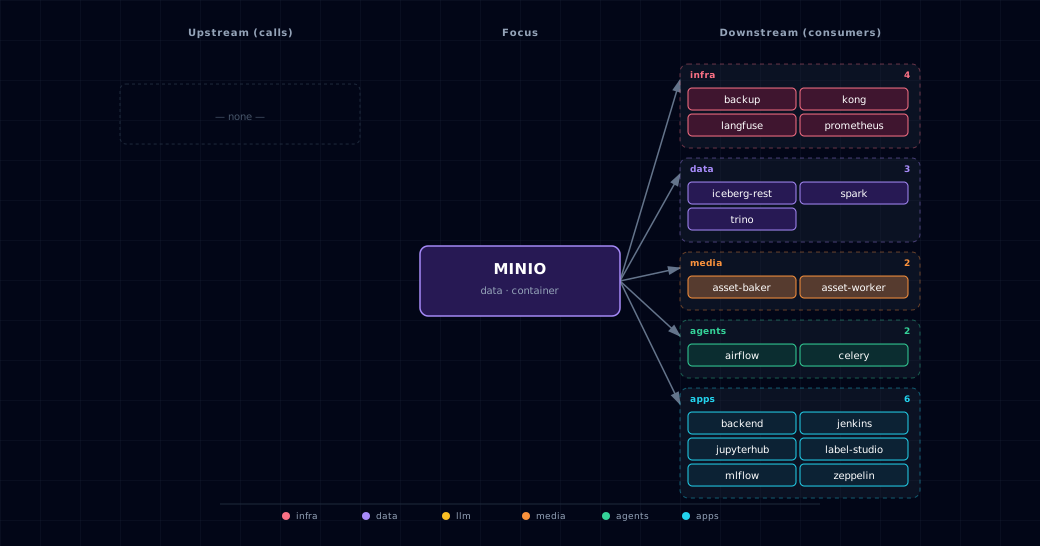
Open the full-size diagram for a full-screen view.
10.4. Future — Missing pair integrations¶
- minio ↔ backend (general artifact API) — Why: Backend RAG ingestion reads consumer-declared corpora with each store's scoped MinIO account. The built-in
backendbucket is not yet a general destination for large blobs, model checkpoints or embedding caches. Mechanism: add an artifact client athttp://minio:9000usingMINIO_BACKEND_ACCESS_KEY/SECRET_KEY, with upload/download routes and path-style addressing. Effort: small. Confidence: high. - minio ↔ n8n — Why: the
n8nbucket and keys are pre-provisioned, and n8n's S3 node supports a custom endpoint. Workflows could store files above Supabase Storage's 50 MB limit. Mechanism: n8n S3 credential athttp://minio:9000; optionalN8N_EXTERNAL_BINARY_DATA_MODE=s3. Effort: small. Confidence: high. - minio ↔ weaviate (direct
backup-s3) — Why: the backup runner already archives nativebackup-filesystemsnapshots.backup-s3would write straight to the bucket and skip the local snapshot volume. Mechanism: enablebackup-s3inWEAVIATE_ENABLE_MODULES, setBACKUP_S3_BUCKET=weaviate-backups,BACKUP_S3_ENDPOINT=minio:9000,BACKUP_S3_USE_SSL=false; addweaviate-backupsentry ininit-minio.sh. Effort: small. Confidence: high. - minio ↔ comfyui — Why: ComfyUI outputs sit in an ephemeral volume, and a
comfyuibucket exists. Uploaded renders would let backend, n8n and open-webui share artifacts across./stop.sh --cold. Mechanism: post-generation hook (custom node or sidecar) uploadsoutput/tos3://comfyui/viaMINIO_COMFYUI_*. Effort: medium. Confidence: medium. - minio ↔ doc-processor — Why: docling output has no persistent landing zone, and the
doclingbucket is unused. Downstream RAG flows cannot find outputs at stable URIs. Mechanism: doc-processor writes payloads tos3://docling/<source-hash>/viaMINIO_DOCLING_*keys. Effort: small. Confidence: high.
10.5. Future — Candidate new services¶
No high-confidence opportunities identified.
10.6. Future — Unused features in this service¶
- Bucket notifications (webhook/Redis/NATS targets) — Why pursue: MinIO can POST object-created events to a webhook or Redis stream. Backend, n8n and Weaviate could react to uploads instead of polling. Effort: medium.
- Object lifecycle rules (expiration + versioning) — Why pursue: the
comfyuiandjupyterbuckets grow without limit. Per-bucket ILM rules (expire after N days, keep N versions) are onemc ilmconfig ininit-minio.sh. Effort: small. - Server-side encryption (SSE-S3 / SSE-KMS) — Why pursue: the stack stores secrets and user uploads in plaintext on the host volume. SSE-S3 with a generated KEK encrypts at rest with no consumer change. Effort: medium.
- STS / AssumeRole for per-user JupyterHub creds — Why pursue: replaces the single shared
MINIO_JUPYTER_*credential with short-lived per-user tokens. Effort: large.
11. Troubleshooting¶
SignatureDoesNotMatch— most often clock skew between host and container. Sync your host clock.- Browser-based S3 client fails with CORS — Atlas sets no MinIO CORS policy, and MinIO reflects any origin by default. A CORS failure usually comes from the client or a proxy between them; check the request's
Originand the Kong route. Restrict origins withmc admin configif needed. 403 AccessDenied— confirm the consumer credential's scoped policy matches the target bucket. Use root credentials to inspect:mc admin policy info local <consumer>-policy.- Cross-path-style failures — MinIO requires path-style addressing. In boto3 use
Config(s3={"addressing_style": "path"}). miniocontainer restart-loops — usuallyMINIO_ROOT_PASSWORDis empty. If it is blank in.env, delete the line and rerun./start.sh, which generates a new value.
12. Capabilities & limitations¶
Support tier: experimental — Capability contract declared; no cited cold-start, workflow, or upgrade qualification run yet (evidence at v0.1.0).
| Capability | Status | Verification | Notes |
|---|---|---|---|
| S3-compatible artifact storage | supported | tested | Atlas exposes the MinIO S3 API and console directly and through Kong for in-stack artifacts, lakehouse data, traces, models, and backups. |
| Scoped consumer bucket provisioning | supported | tested | The idempotent init service creates built-in and declared extra-consumer buckets, policies, and service-account credentials with scoped access. |
| Highly available storage lifecycle controls | not-supported | documented | The stock single-node deployment configures no replication, object versioning, lifecycle retention, or server-side encryption policy. |