5.2.35. n8n¶
1. Overview¶
Workflow automation engine, run in queue mode by default: an n8n web/API container and an n8n-worker container that takes jobs from Redis. Its workflows connect LLM (LiteLLM), media (ComfyUI, STT, TTS, Docling, SearXNG) and data (Supabase, Weaviate) services without code.
Image: n8nio/n8n:2.28.2. The web/API container serves HTTP and the UI; the worker runs executions. Both share state through Supabase Postgres (workflow definitions, execution history, credentials) and Redis (queue and execution coordination).
The one-shot n8n-init runs first, installs the pinned ComfyUI community nodes and exits. The web/API and worker containers start only after it succeeds, and the launcher fails if it exits nonzero. It does not import workflow templates (services/n8n/init/config/) or PostgreSQL credentials; import them manually (§4).
Track placement: n8n is in all, gen-ai-rag and gen-ai-eng. In the RAG track it orchestrates document ingestion, search-to-extraction flows, vector-store operations and human-reviewed automation. Weaviate is optional for n8n, so n8n also runs on gen-ai-eng, which does not include Weaviate.
n8n (event-driven, visual: cron triggers, webhooks, manual runs) and Hermes (conversational, skill-driven) complement each other. Workflows call Hermes through HERMES_ENDPOINT. Hermes → n8n is not wired (see §4).
2. Access¶
| Path | URL | Notes |
|---|---|---|
| Direct | http://localhost:${N8N_PORT} (default 63075) |
UI + REST API. |
| Kong | http://n8n.localhost:${KONG_HTTP_PORT} |
Recommended for browser use; needs ./start.sh --setup-hosts. Kong route uses preserve_host: True. |
| Webhook | ${WEBHOOK_URL}webhook/<path> |
n8n's externally reachable webhook entry point; WEBHOOK_URL defaults to the complete Kong base URL, including scheme and port. The worker gets the same WEBHOOK_URL and N8N_EDITOR_BASE_URL, because queue-mode executions build $execution.resumeUrl, Wait-on-webhook, Form and approval links there. |
Canonical port table: Ports and Routes.
3. Configuration¶
N8N_SOURCE=container                # container | disabled
N8N_PORT=63075                      # computed by topology.py
N8N_ENCRYPTION_KEY=<random>         # auto-generated by bootstrapper; rotate before deploy
N8N_HOST=n8n.localhost              # Kong alias hostname (fixed in compose.yml; not read from .env)
N8N_PROTOCOL=http
N8N_EXECUTIONS_MODE=queue           # queue (default, requires worker + redis) | regular (single-process)
N8N_INIT_NODES=n8n-nodes-comfyui@0.0.9,@ksc1234/n8n-nodes-comfyui-image-to-image@1.0.2
n8n 2.28.2 always uses the owner-account setup flow. Community nodes load from the pinned packages that n8n-init installs. The pinned image needs no auth-mode or community-package env vars.
Both containers run with NODE_ENV=production (the image default). Development mode would add any-origin credentialed CORS, drop X-Frame-Options and return stack traces from the REST API.
Production mode also checks the editor WebSocket Origin against the Forwarded host that Kong injects (n8n.localhost:${KONG_HTTP_PORT}). The editor works there and on the direct port. Through a tunnel hostname (cloudflared with httpHostHeader: n8n.localhost) or another Kong port, the editor shows "Connection lost". Webhooks still work.
N8N_BLOCK_ENV_ACCESS_IN_NODE is "false" on n8n and n8n-worker. Otherwise n8n 2.x rejects $env in expressions. Every bundled workflow authenticates to the backend with $env.BACKEND_N8N_API_TOKEN, and the research workflow also reads $env.LITELLM_*. Anyone who can edit workflows can therefore read the container environment, including database and encryption credentials. Treat n8n editor access as administrator access.
Adaptive env (auto-injected based on active SOURCE values):
STT_ENDPOINT=...                    # resolved per STT_PROVIDER_SOURCE
PARAKEET_API_TOKEN=                 # generated Parakeet bearer; server-side only
TTS_ENDPOINT=...                    # resolved per TTS_PROVIDER_SOURCE
DOCLING_ENDPOINT=...                # resolved per DOC_PROCESSOR_SOURCE
DOCLING_API_TOKEN=                  # generated Docling bearer; server-side only
Required Postgres/Redis env (built from the upstream services' creds):
DB_TYPE=postgresdb
DB_POSTGRESDB_HOST=supabase-db
DB_POSTGRESDB_DATABASE=postgres
DB_POSTGRESDB_USER=${N8N_DB_USER}
DB_POSTGRESDB_PASSWORD=${N8N_DB_PASSWORD}
QUEUE_BULL_REDIS_HOST=redis
QUEUE_BULL_REDIS_PASSWORD=${REDIS_PASSWORD}
BACKEND_N8N_API_TOKEN=            # auto-generated workflow-scoped bearer
The bundled Backend-calling workflows send Authorization: Bearer $env.BACKEND_N8N_API_TOKEN on every request. Both the web and worker containers have the value, because queue-mode executions run on the worker. The token reaches only a limited set of Backend routes; the Backend docs list them. Do not return it in webhook payloads, execution output or browser-side code.
Only BACKEND_N8N_API_TOKEN is route-scoped. The web and worker containers also receive the stack-wide LiteLLM master key and provider-level credentials for cloud models, Docling and Parakeet. Trusted workflow expressions may call those services.
- Calls to
${DOCLING_ENDPOINT}/v1/document/convertmust sendAuthorization: Bearer {{$env.DOCLING_API_TOKEN}}. - Calls to a Parakeet
${STT_ENDPOINT}/v1/audio/transcriptionsroute must send{{$env.PARAKEET_API_TOKEN}}. Speaches and whisper.cpp do not use it. - Use the LiteLLM master key and provider-level credentials only in server-side expressions. Never put them in execution output, webhook responses or browser JavaScript.
Optional runtime dep: weaviate (runtime_deps.n8n.optional). No bundled workflow uses it. With WEAVIATE_SOURCE=disabled, n8n and n8n-worker still start, and WEAVIATE_URL is blank; a workflow that needs Weaviate must treat a blank URL as not configured.
4. Architecture & wiring¶
Queue mode flow:
- UI/webhook hits
n8n:5678(web container) → workflow record stored in Supabase Postgres. - Execution is pushed onto BullMQ queue in Redis db
/0(QUEUE_BULL_REDIS_DB: 0). n8n-workerpolls Redis, picks up the job, runs the workflow, writes execution history back to Postgres.- UI streams progress via Redis pub/sub back to the web container.
Init flow (n8n-init, pinned n8n image + npm lockfile):
- Before n8n starts,
n8n-initinstalls the committed package set withnpm ci --omit=dev --ignore-scriptsinto the shared/home/node/.n8n/nodes. - On a warm restart it skips the install if two conditions hold. The installed
package.jsonandpackage-lock.jsonmatch the committed ones, andnode_modules/.package-lock.jsonexists. Restarts then need no npm registry access. - All package versions are pinned, including the
n8n-workflowpeer dependency. Comments next to the n8n-init lockfile give the reasons. N8N_INIT_NODEScan replace the default set, as comma-separated exactname@x.y.zspecs. An unchanged custom set is skipped on later starts, so an offline restart keeps it. A changed set is installed into a staging directory and swapped in only ifnpm installsucceeds.- The workflow template in
services/n8n/init/config/(mounted at/config/) is not imported; import it manually in the n8n UI. n8n-initexits 0 only when the complete package tree is installed. Otherwise it exits 1, and n8n does not start. It does not call n8n's authenticated internal REST API.
Hard dependencies (depends_on.required): supabase, redis, litellm. Without LiteLLM, the AI Agent nodes fail.
Adaptive integrations (runtime_adaptive.n8n.adapts_to): stt_provider, tts_provider, doc_processor, tika, lightrag, hermes, crawl4ai, supavisor. When one is disabled, its endpoint env var is empty, and workflow nodes that use it return 502 at run time.
Hermes wiring. Workflows call Hermes with the HTTP Request node at HERMES_ENDPOINT. For Hermes → n8n, n8n's public REST API has no execute endpoint. Expose a Webhook-trigger workflow and have Hermes POST to its URL.
Seeded workflows. Import them manually in the n8n UI:
services/n8n/init/config/searxng-research-workflow.jsonis a worked example of the SearXNG → LiteLLM research pattern.- More examples are staged under
services/n8n/workflows-stage/workflows/. - Parameter ranges (query count and length, loop limits, search-API choice) and node behavior are in each workflow's inline notes.
Secure every webhook before activation. The legacy bundled POST /research fixture has no webhook authentication or credential declaration. Each staged webhook fixture names an Atlas Webhook Header Auth credential. Create a local n8n Header Auth credential with that name, select it on the webhook node, and give callers the same header and value.
Through Kong (n8n.localhost, the WEBHOOK_URL that callers use), a webhook can hold its response open for up to 300 s. The research and ComfyUI fixtures need this. langmem-consolidation runs only while the memory service reports enabled and status: healthy.
Consumer workflow seeding. A downstream consumer can declare n8n_workflows in atlas.consumer.yml (see §10 of the Consumer Manifest Reference). After n8n is healthy, an n8n-seed container validates, namespaces (atlas-consumer-<id>), imports and activates each workflow. Seeding is idempotent and best-effort per workflow, so one bad workflow cannot stop startup.
With N8N_API_KEY set, workflows removed from the manifest are deactivated and deleted. This includes removing the last one; the seed then runs with an empty plan on every start. The full spec is in §10 of the Consumer Manifest Reference. The code is bootstrapper/core/consumer_manifest.py and services/n8n/init/scripts/seed-workflows.js.
Cleanup requires a complete, valid workflow inventory. A malformed page, repeated cursor or exceeded page limit skips cleanup and logs a warning. Import results are retained, and readiness probes still run. Each orphan is processed once per run.
5. Calling LightRAG from n8n¶
When LIGHTRAG_SOURCE != disabled, n8n containers receive LIGHTRAG_ENDPOINT and LIGHTRAG_API_KEY. Use the HTTP Request node:
- URL:
={{$env.LIGHTRAG_ENDPOINT}}/query - Auth: header
X-API-Key: ={{$env.LIGHTRAG_API_KEY}}only. Do not also send the key asAuthorization: Bearer; LightRAG rejects that with 401. - Body (JSON):
{"query": "Your question", "mode": "hybrid"}.modeislocal,global,hybrid,naive,mixorbypass; the default ismix.
6. Dependencies & Integrations¶
6.1. Current — Upstream (this service calls)¶
| Service | Category |
|---|---|
| redis | data |
| supabase | data |
| supavisor | data |
| weaviate | data |
| litellm | llm |
| crawl4ai | media |
| doc-processor | media |
| searxng | media |
| stt-provider | media |
| tika | media |
| tts-provider | media |
| hermes | agents |
| lightrag | agents |
| backend ↔ | apps |
6.2. Current — Downstream (services that call this)¶
| Service | Category |
|---|---|
| kong | infra |
| prometheus | infra |
| backend ↔ | apps |
| jupyterhub | apps |
6.3. Architecture diagram¶
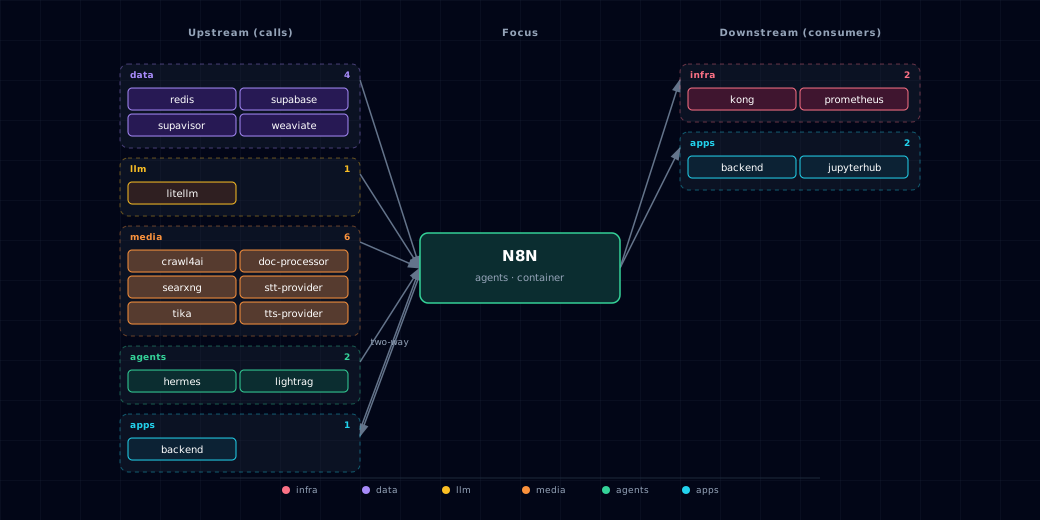
Open the full-size diagram for a full-screen view.
6.4. Future — Missing pair integrations¶
- n8n ↔ comfyui — Why:
n8n-nodes-comfyuiis installed byn8n-init, but noCOMFYUI_ENDPOINTenv is injected into n8n's compose, so users hand-enterhttp://comfyui:18188in every workflow credential. Mechanism: injectCOMFYUI_ENDPOINT=${COMFYUI_ENDPOINT}(matches the STT/TTS/DOCLING pattern); addcomfyuitoruntime_deps.optional. Effort: small. Confidence: high. - n8n ↔ minio — Why: MinIO provisions an
n8nbucket andMINIO_N8N_*credentials. n8n receives neither the credentials nor the S3 endpoint, so the bucket is unused. Mechanism: env-injectS3_ENDPOINT=http://minio:9000,S3_BUCKET=${MINIO_BUCKET_N8N},S3_ACCESS_KEY/S3_SECRET_KEY; addminiotoruntime_deps.optional. Path-style addressing required. Effort: small. Confidence: high. - n8n ↔ neo4j — Why: Neo4j is the stack's graph store but has no first-party n8n node; KG-from-document flows can't write to Neo4j without custom HTTP-node calls. Mechanism: inject
NEO4J_URI=bolt://neo4j-graph-db:7687+ creds; use the HTTP Request node hittinghttp://neo4j-graph-db:7474/db/neo4j/tx/commituntil a vetted community node is adopted. Effort: medium. Confidence: medium. - n8n ↔ searxng — Why: n8n advertises a
SearXNG Toolsub-node for AI-agent workflows but the endpoint is not injected. Mechanism: injectSEARXNG_ENDPOINT=http://searxng:8080; addsearxngtoruntime_deps.optional. Effort: small. Confidence: high. - n8n ↔ openclaw — Why: OpenClaw is the messaging-platform gateway. Wiring it to n8n turns every n8n webhook into a chat-triggered automation. Mechanism: OpenClaw → n8n via webhook at
http://n8n:5678/webhook/<path>; n8n → OpenClaw via HTTP Request node; shared bearer secret in both manifests. Effort: medium. Confidence: medium.
6.5. Future — Candidate new services¶
- Browserless (details) — Headline: headless-Chrome backend so n8n can scrape JS-rendered pages, render PDFs, screenshot. Wires into: searxng, doc-processor, backend.
- NocoDB (details) — Headline: spreadsheet UI over the existing Supabase Postgres, with a first-party n8n node for row CRUD. Wires into: supabase, backend.
6.6. Future — Unused features in this service¶
- MCP Server Trigger node — Why pursue: the pinned n8n runtime ships first-party MCP client, tool, registry and trigger nodes. No bundled workflow exposes an Atlas workflow as an MCP tool for Hermes or LiteLLM clients. Effort: small.
- Native Weaviate Vector Store cluster node — Why pursue: upstream ships a native Weaviate vector-store node; workflows currently talk to Weaviate via raw HTTP. Switching unlocks embeddings + retrievers without custom code. Effort: small.
- Signed webhook verification — Why pursue: staged Backend-calling examples use n8n Header Auth. Provider-native signature verification would also cover third-party event sources that sign request bodies. Effort: small.
7. Troubleshooting¶
Command start not found restart loop. The cause is not established; a damaged n8n-data volume after an interrupted start is one possibility. Stop the n8n containers first: Docker refuses to remove a volume in use. Then run docker volume rm <project>-n8n-data (not ./stop.sh --cold). The next ./start.sh recreates the volume and reinstalls the community nodes. Workflows and credentials stay, because they live in Postgres (schema n8n) and N8N_ENCRYPTION_KEY comes from .env.
Init container exits with EACCES writing nodes. The community-package install needs a writable node-modules directory. Check docker logs <project>-n8n-init. The cause is usually a remnant of an earlier failed run. Stop the n8n containers, then run docker volume rm <project>-n8n-data to clear it.
Workflows enqueued but never execute. Queue mode needs both the web and worker containers. Check that docker compose ps | grep n8n shows two healthy n8n rows and that both reach Redis.
AI Agent node calls fail. LiteLLM is down, or LITELLM_MASTER_KEY changed and n8n was not restarted. The key is read at container start, so restart n8n after a rotation.
docker compose ps n8n n8n-worker
docker compose logs -f n8n
docker compose logs -f n8n-worker
docker compose logs n8n-init        # one-shot; useful for first-run debug
For general startup and routing issues, see Troubleshooting.
8. Capabilities & limitations¶
Support tier: experimental — Capability contract declared; no cited cold-start, workflow, or upgrade qualification run yet (evidence at v0.1.0).
| Capability | Status | Verification | Notes |
|---|---|---|---|
| Queue-mode workflow execution | supported | tested | Atlas serializes database migrations, stores workflows in Postgres, and offloads manual and triggered executions through Redis to a dedicated worker. |
| Bounded consumer workflow seeding | partial | tested | The bootstrapper validates, namespaces, imports, activates, and reconciles declared consumer workflows with time and size bounds, but continues best-effort when one workflow fails. |
| Bundled AI workflow examples | partial | tested | Atlas ships structurally validated research, memory, and image examples, while operators must import staged examples and bind real credentials before production webhook activation. |
| Workflow credential propagation | partial | tested | Both web and worker expose a scoped Backend token plus the stack-wide LiteLLM master key and provider service credentials to workflow expressions. Trusted authors must avoid returning them in outputs or webhooks. |
| Editor and webhook access control | partial | tested | n8n supplies its own login, while direct and CORS-only Kong routes add no Atlas auth; staged privileged examples require operator-bound Header Auth. The legacy bundled /research fixture declares no authentication and must be secured before activation. |
| Idempotent external side effects | not-supported | documented | Queue retries, manual re-runs, and webhook redelivery can repeat arbitrary workflow side effects; Atlas cannot make third-party nodes transactional or universally idempotent. |
| Workflow execution high availability | partial | documented | Postgres and Redis preserve workflow and queue state across process restarts, but Atlas fixes one web and one worker replica with no multi-node failover certification. |